




What a business directory actually needs
Developing a high-utility directory app is not a standard web design task. A successful business directory, partner catalog, or membership community resource lives and dies on how effectively it organizes relational data and displays it back to authenticated users.
Whether you are constructing public search portals or closed communities, the directory must load instantly, filter on demand, and restrict write access to individual listing owners.
To find the platforms that serve this use case best, we map these operational requirements directly to our six criteria. Ease of build is crucial for getting listings live, but maintainability is the real test of a directory as records scale, categories evolve, and listings require daily updates.
Security and access control determines whether members can safely manage their own business profiles without risking other users data. Production readiness guarantees the application remains fast and responsive under thousands of concurrent search queries.
Finally, data and integrations dictates how cleanly the frontend connects to databases where member lists, lead metrics, or resource lists reside, while design flexibility shapes how easily the search layout maps to your brand guidelines.
For the directory class, the optimal trade-off favors data handling and manageable, visual permission routing. While a consumer directory might reward raw graphic freedom, enterprise and business setups require reliable information structures, predictable usage pricing, and visual tools that do not demand developers to adjust simple filter fields.
The use-case comparison
| Platform | Overall | Advantage | Main reason to exclude it |
|---|---|---|---|
| Softr | 8.1 | Pre-built authenticated user groups and server-side record privacy matching flat tiers. | Visual design is limited to native, block-based responsive layouts. |
| Glide | 6.3 | Transforms spreadsheets into polished, mobile-optimized dynamic cards in key minutes. | Punishing seat-based pricing model for directories with large user lists. |
| Airtable | 6.3 | Best-in-class relational database fields, formulas, and multiple list views. | Desktop-only layout template and lack of native external profile registration. |
| Bubble | 6.8 | Total layout authority and advanced conditional search filters. | Steep learning path, complex manual privacy rules, and variable pricing. |
| WeWeb | 6.2 | State-of-the-art CSS flexbox design alongside exportable Vue.js files. | Requires the user to construct and pay for an external backend database. |
| Replit | 7.4 | Compiles any custom design or API filter directly into clean developer code. | Requires technical ownership and code-level backend security edits. |
1. Softr - best for business, member, and partner directories
 Softr homepage snapshot
For most professional resource catalogs, Softr represents the highest-performing option on the market. It secures its #1 rank by earning a 9.0 for ease of build and a 9.0 for maintainability. The platform handles directory structures by offering native, battle-tested search and kanban list elements that inherit a centralized global design theme automatically.
Setting up specific member access takes minutes: authentication rules and user groups are pre-built, allowing you to establish secure partner portals where individuals can safely log in to update only their own listing fields.
This platform eliminates design regression loops because any update occurs via visual settings rather than regenerated codebase files. Additionally, the native Softr Databases and Airtable connectors allow massive directories to load in single page application mode without speed delays.
If a listing requires a highly specialized web element, you can deploy the visual Vibe Coding block to generate custom React components safely. The main visual ceiling is that design flexibility scores 5.5. If your project demands raw, pixel-level canvas styling or a native mobile download file format, you will hit the structured block limitation.
When flat operational pricing and maintenance are the primary criteria, Softr is the clear buy.
2. Glide - best for mobile-first partner lists
 Glide homepage snapshot
If your community directory is meant to be accessed primarily on mobile devices, Glide provides an incredibly quick path from data to launch. Scoring an 8.5 for ease of build, Glide instantly maps structured columns from Google Sheets, Airtable, or its own Glide Tables into highly polished card lists, map interfaces, and simple profile forms.
The trade-off is structural. Design flexibility scores a low 4.0 because your directory is strictly limited to Glide’s pre-configured mobile templates, meaning your brand styling must match the platform look. Furthermore, its security and access control scores 5.5. Configuring deep, record-level editing logic for external partners becomes complex compared to portal-first tools.
Buyers must also evaluate the financial model: the Business plan caps at 100 shared users for $249 a month, meaning high-scale public member projects run into enterprise contracts early. Choose Glide when your target user relies on standard mobile layouts and the directory population is small.
3. Airtable - best for internal database curation
Directories are built on structured data, and Airtable remains the most accessible relational manager in our index, earning an 8.0 for data and integrations and an 8.5 for ease of build. With rich field types, lookups, rollups, and multi-source syncing, organizing thousands of partner contracts or member lists remains straightforward for non-technical teams.
However, its limits appear immediately when evaluating it as an application builder. Production readiness scores a 5.5 and security and access control scores a 5.0. Airtable’s Interface Designer is desktop-focused, carries blocky formatting, and lacks a native client onboarding system.
Its permission model resides at the base level, meaning you cannot easily isolate records so that Partner A cannot inspect the details of Partner B within the same interface. Forcing safe public directory logins requires expensive third-party wrappers or premium guest bundles. Use Airtable as an excellent internal records directory, or pair it as a backend database under a true frontend platform.
- 8.0 data and integrations
- 8.5 ease of build
- Lookups, rollups, syncing
- Best for internal curation
- 5.5 production readiness
- 5.0 security and access control
- Base-level permissions only
- No native client onboarding
4. Bubble - best for complex custom logic and search
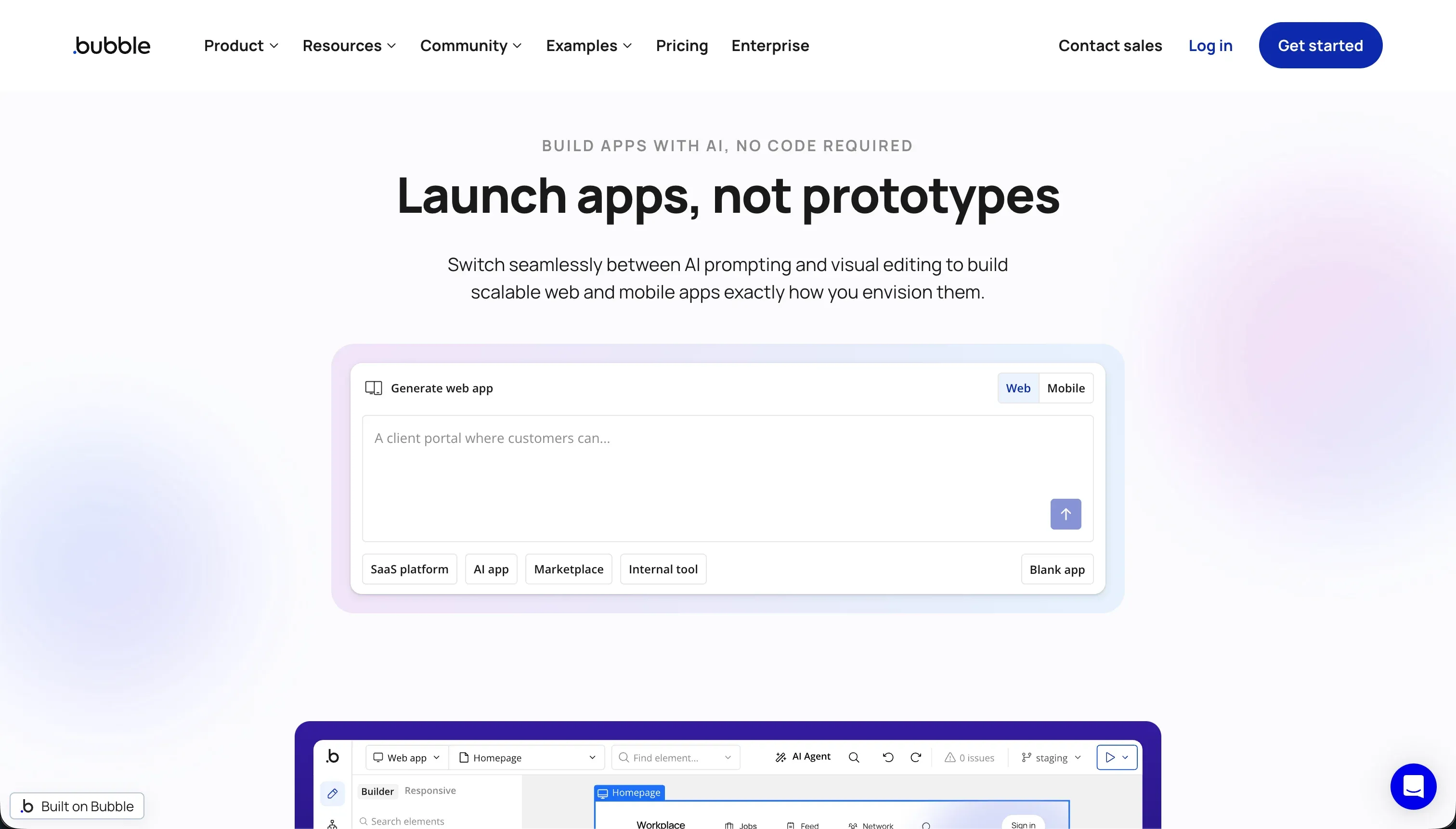 Bubble homepage snapshot
For directory projects that require highly specific matching logic, custom listing metrics, or multi-tiered interactive search filters, Bubble provides the deepest functional ceiling. Scoring an 8.5 for design flexibility and an 8.0 for data and integrations, its visual database handles intricate relational mapping alongside backend scheduled workflows and automated stripe invoices.
The cost of this power is the category’s steepest learning path. Ease of build scores a low 5.0 because constructing secure directories requires developer-like relational reasoning. Security and access control scores 6.5 because server-side privacy rules must be configured and tested entirely by hand by the creator. If your rule setup contains a single error, listing information can leak silently to the web.
Additionally, memory strain and unoptimized workflow queries can cause workload-unit consumption to surge unexpectedly. Shortlist Bubble when your directory is a core digital product requiring complex logic, but avoid it if you need a rapid, low-maintenance business app.
5. WeWeb - best for design-led web catalogs
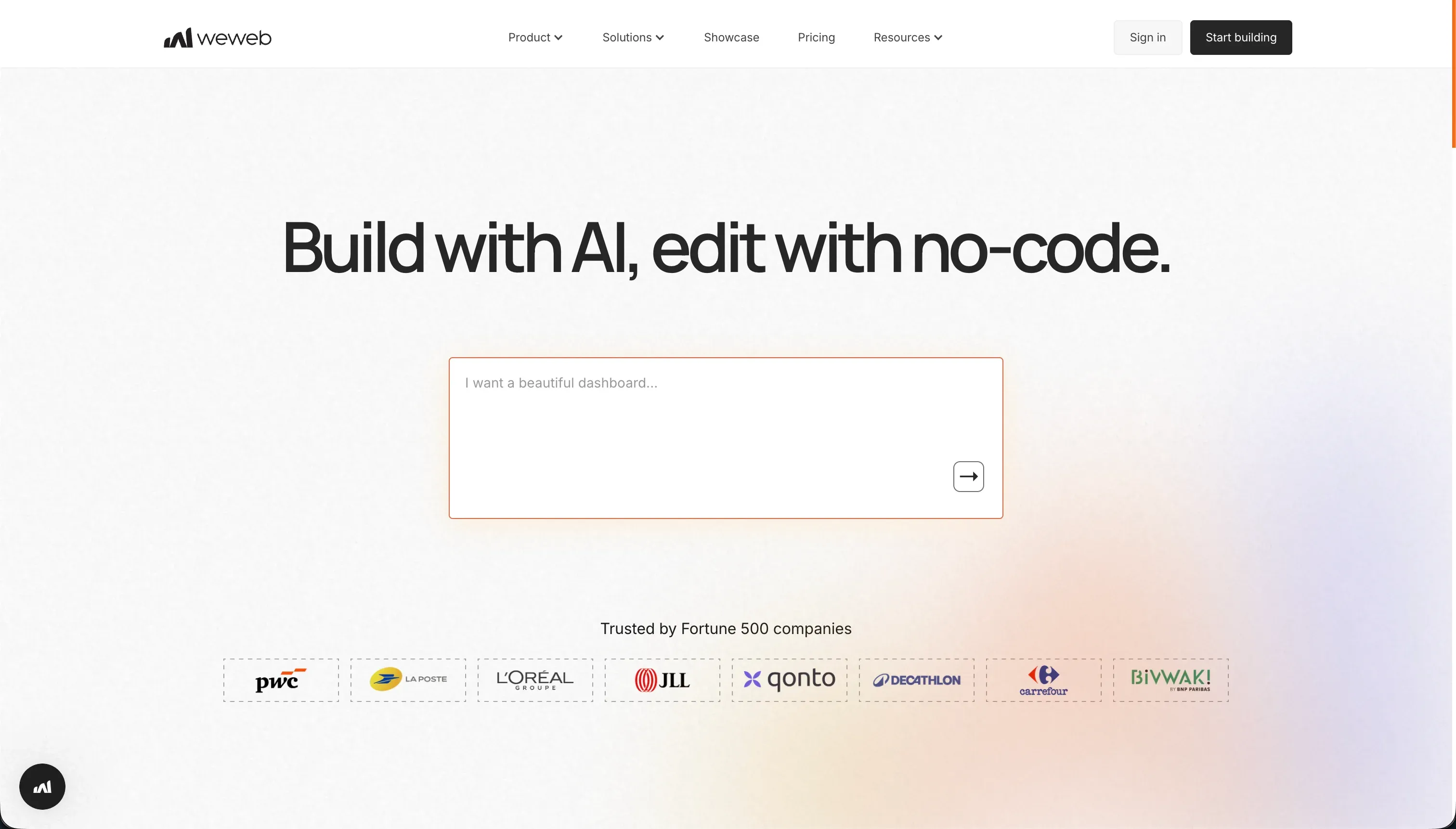 WeWeb homepage snapshot
For agencies or engineering teams building highly customized public directories, WeWeb delivers exceptional front-end layout styling, scoring an 8.5 for design flexibility. Operating on a decoupled model, WeWeb connects to external backends like Supabase or Xano, letting builders craft pixel-precise responsive layouts using professional CSS frameworks.
However, this model is a poor fit for fast internal tools or non-technical business teams. Ease of build scores 4.0 because WeWeb has no native data storage. Setting up interactive search grids, conditional list variables, and partner login flows requires manual API payload wiring and complex backend setup.
Security and access control scores 5.5 because safety rules exist solely on whatever separate backend database you pay for, meaning simple mistakes can expose directories in client browsers. Furthermore, production plans start at $59 a month for a single app before counting custom backend fees. Shortlist WeWeb only if you have developers ready to maintain a multi-tool cloud stack.
6. Replit - best for code-only developer directory ownership
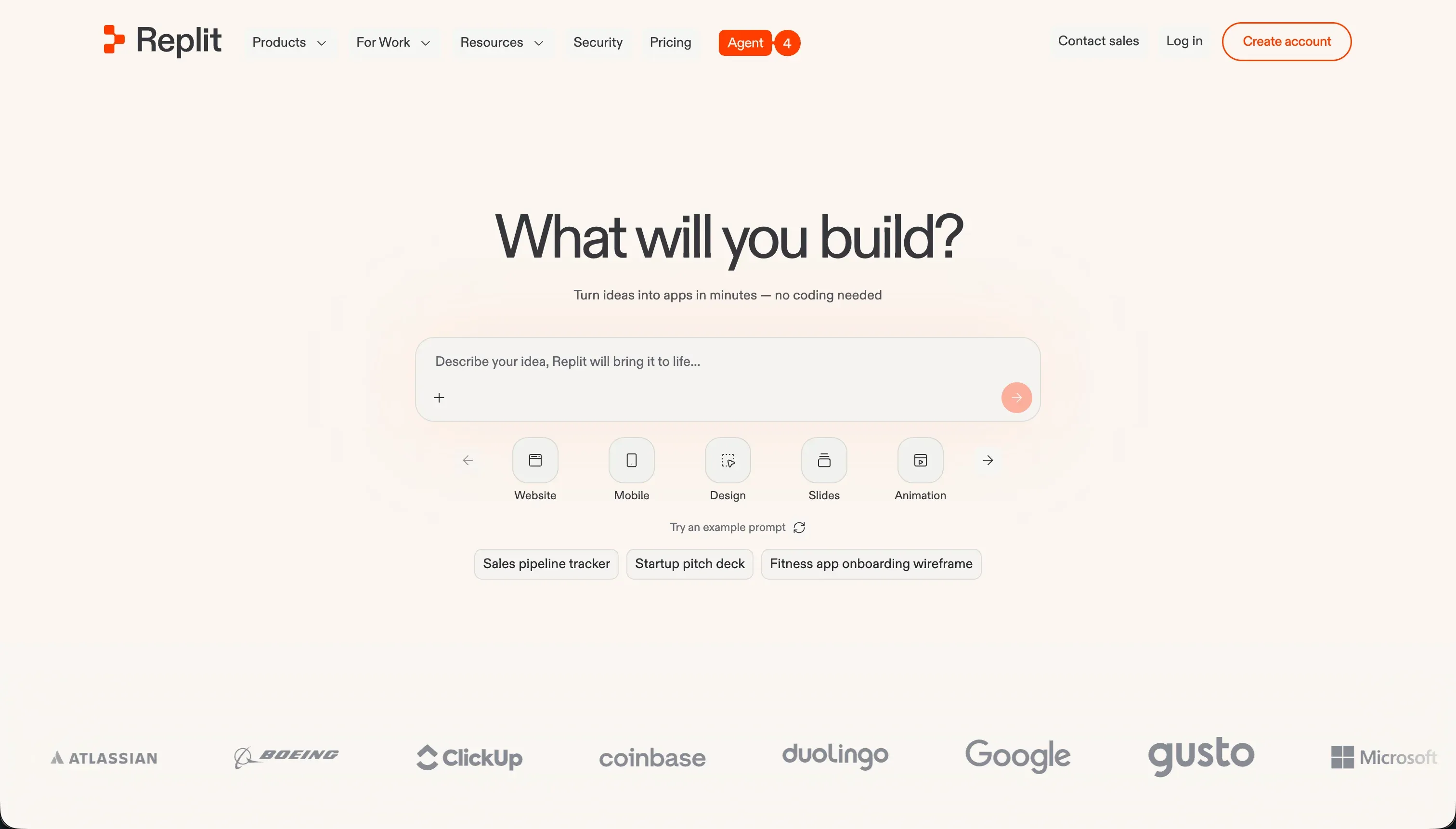 Replit homepage snapshot
For teams seeking exact application control and absolute code ownership, Replit translates conversational text prompts into a fully hosted, real developer code portal. Earning an 8.5 for design flexibility and an 8.0 for production readiness, the Replit Agent quickly generates, provisions, and deploys any directory UI without template constraints.
This developer-first environment demands permanent technical oversight. Security and access control scores 6.0 because all member roles and profile security rules are written in code directly, demanding visual code reviews to ensure secure data isolation.
Maintainability scores 7.5: although having real version-controlled clean files is excellent, diagnosing LLM-introduced bugs or dependency drift requires coding knowledge.
Finally, billing is credit-priced on compute effort, and running extensive test loops can lead to financial tracking surprises. Buy Replit if you have developers ready to own, test, and host your directory codebase with zero platform boundaries.
Shortlisting directory platforms for your team
When creating business, partner, or community resource directory applications, your choice should match your team’s technical capacity and the total scale of external users. For standard business, partner, and member catalogs where fast deployment, predictable flat pricing, and granular row-level profile editing are the priority, Softr delivers the most secure, maintainable foundation.
It allows you to expand your directory safely without per-user licensing penalties. If the directory must live as a mobile-optimized app and has moderate user scaling requirements, Glide is a highly efficient visual option.
For more complex directories that require highly specific interface logic, Bubble provides a powerful though complex visual workspace. Technical agencies requiring complete code ownership should evaluate Replit or WeWeb.
To prepare your project, run a pilot connecting a realistic slice of member data, configure one partner profile editing form, and verify record isolation. Read our complete rating standard at our evaluation methodology guide page.