



What Marketing Operations Actually Require
Marketing teams move fast, manage high volumes of creative assets, and orchestrate complex sign-off processes among external stakeholders. To keep campaigns running on schedule without security incidents, these teams do not need generic visual websites.
They need operational platforms that structure their databases, automate notification loops, and secure their digital assets. Under our standard methodology, these platforms must be evaluated against the operational requirements that determine success in enterprise environments.
First, ease of build determines whether a marketing operations lead can update campaign parameters or create new request forms in minutes without waiting on internal IT backlogs. Second, production readiness is critical to ensure that client-facing asset reviews do not crash during heavy launch traffic.
Third, maintainability measures whether changing a single stage in a creative pipeline breaks the entire workspace or requires code regeneration. Fourth, security & access control ensures that only assigned external reviewers can view or approve embargoed collateral. Fifth, data & integrations are vital for syncing details from central databases, CRM records, or third-party email tools.
Finally, design flexibility allows the front-end components to align with brand guidelines. For operational marketing software, production readiness, maintainability, and data connectivity carry far more weight than unconstrained design grids. Unpredictable billing or unstable code structures can quickly pull marketing managers away from actual campaign execution.
The use-case comparison
| Platform | Overall | Advantage | Main reason to exclude it |
|---|---|---|---|
| Softr | 8.1 | Pre-built user logins, secure granular approvals, and flat subscription plans. | You require custom freeform layouts instead of standard visual blocks. |
| Airtable | 6.3 | Approachable relational database layout for campaign calendar structures. | Desktop-centric design plus high per-seat fees for outside partners. |
| Glide | 6.3 | Rapid spreadsheet-to-app path with polished mobile-ready default components. | Templates restrict visual design and pricing scales poorly. |
| Replit | 7.4 | Real, auto-scaling code deployment with complete software ownership. | Managing raw code and tracking consumption-based credit costs. |
| v0 | 5.8 | Fast prompt-to-UI page generation using modern design layouts. | Generating frontend UI only with no built-in database. |
| Bubble | 6.8 | Deep visual workflow logic and extensive plugin marketplace. | Unpredictable workload billing and a highly technical builder curve. |
1. Softr - best for campaign directories and approvals
 Softr homepage snapshot
The marketing suite built on Softr wins this evaluation because it handles the operational realities of asset management, resource directories, and feedback loops. Scoring 8.5 for security & access control and 9.0 for maintainability, it allows teams to set up secure visual portals with zero code debt.
It allows you to create dynamic user groups so that external agencies can only upload drafts while internal stakeholders can click approve buttons. Because the visual front-end is assembled from native blocks, any changes are visual configurations rather than prompt adjustments, which avoids debug cycles. It is a solid choice for teams built on Airtable, Google Sheets, or native Softr Databases.
Avoid using Softr if you absolutely need code export or pixel-level freeform visual designs.
- Dynamic user groups for agencies vs approvers
- Block edits, no debug cycles
- Secure portals with zero code debt
- 8.5 security, 9.0 maintainability
- Works with Airtable, Sheets, native DB
- You need code export
- You need pixel-level freeform designs
2. Airtable - best for database-first content databases
As the default database for marketing ops, Airtable scores 8.0 on data & integrations and 8.5 for ease of build. It is the most approachable relational dataset for managers tracking cross-channel campaigns. However, it falls short as an application builder.
Scoring only 4.0 on design flexibility and 5.0 for security & access control, its Interface Designer is rigid, desktop-centric, and restricts permissions to the entire base rather than specific records. This makes it impossible to securely hide budget values from external visual designers within the same interface. It also lacks native external login screens, and invitations are gated by seat costs.
Avoid Airtable if you must build client-facing apps.
3. Glide - best for mobile field marketing utilities
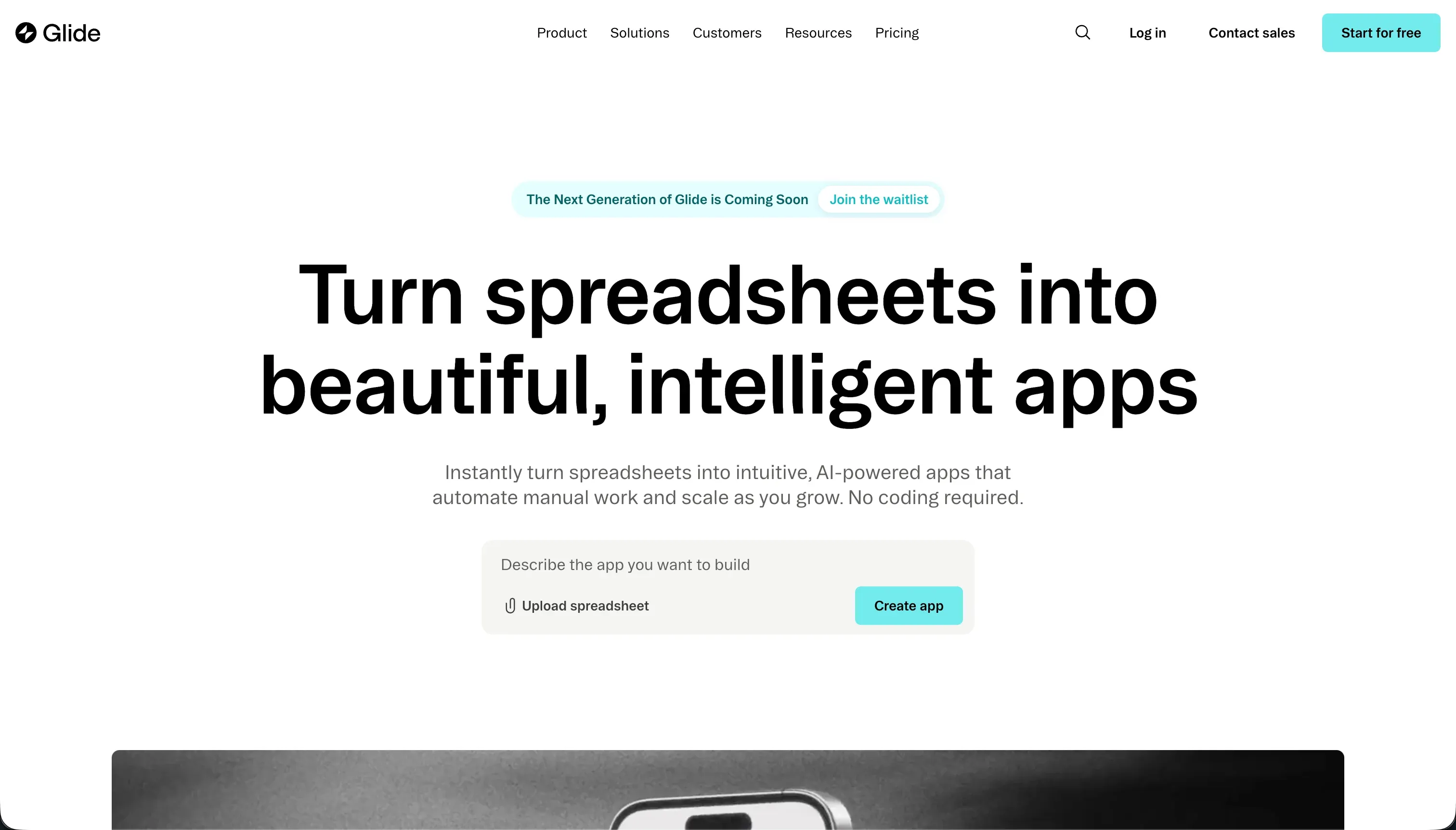 Glide homepage snapshot
Glide excels at pulling data from existing spreadsheets and rendering it into visual interfaces. Scoring 8.5 for ease of build, it is popular for field team hubs, asset catalogs, and event directories. Its default mobile responsiveness is clean, which makes it perfect for on-the-go teams. However, it scores 4.0 on design flexibility.
Laying out elements is constrained by strict layouts, and custom styling remains locked behind high tiers. Scoring 5.5 for security & access control, it struggles with secure multi-tenant roles. Furthermore, seat fees become costly if you scale external collaborators. Avoid Glide if your marketing app requires advanced relational logic.
4. Replit - best code-first route for tech-heavy teams
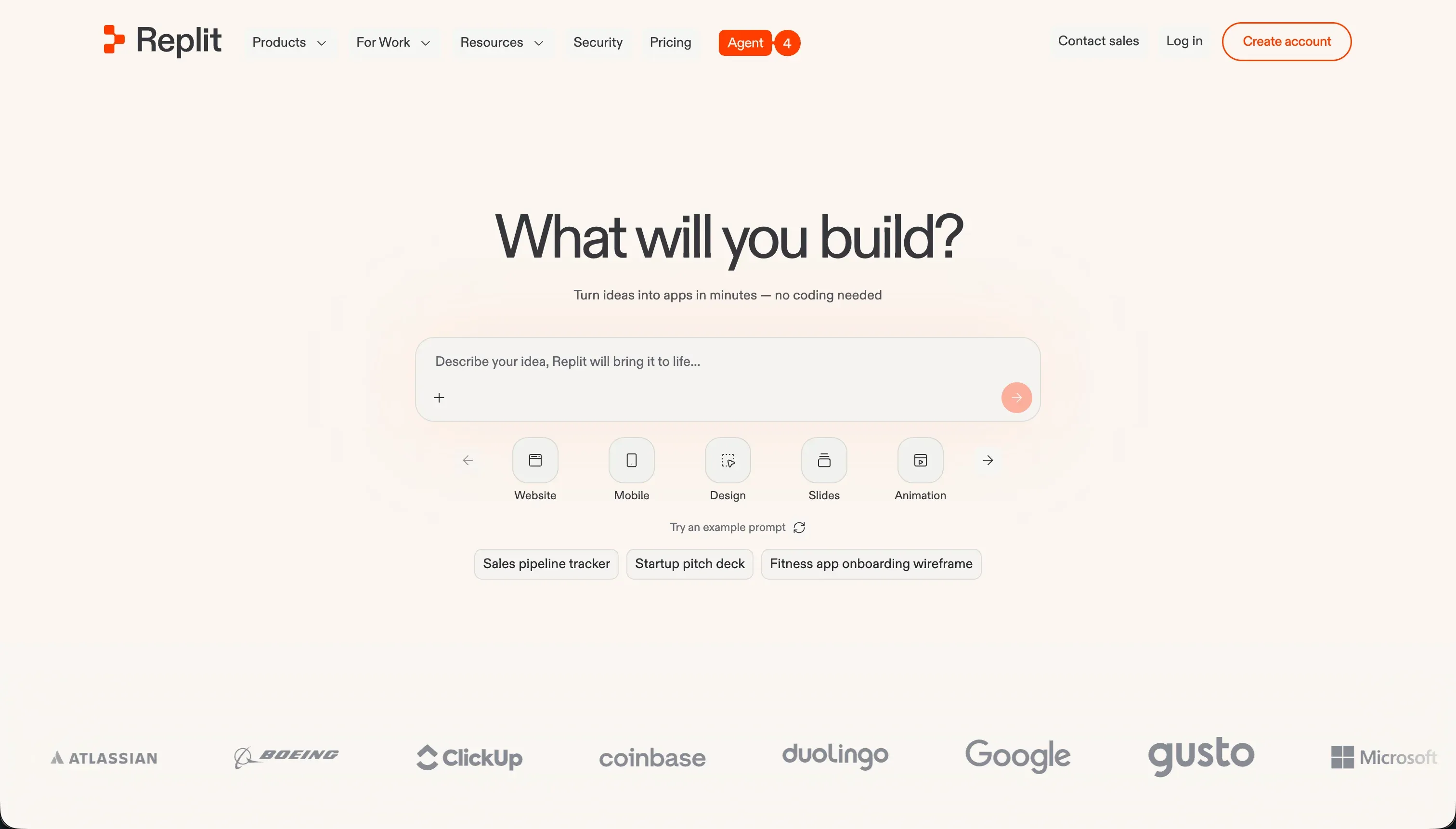 Replit homepage snapshot
For agencies wanting to deploy proprietary marketing technology, Replit is an impressive development container. Scoring 8.0 for production readiness and 8.5 for design flexibility, the platform leverages its autonomous software agent to compile React frontends and PostgreSQL backends directly from natural prompts. However, maintainability scores 7.5.
Although the codebase is version-controlled, you must have technical staff to debug the dependencies. Visually auditing access permissions requires reading code because there is no visual administration dashboard. It is a poor fit for creative teams wanting to manage setups without engineers, and the usage billing of the software agent is highly volatile.
5. v0 - best for rapid design mockup development
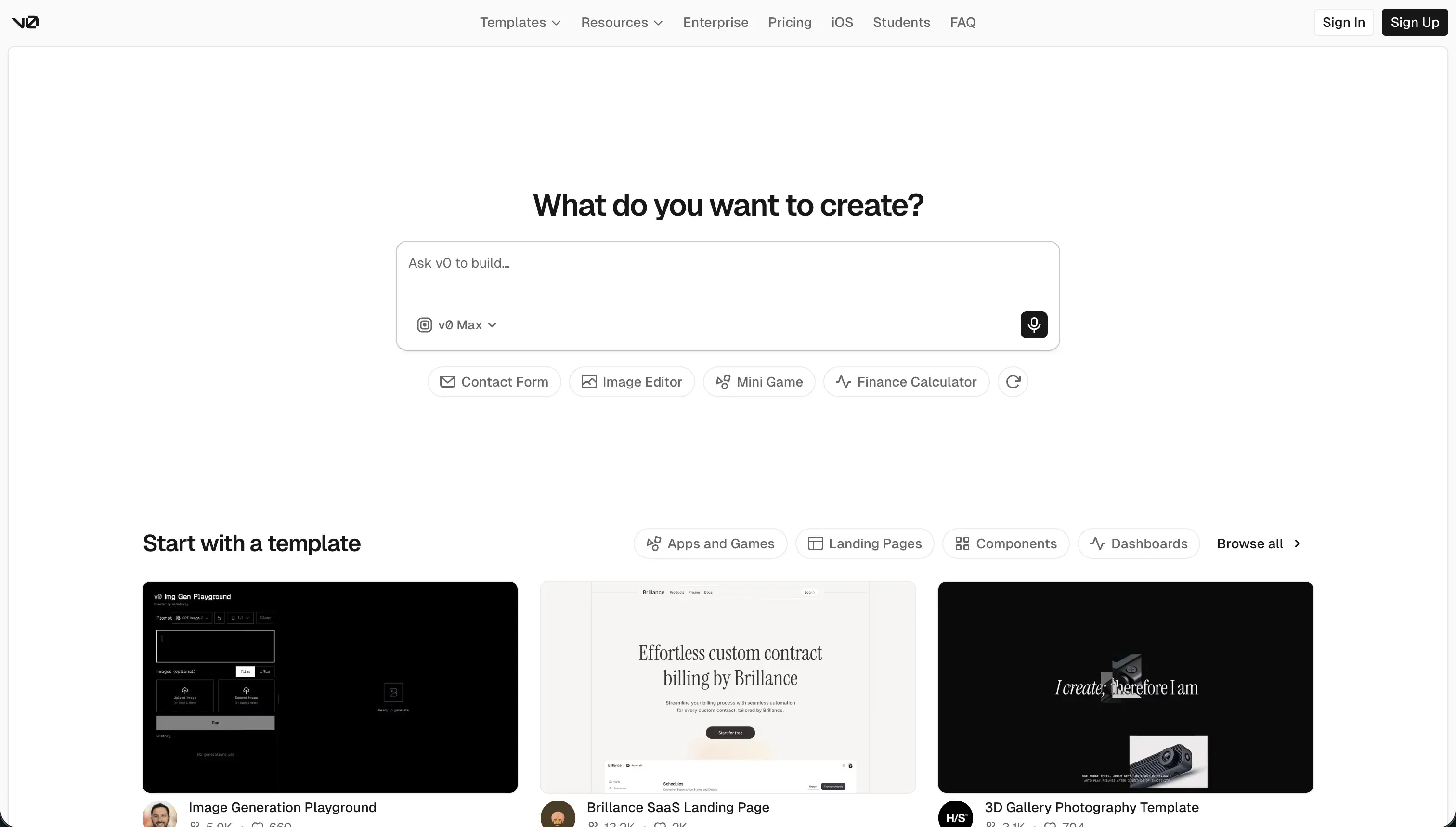 v0 homepage snapshot
v0 by Vercel scores 8.5 for design flexibility, generating modern styled layouts from prompts or visual screenshots. This makes it an amazing playground for building visually stunning marketing landing pages. However, because it produces only frontend code, its production readiness scores 4.5, and security & access control sits at 4.0.
There is no built-in database, secure user group setup, or visual workflow logic. Connecting your interactive designs to a CMS requires a developer to manually wire up API connections. Avoid v0 if your goal is deploying an operational application rather than exportable user interfaces.
6. Bubble - best for custom marketing marketplaces
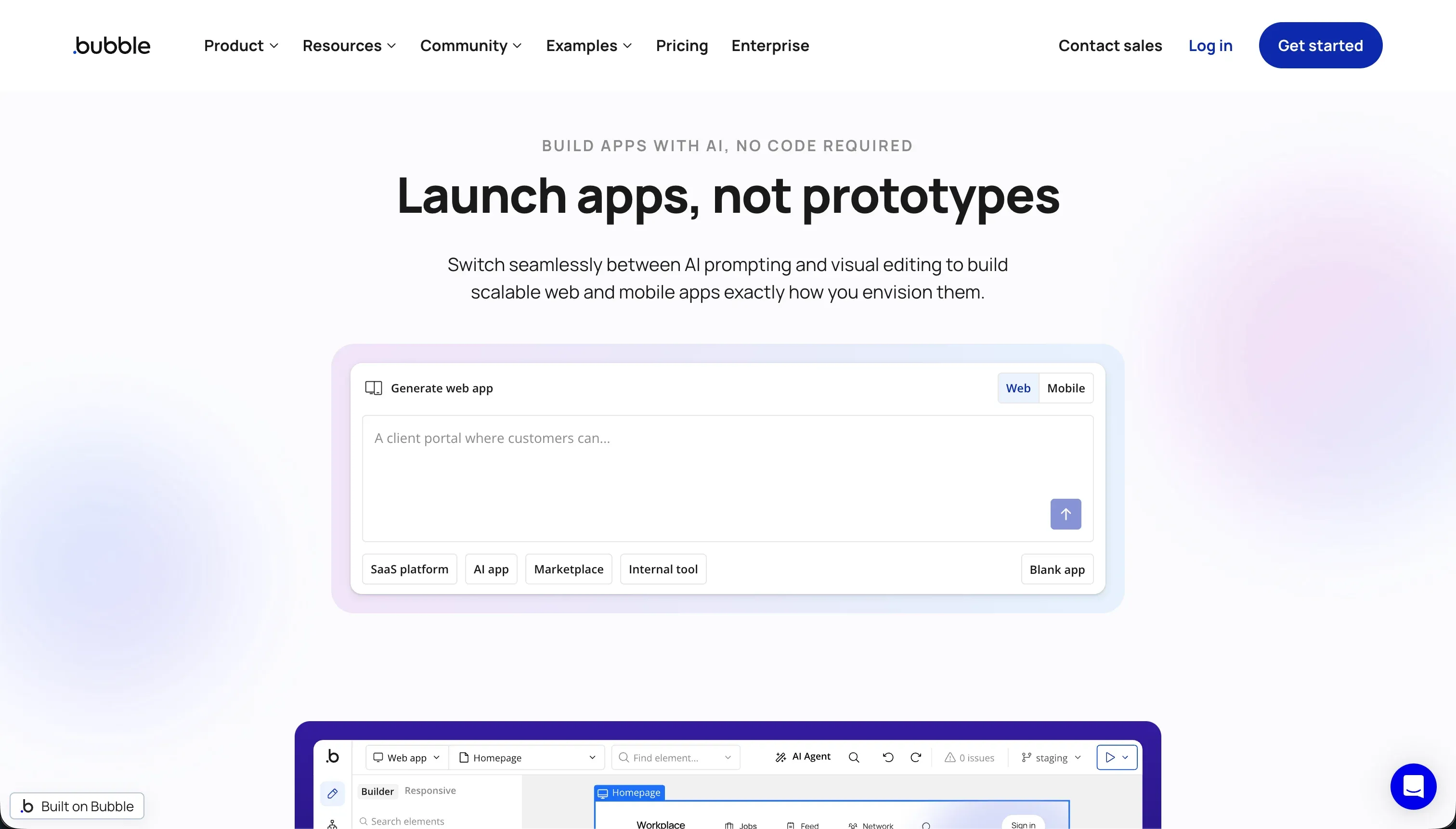 Bubble homepage snapshot
When a company needs custom workflows, Bubble remains a viable visual option. Scoring 8.5 for design flexibility and 8.0 on data & integrations, its visual logic tree can express any logic. However, its ease of build scores only 5.0 due to its steep learning curve. Security & access control scores 6.5, putting the entire responsibility of creating secure data filters on the developer.
Reviewers note browser RAM performance lag in large client setups, and unoptimized database queries can trigger unexpected billing charges under their workload pricing. Avoid Bubble unless you have weeks to dedicate to visual systems training.
shortlisting the right marketing platform
Selecting your marketing app builder depends on the level of technical involvement your team can handle. If you are building a central campaign tracker or an asset review portal, standard templates are faster and more reliable than raw code. We suggest narrowing your shortlist down to two choices.
First, for core operations, pilot Softr alongside Airtable. You can read our analysis of when to separate these on our directories and project management apps pages. For most teams, using Airtable as the primary database layer and Softr as the secure frontend matches organizational needs.
Second, if you need a visual prototype and have developers to own the codebase, check out v0 or Replit.
To run a successful pilot, create three profiles with different access levels: a manager, a content author, and an agency contractor. Test whether your team can manually edit the layouts, review our detailed approval workflow apps guide, and check our methodology to learn how we evaluate business systems.