



What Approval Workflow Apps Actually Need
Approval workflow applications carry a rigid set of technical requirements. Whether routing a financial purchase request, a vendor invoice, or an operational change request, the tool must enforce logical steps where only designated team members can edit or sign off on specific stages of the record.
These parameters require high scores in security & access control, where role-based data restrictions keep sensitive fields locked down from unauthorized eyes, and server-side logic execution prevents client-side tampering.
Additionally, maintainability determines whether these apps succeed over time; as approval structures shift or compliance mandates change, an operations owner must be able to visually adjust permissions and step logic without triggering debugging loops.
Ease of build also shapes your operational efficiency. Business teams can model these systems rapidly using visual templates or conversational AI co-builders, while technical platforms shift that burden entirely to engineering resources. The data & integrations category remains crucial, as approvals typically pull from existing CRMs, SQL warehouses, or spreadsheet archives and push finalized state updates downstream.
While design flexibility is helpful for polishing final admin forms, it remains secondary to production readiness and access security. If an interactive form fails to route correctly or a record becomes visible to a restricted tier of staff, the application fails. This ranked analysis maps the top workspace builders against these six criteria to help you find the correct organizational fit.
The use-case comparison
| Platform | Overall | Advantage | Main reason to exclude it |
|---|---|---|---|
| Softr | 8.1 | Pre-built auth, visual user groups, secure server-side form logic | No direct code export and limited pixel-perfect layout controls |
| Retool | 6.8 | Direct SQL read/write, managed PostgreSQL, advanced developer APIs | Requires SQL/JS proficiency and charges seat-based fees for users |
| Bubble | 6.8 | Deep custom logic, visual workflows, native backend scheduler | Unpredictable workload billing and a steep administrative learning curve |
| Glide | 6.3 | Fast spreadsheet-to-app conversion, polished mobile-first elements | Rigid UI patterns and user counts that scale poorly on pricing |
| Replit | 7.4 | Real, exportable application code on managed autoscaling cloud servers | Technical labor overhead and unpredictable effort-based billings |
| Airtable | 6.3 | Intuitive relational database, multiple flexible operational views | Lacks granular record-level security and has costly guest pricing |
1. Softr - best overall for governed operations and portals
 Softr homepage snapshot
Softr ranks first because its infrastructure maps exactly to standard corporate approval rules. Authentication, user groups, and row-level data restrictions are platform-level systems, configured visually rather than generated by raw AI prompts. It is highly suited for operations teams who need to establish custom forms and multi-tiered sign-offs.
Its security & access control scores 8.5 because visibility rules can easily hide or show specific submit buttons based on roles, ensuring an employee can submit a request while only an authorized supervisor can see and edit the approval field. Maintainability scores 9.0, meaning you can easily update a department routing path inside the visual studio without destabilized frameworks.
The main exclusion is that Softr does not support code export, meaning if your long-term goal is hosting the application entirely on your own infrastructure, you should choose a code-first alternative instead.
2. Retool - strongest technical alternative for developer teams
 Retool homepage snapshot
Retool is the logical selection when approvals are managed directly by an engineering group. It scores an impressive 8.5 in data & integrations because it directly queries SQL databases, GraphQL, and proprietary REST APIs, enabling you to build high-performance approval screens on top of internal production systems. Over 100 pre-configured UI elements let developers quickly drag high-density layouts into place.
The trade for this power is ease of build, which scores a low 4.0 because configuring active queries, validation forms, or state values demands deep commands of SQL and JavaScript. Security & access control scores 7.5 but requires custom developer code to build external-facing user signups.
Do not select Retool if your goal is empowering non-technical business managers to build and deploy workflow tools independently.
- 8.5 in data & integrations
- Direct SQL, GraphQL and REST queries
- Approval screens on production systems
- 100+ pre-built UI elements
- High-density layouts, fast for developers
- 4.0 in ease of build
- Requires SQL and JavaScript fluency
- 7.5 in security & access control
- External signups need custom code
- Not for non-technical managers
3. Bubble - best visual engine for highly custom logic workflows
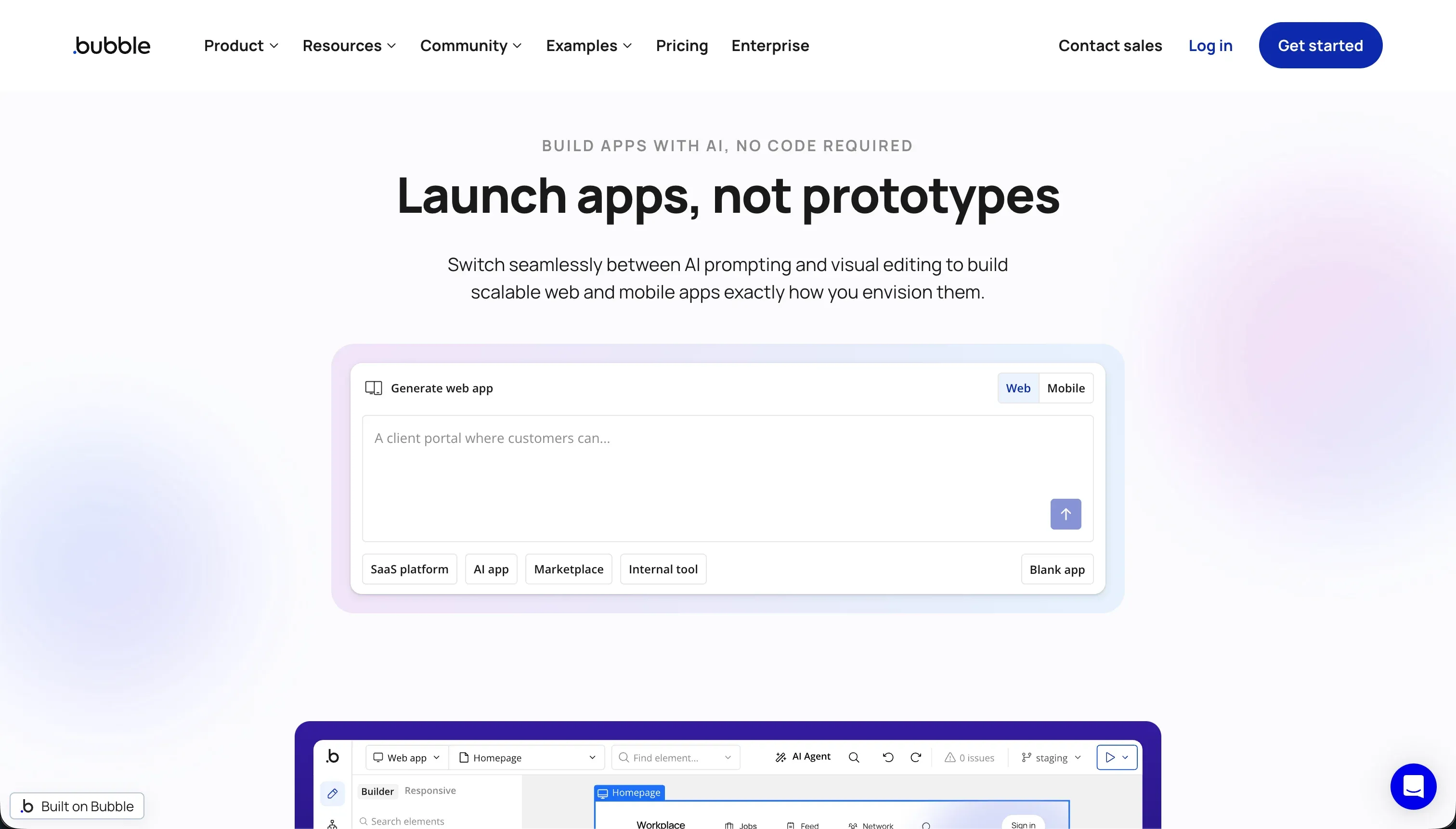 Bubble homepage snapshot
Bubble is the right fit if your approval pipeline requires deeply specialized, complex relational mappings and custom backend event scheduling. Design flexibility scores 8.5, and data & integrations scores 8.0, giving visual builders complete control over both pixel layout and custom relational variables. Server-side privacy rules can also isolate data securely down to individual users.
The tradeoff arrives with a steep visual setup curve, leading to an ease of build score of 5.0. Furthermore, keep in mind its volatile workload unit pricing; unoptimized database lookups or massive batch loops across thousands of records can create unexpected billing spikes, making it an expensive option of choice for standard operational software.
4. Glide - quickest spreadsheet to workflow option for small teams
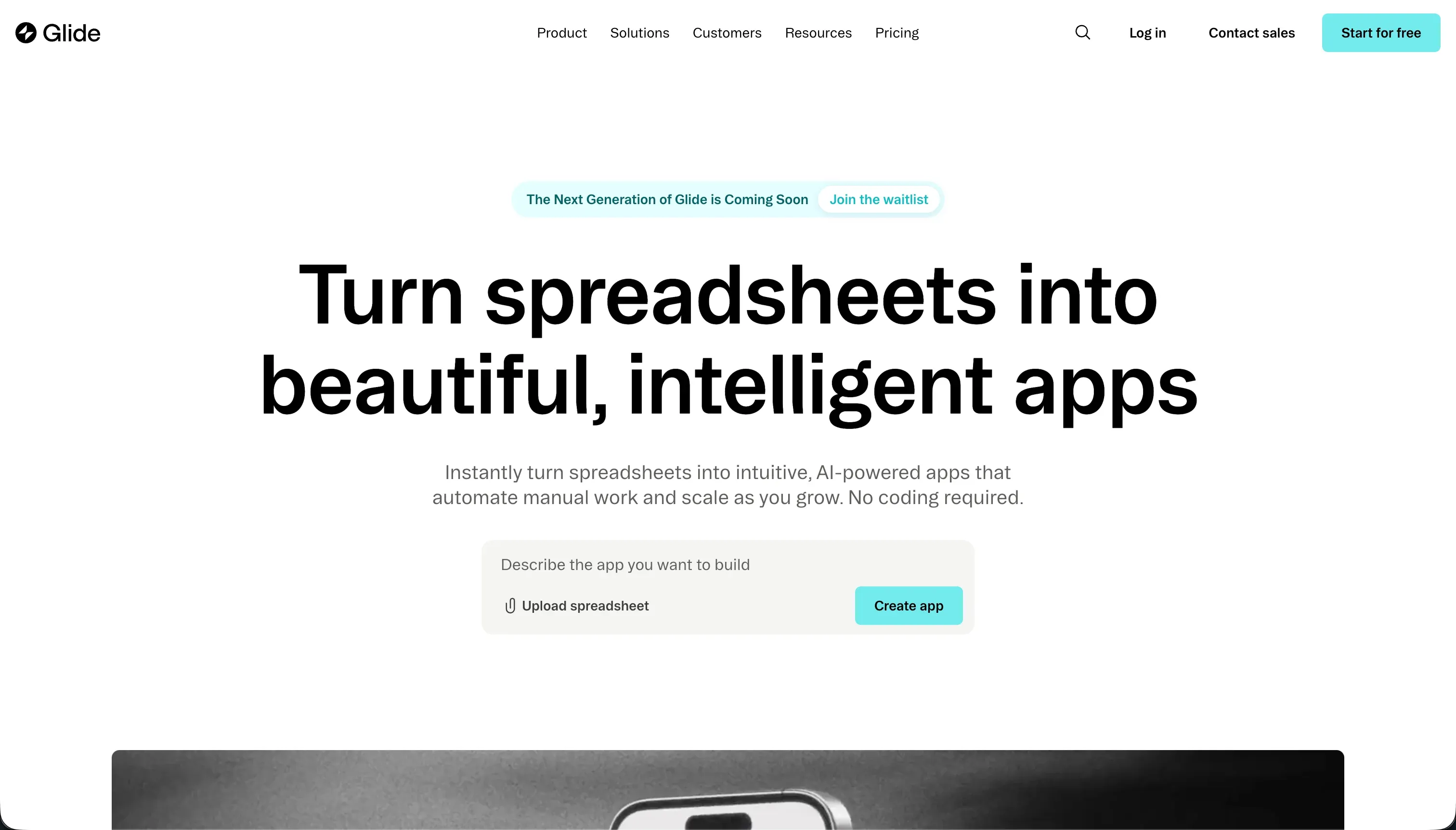 Glide homepage snapshot
Glide is highly effective for transitioning basic spreadsheets into polished mobile-first approval tools. It scores an ease of build of 8.5 because it immediately converts columns in Google Sheets, Airtable, or Excel into responsive checklists and action screens. This speed makes it highly recommended for field teams who need to sign off on maintenance and inventory checklists on the go.
However, security & access control scores 5.5; its permission settings become thin when you need robust, granular multi-tenant isolation rules. Per-user scaling is also a bottleneck, making it too expensive to deploy once your shared user list scales past 100 accounts.
5. Replit - best code level control with full platform exportability
 Replit homepage snapshot
Replit is built for engineering teams who demand complete system ownership. Its autonomous AI agent generates functional application files, configures databases, and provisions autoscaling cloud environments from simple prompts. It scores an 8.0 on production readiness because the output is real, standard developer code that you can easily host outside the platform if needed.
But this technical accessibility comes at a cost: team developers must still manually audit, secure, and update the compiled code, scoring 6.0 in security. Additionally, its effort-based credits are hard to calculate, and debugging loops can result in massive, unexpected billing overages.
6. Airtable - best interactive database view for internal operations
Airtable acts as a visual, spreadsheet-styled collaborative database, scoring an 8.0 on data & integrations. With support for linked records, custom automations, and multiple operational views, it makes organizing complex approval pipelines easy for non-developers. Its Interface Designer adds a visual canvas on top of your databases without code.
But security & access control scores a low 5.0 because permissions are base-level; you cannot isolate specific fields or single records within the same workspace cleanly. Combined with seat-based billing that scales costs rapidly, it is best kept as an internal admin tracking console rather than a secure, scaled app environment.
Shortlisting the Right Approval Builder
To correctly narrow down your selection, you must prioritize the technical baseline of your deployment team.
If your primary goal is to let non-technical operations teams safely generate and maintain workflow tools, you should look toward directories like the best operations teams platforms or the best finance teams apps.
Softr remains the strongest fit for visual builders because of its visual user groups and predictable flat-rate tiers. It keeps sensitive data secure without forcing you to manage code.
Alternatively, if you have dedicated software engineers comfortable with SQL queries and API structures, Retool provides unrivaled connectivity into legacy systems, while Replit ensures absolute code ownership. We recommend running a brief checklist test: draft a 3-step routing form, configure an administrative privilege group, and attempt to edit the workflow logic in month six.
Review our exhaustive scoring weight standards on the methodology page to trace how we grade these operational criteria, and check our best internal tools guide to evaluate broader ecosystem options.