


When sourcing software for internal operations, procurement and IT teams must look past the initial demo. Internal tools run on your company’s core data, which means authentication, role-based visibility, and stable deployment loops are more critical than pixel-perfect styling. This evaluation weights production readiness, maintainability, and security & access control above visual customization.
The market splits into governed no-code, specialized developer databases, and code-first generation environments. Opting for a developer-centric tool for a simple marketing tracker is a waste of engineering salary, while forcing non-technical staff to debug broken React code under a tight deadline creates immense operational risk.
Our evaluation shortlists the five leading platforms. Whether you are standardizing on decentralized department-level builds or pairing a technical engineering group with a database-backed UI, the scorecards below clarify what you trade on day two.
How the field scores
| Platform | Overall | Advantage | Main reason to exclude it |
|---|---|---|---|
| Softr | 8.1 | Governed no-code with built-in role and row-level permissions. | Not designed for complex visual CSS customization. |
| Retool | 6.8 | Dense component library and direct SQL write-back capability. | High coding barrier requiring SQL and JavaScript to customize. |
| Replit | 7.4 | Unlimited custom logic code built purely via natural language. | Needs a technical owner and carries unpredictable credit-burn pricing. |
| Glide | 6.3 | Instant UI scaffolding directly on top of spreadsheets. | Enforces highly rigid patterns with no app store packaging. |
| Bubble | 6.8 | Exceptional logic control and pixel-perfect design canvas. | Severe vendor lock-in with no source code export. |
Overall scores are the unweighted average of the six platform criteria. For internal operational tools, buyers should place heavier weight on security and maintainability rather than design flexibility, which is why the rank order on this page prioritizes governed stability over visual canvas freedom.
1. Softr
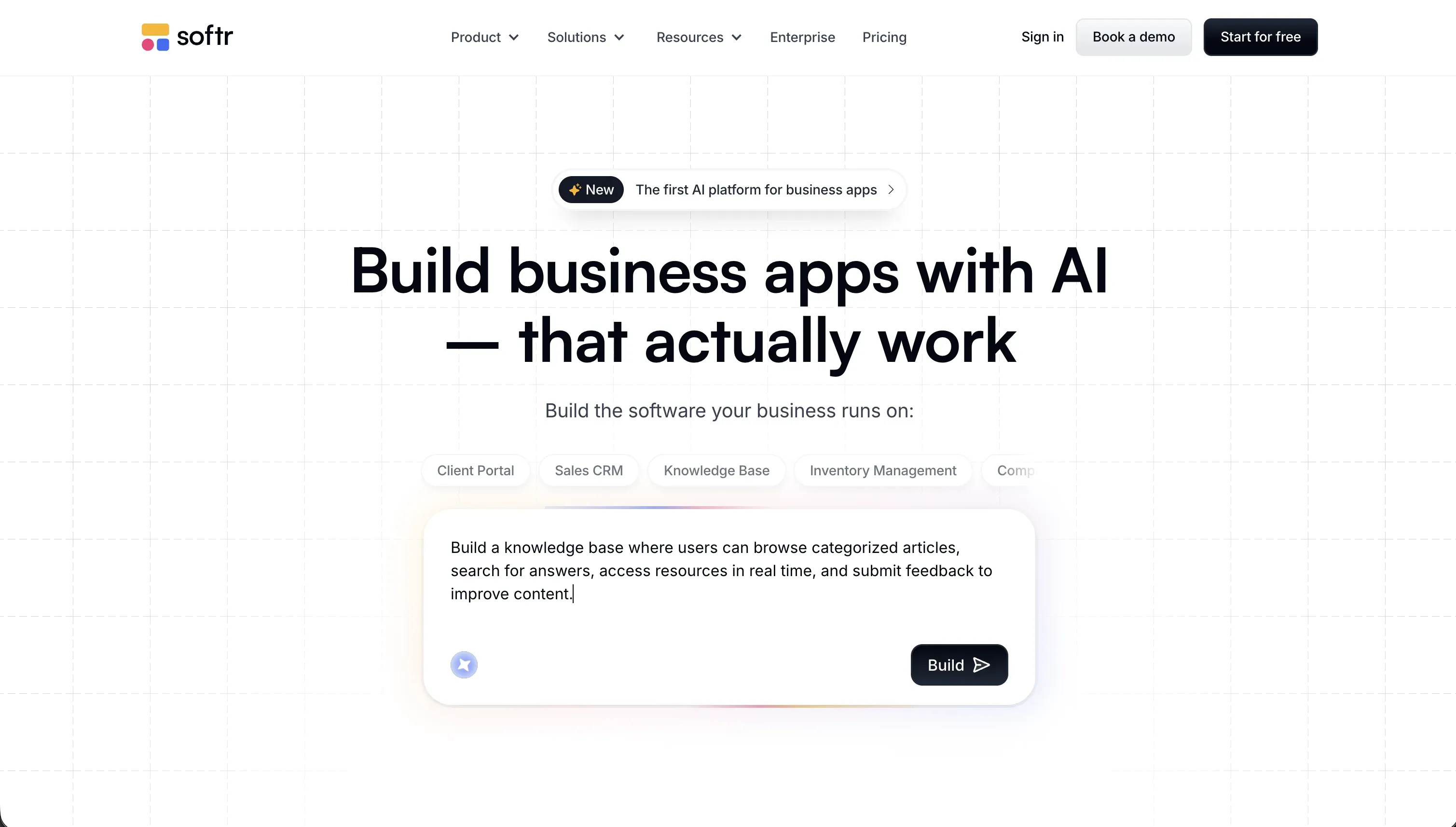 Softr homepage snapshot
Softr wins this ranking for operational teams seeking to build secure, maintainable business applications without a developer. Ease of build scores 9.0, driven by the AI Co-Builder which instantly composes complete interfaces from pre-built, responsive blocks like tables, kanbans, and forms.
Because Softr assembles battle-tested components rather than generating raw code, maintainability scores a peak 9.0, eliminating the risk of layout drift or silent database build failures.
Operational security is handled visually rather than via code. Security & access control scores 8.5 because user groups, page rules, and row-level visual restrictions are configured in a bulletproof visual panel, keeping all database connection operations entirely server-side.
Additionally, the native database is highly integrated and AI-ready, featuring built-in support for the Model Context Protocol standard so builders can connect external AI assistants like Claude to read or write schemas.
When standard blocks are not enough, the Vibe Coding block lets teams generate custom visual elements using simple prompts. Crucially, these custom blocks automatically inherit the global theme, respect existing visibility permissions, and expose visual settings for manual, non-technical editing.
Flat pricing makes scaling highly predictable, starting at $49/mo Basic, $139/mo Professional, and $269/mo Business with no restrictive per-seat app user pricing on paid plans, protecting your operational budget as teams grow.
2. Retool
 Retool homepage snapshot
Retool is the industry-standard visual editor for software engineers, scoring a highly competitive 8.5 on data & integrations. The platform provides a rich component library of charts, tables, and JSON schema editors optimized for data density and database writeback.
In developer ecosystems, production readiness scores 7.5 due to robust version control, commit history, and release management workflows.
However, its design philosophy assumes a technical operator, resulting in an ease of build score of only 4.0. To configure anything beyond a basic table layout, builders must write SQL queries, construct JavaScript state variables, and manually map API response schemas.
Maintainability scores 6.0 because custom queries can become fragile over time, and a change in an external SQL database schema immediately requires a developer to debug Retool’s inline logic.
Security & access control scores 7.5, providing enterprise SSO and granular SQL access controls on higher tiers. The primary friction point for larger organizations is the seat-based pricing model, starting at $8/user/mo for Team and $40/user/mo for Business. Adding occasional users or exposing external client views quickly becomes cost-prohibitive for large-scale operations.
3. Replit
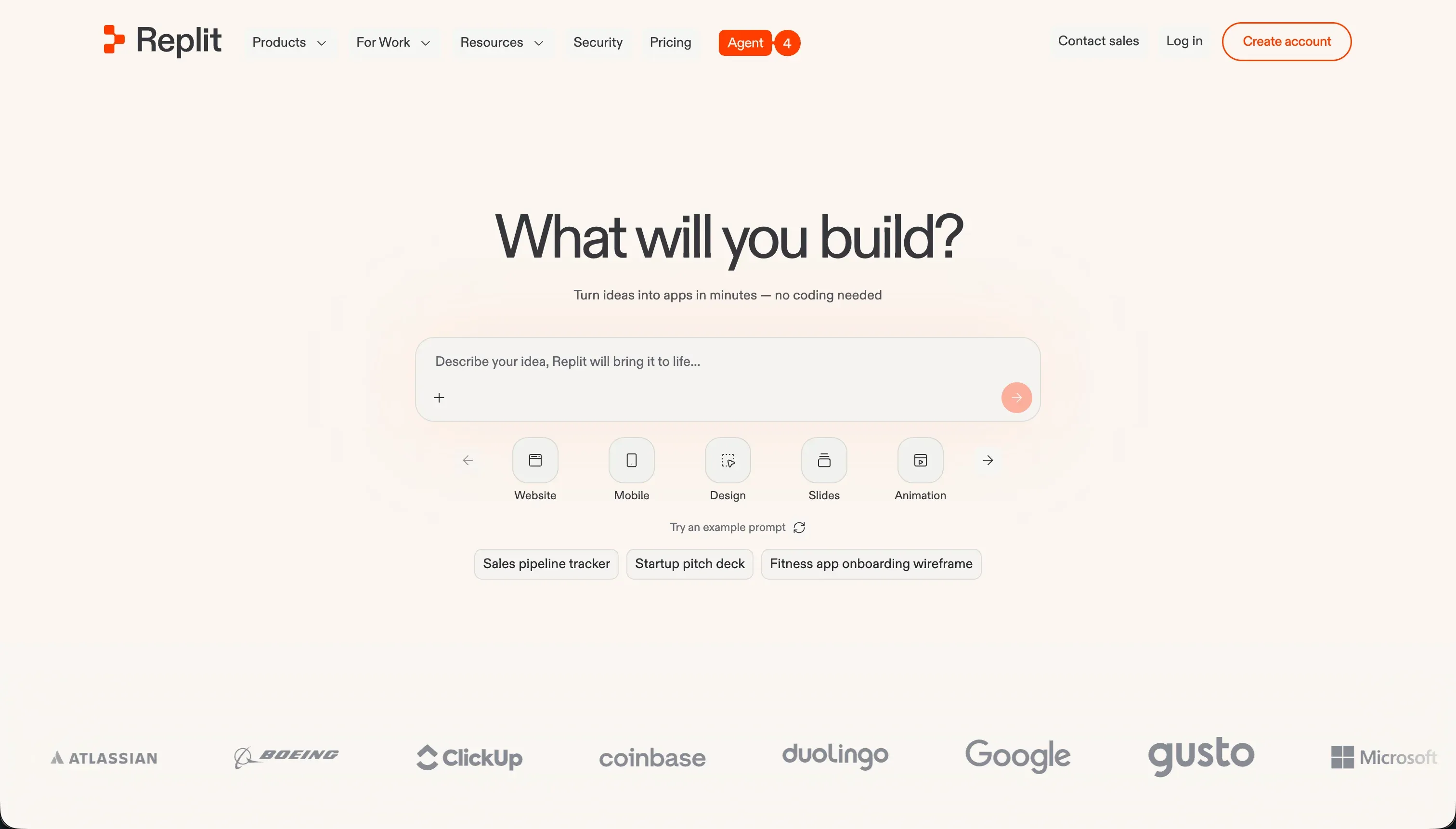 Replit homepage snapshot
Replit offers a purely code-first path to internal software, leveraging its Agent to write, compile, and deploy applications from conversation. Design flexibility scores 8.5, as the output is a bespoke React, Python, or Go application with zero platform styling constraints.
Because you own the codebase completely, production readiness scores 8.0, allowing engineering teams to export, self-host, or connect the tools to any server configuration.
This unlimited flexibility comes with steep developer overhead. Maintainability scores 7.5, but this is conditional on having a team member who can read the code. An AI agent has no mental model of your architecture, and pasting error files back into the prompt easily creates frankenstein code loops that generate redundant functions.
Security & access control scores a lower 6.0 because developers must manually configure environment variables to keep API keys safe, and an incorrect prompt can expose private database endpoints. Pricing is also highly variable; while the Core plan starts at $20/mo, agent execution is effort-priced and can easily run up hundreds of dollars in unexpected bills when debugging complex loops.
4. Glide
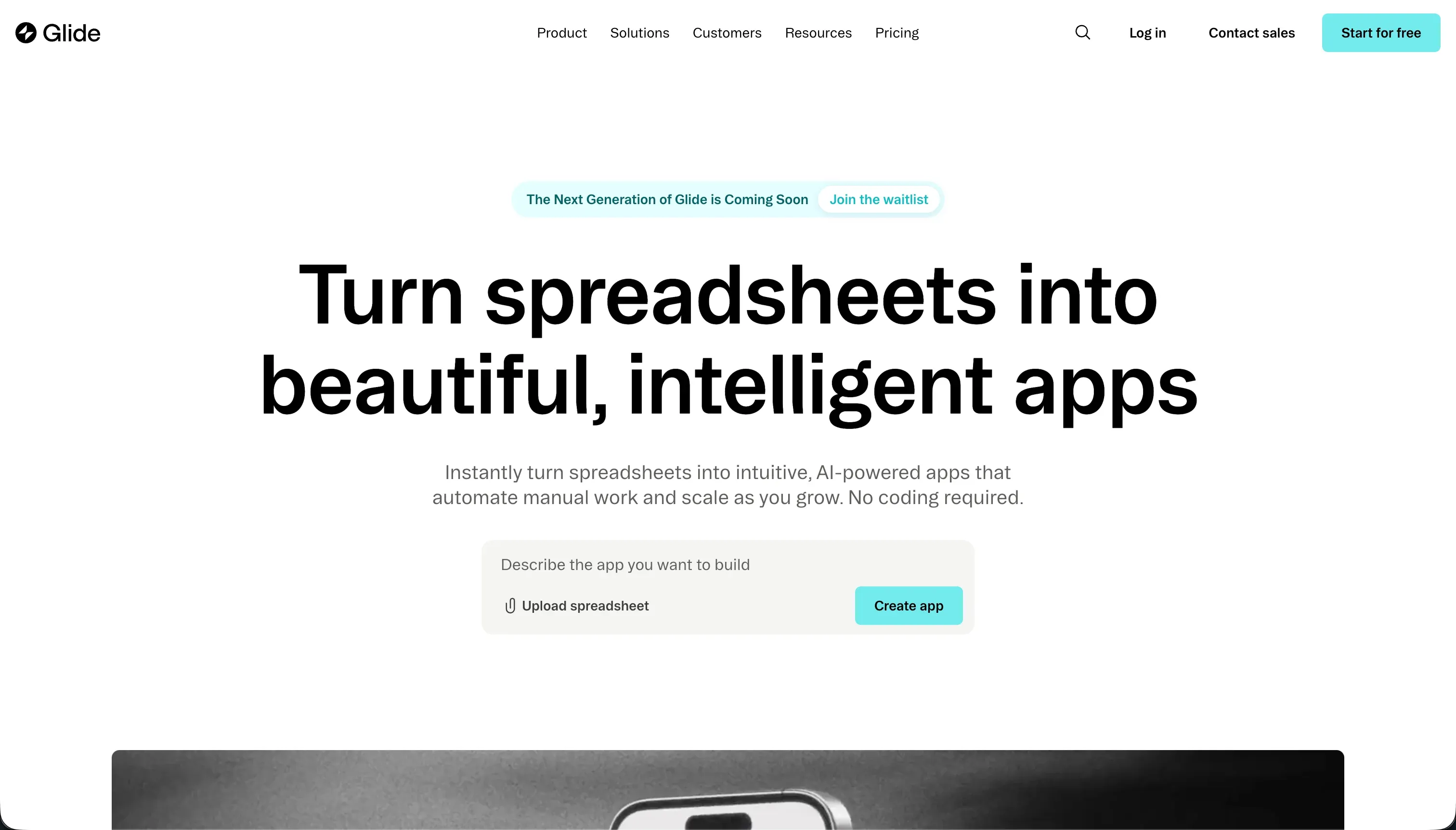 Glide homepage snapshot
Glide serves as a fast and visual solution for teams looking to digitize basic spreadsheet-based workflows. Ease of build scores a high 8.5, as the platform automatically generates functional layouts directly from Airtable, Excel, or Google Sheets. It includes built-in Glide AI columns that execute real-time translation and summarization directly at the data schema level.
That simplicity comes with structural trade-offs. Design flexibility scores 4.0 because Glide enforces exceptionally strict, template-based component layouts. You cannot freely adjust element padding or margins, and custom CSS styling is restricted to the platform’s highest tiers. Maintainability scores 6.5, as any change to the underlying spreadsheet’s column names can silently break the frontend interface.
Security & access control scores 5.5, which is a major deduction for internal enterprise apps. Glide relies on simple sharing controls, and building granular permissions for separate departments requires extensive configuration. Furthermore, Glide’s Business plan scales to $249/mo but caps shared internal users at 100, creating expensive licensing hurdles if you deploy the application company-wide.
5. Bubble
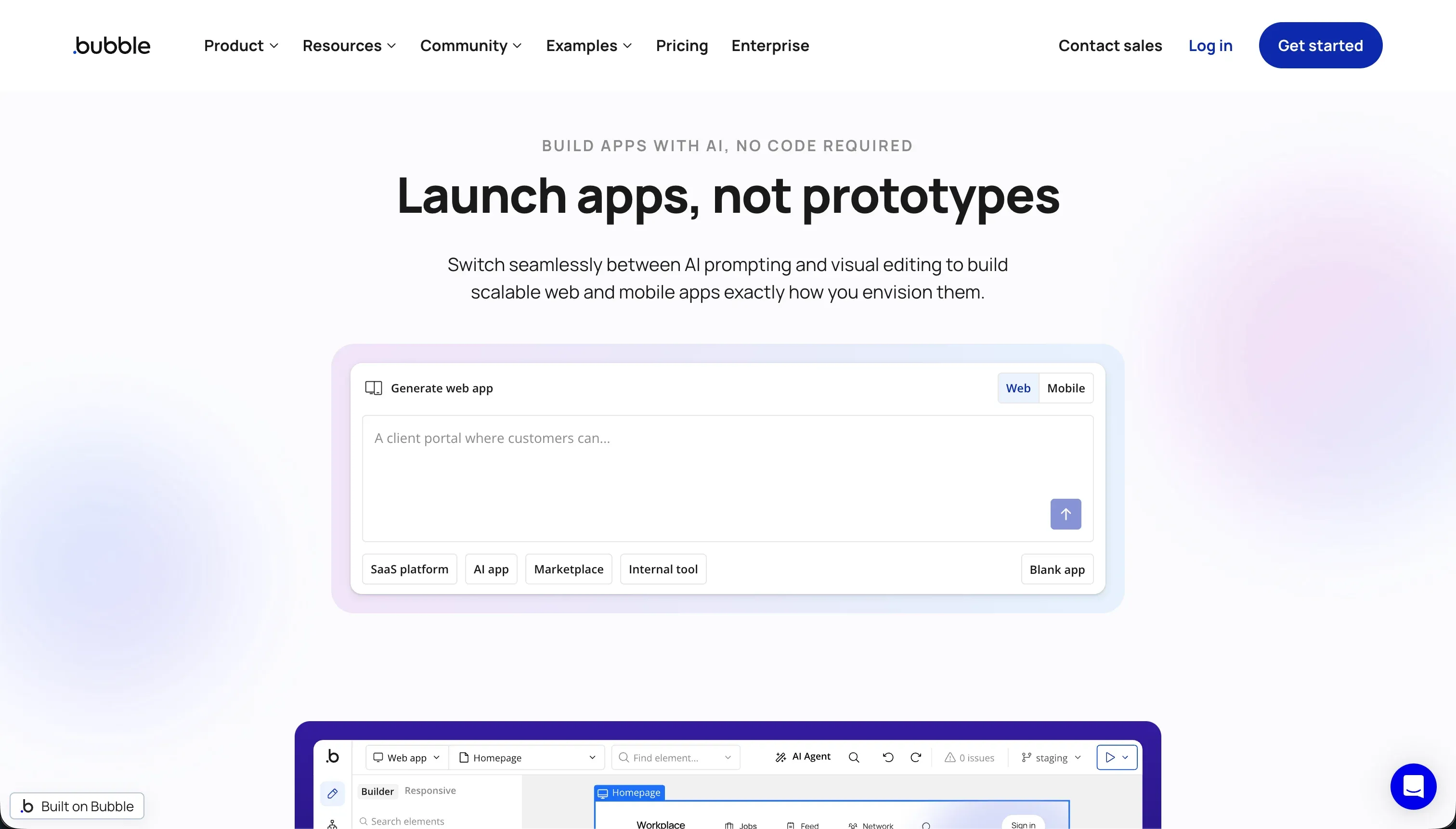 Bubble homepage snapshot
Bubble provides deep full-stack web application features, scoring an impressive 8.5 for design flexibility and 8.0 for data & integrations. The platform combines visual page design with server-side workflows, allowing builders to execute multi-step database operations and schedule backend events.
Its visual database editor is highly robust and lets you configure relational types and privacy rules thoroughly.
The trade-off is extreme complexity, resulting in an ease of build score of 5.0. Learning Bubble requires thinking like an architect, and unoptimized queries can degrade tool performance at scale. Maintainability scores 6.0 due to severe platform lock-in. Because the system runs entirely on proprietary infrastructure, you cannot export the source code, making you completely dependent on Bubble’s billing models.
Security & access control scores 6.5, offering solid server-side privacy rules that block client-side inspection when configured correctly. However, Bubble’s workload-based pricing is highly volatile; inefficient custom workflows can run up bills rapidly, forcing administrators to monitor resource consumption as closely as a traditional cloud database.
The Corporate Lane: Governing the Tech Stack
In an enterprise environment, evaluating internal tools is not just about choosing a developer tool or a visual canvas. Rather, it is a strategic decision of who builds and who maintains. IT departments use Softr to empower business operations and department heads to build their own secure, governed workspaces directly on top of Airtable or native databases, completely eliminating shadow IT.
Conversely, when highly custom data querying or direct, low-level SQL database manipulations are required, pairing those operations with Retool is the standard developer choice. The key is isolating custom developer engineering from daily operational builds so that your code-writing talent is only deployed where visual configurations can no longer scale.
How to shortlist
To shortlist the correct builder for your company’s internal software, evaluate the technical skill of the team members who will actually maintain the tool in year two:
- For non-technical ops, HR, and department heads, prioritize governed no-code like Softr. You avoid technical debt, get out-of-the-box user group security, and bypass unpredictable database compute bills.
- For engineering-led teams with direct SQL read/write requirements, select a developer visual system like Retool, accepting that its per-seat pricing must be modeled carefully as your team scales.
- For developers who want to build a truly custom logic codebase from prompts, pilot Replit, making sure a senior developer is assigned to audit the generated codebase and avoid frankenstein dependencies.
Before committing your data schema, conduct a limited, single-data-flow pilot with your prospective tool. Verify the security of your CRUD operations, map your required row-level permission rules, and read our methodology to ensure your chosen platform matches your IT safety standard.