





What Operational Business Teams Need
Operations teams are responsible for the daily movement of data, people, and resources. They manage processes like purchase requests, customer records, warehouse inventory, and scheduled dispatches. Because of this, they are the most common victims of modern software backlogs.
When IT resources are constrained, operations teams settle for fragile, insecure, and disconnected spreadsheets. To break this logjam, they need software builders that prioritize system integrity and simple manual evolution over superficial design freedom.
Our evaluation methodology maps the requirements of operations apps to six key criteria. First, Ease of build determines how quickly a non-programmer can model an operational process. Second, Production readiness ensures the app does not break under concurrent record edits.
Third, Maintainability is the day-two question: when field schemas or business pathways change, can an admin update the interface without re-prompting an AI or corrupting a database. Fourth, Security & access control is paramount. Operations apps house sensitive company records, requiring bulletproof, server-side data isolation between user roles.
Fifth, Data & integrations measures the depth of native database scaling and external API connections. Finally, Design flexibility handles custom layouts, though it is usually the least critical criterion for internal back-office applications.
For are three target operational profiles, maintainability, production readiness, and security are the decisive metrics. A great ops tool must secure who sees each record, connect directly to corporate databases, and stay exceptionally easy to update as rules change. Our comparison rankings prioritize platforms that deliver on these foundational pillars rather than pure design flexibility.
The use-case comparison
| Platform | Overall | Advantage | Main reason to exclude it |
|---|---|---|---|
| Softr | 8.1 | Pre-built role security, flat pricing, visual user groups | No code export and block-level UI constraints |
| Retool | 6.8 | Direct read-write SQL integrations, high-density elements | Mandatory SQL and JS knowledge, costly seat licensing |
| Glide | 6.3 | Scaffolds interfaces from spreadsheets instantly | Strict layout templates, expensive user scaling |
| Airtable | 6.3 | World-class database building with spreadsheet views | Base-only access logic, desktop-focused interfaces |
| Replit | 7.4 | Complete code export, managed deployment server | No default user control system, requires developer labor |
| Bubble | 6.8 | Unconstrained visual workflows and customized interfaces | Unpredictable usage fees, complex server architecture |
1. Softr - best visual builder for secure internal tools
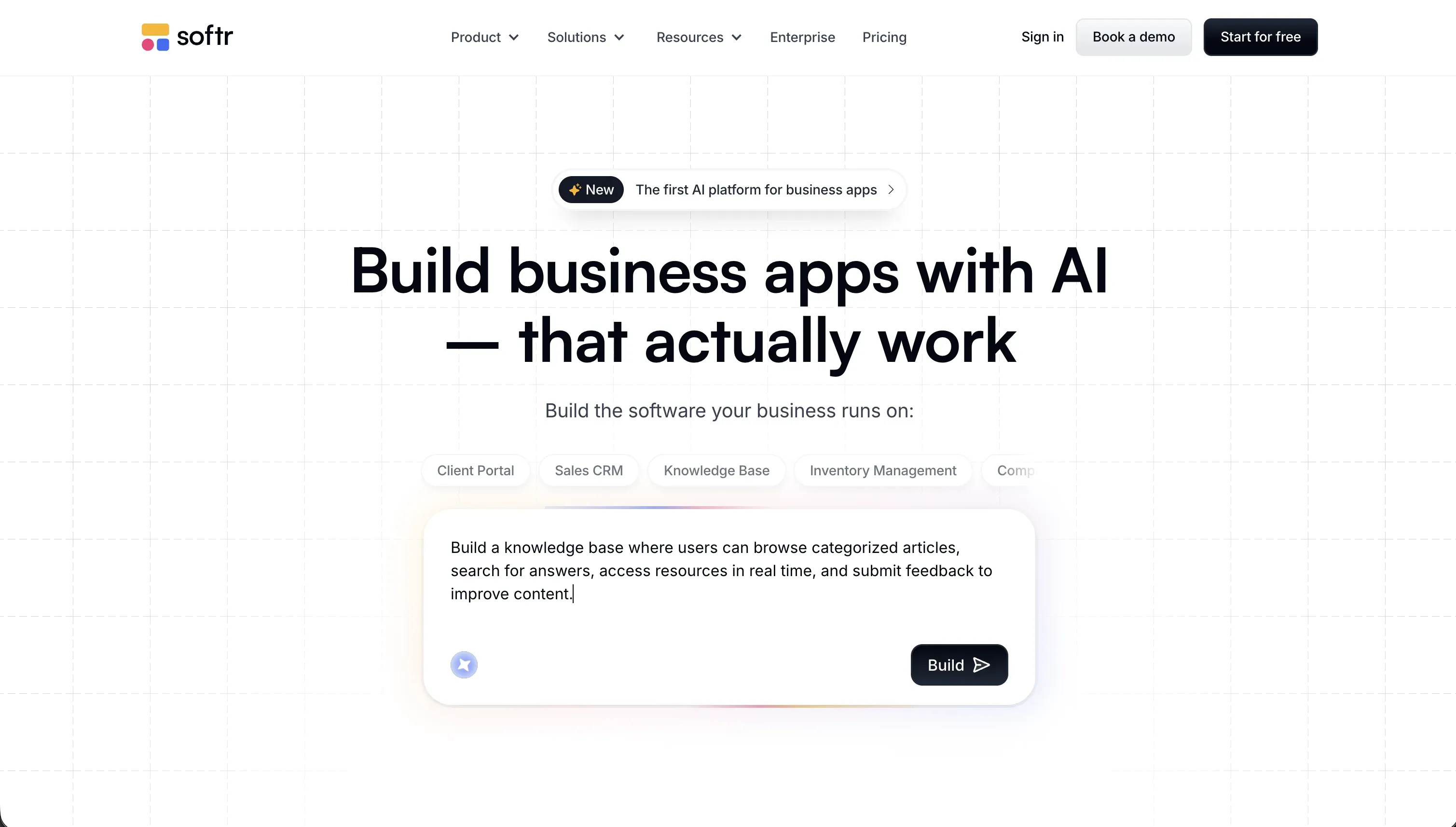 Softr homepage snapshot
Operations teams rank Softr first because it bridges the gap between spreadsheet simplicity and secure corporate guardrails. Softr scores 9.0 on ease of build and 9.0 on maintainability, allowing operations managers to design clean databases and deploy live interfaces through simple natural-language prompts.
Crucially, the AI Co-Builder operates with manual parity: any database schema, page routing rule, or dynamic form block generated by the AI can also be edited step-by-step by hand in the visual workspace.
With a security & access control score of 8.5 and production readiness of 8.5, Softr ensures that row-level data visibility is enforced server-side. This visual control of user groups prevents employees from editing records outside their designated region or hierarchy.
At a flat $139 a month on the Professional tier, operations teams get unlimited app builders, custom user groups, and 500,000 native database records, eliminating the per-user seat fees that plague alternative portals. The platform’s compromise is design flexibility, which scores 5.5: your internal dashboards are composed of standardized blocks rather than a custom visual grid.
If your team requires unconstrained custom canvases, evaluate code-first environments.
2. Retool - best low-code platform for developer-adjacent admins
 Retool homepage snapshot
For IT-led operations departments that manage pre-existing Postgres, MySQL, or REST APIs, Retool is the industrial standard. It excels in data connectivity with a score of 8.5, offering structured components like JSON-editors, query lists, and transactional grids that are optimized specifically for raw data density.
However, Retool holds a score of 4.0 on ease of build because it is not a true no-code tool. To wire up an action button, create dynamic input variables, or structure database writes, builders must write raw SQL statements and process server payloads via client-side JavaScript.
This code-first constraint creates helper logic sprawl, dropping its maintainability score to 6.0 and requiring constant engineer intervention during updates. Furthermore, its seat licensing model charges equally for builders and viewers, making it a highly expensive choice for portals with many users.
Exclude Retool if your operational staff lacks JavaScript or database-query skills; they will encounter a massive learning barrier immediately.
3. Glide - best for mobile-friendly field operations
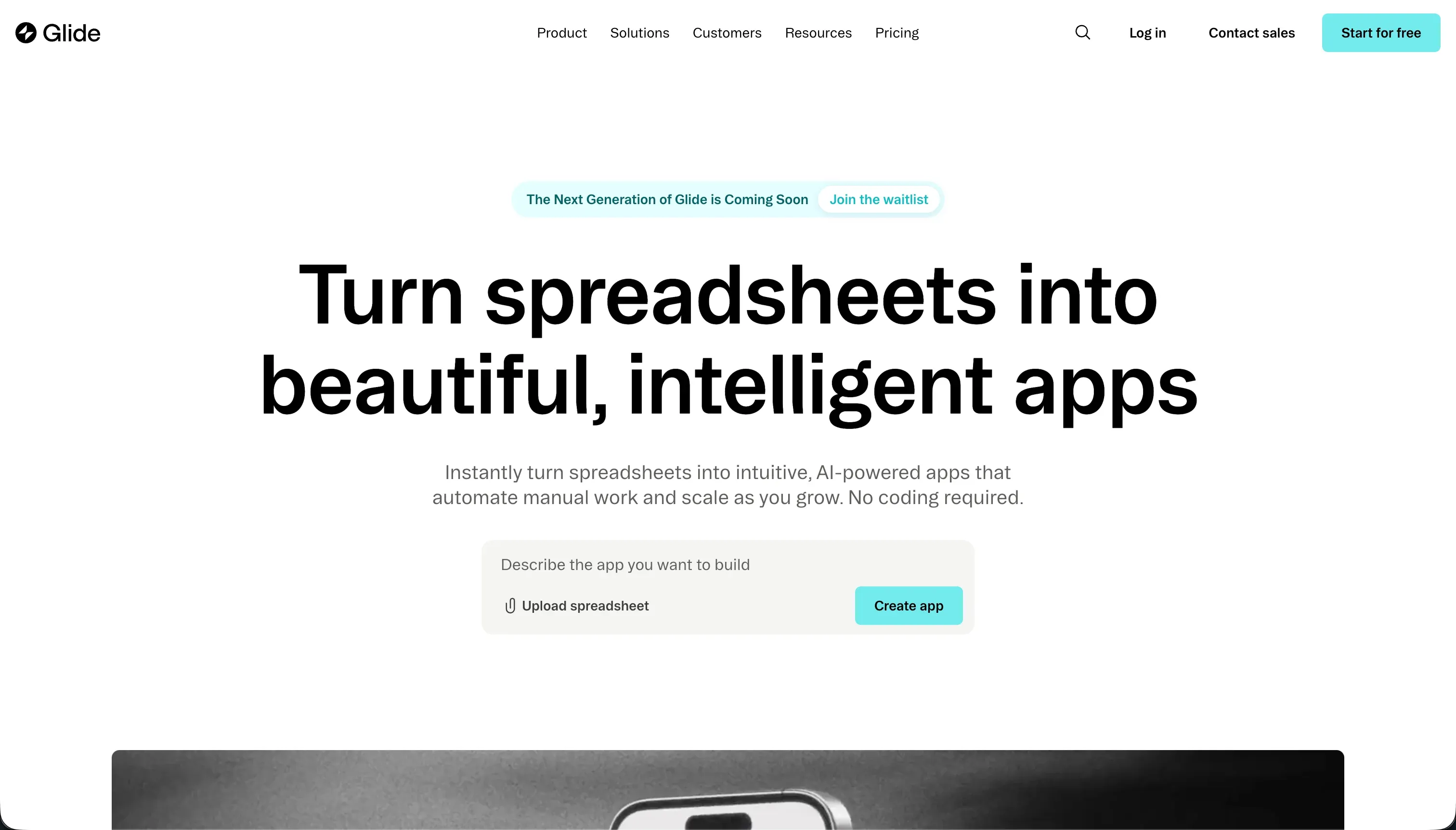 Glide homepage snapshot
When operations occur outside the office, teams rely on Glide to turn legacy spreadsheets into polished, mobile-responsive tools. Glide scores 8.5 on ease of build, enabling non-technical operators to map Google Sheets, Airtable, or its native Glide Tables into responsive lists, forms, and cards that run beautifully on tablets and smartphones.
Glide lacks structural depth when handling larger organizational rules, scoring 5.5 on security & access control and 6.5 on maintainability. Its security models rely on thinner row-owner rules that are hard to scale as complex multi-team hierarchies emerge, and long-term customers complain about feature capabilities moving behind higher paywalls mid-project.
Licensing costs also ramp up quickly: the $249 a month Business tier caps shared users to 100 on strict templates that score 4.0 on design flexibility. Buy Glide if your primary operational goal is deploying clean, mobile trackers quickly from a spreadsheet backend. Bypass it if you require desktop-customized interfaces or advanced logical structures.
4. Airtable - best relational database layer for internal schemas
Operations managers consistently reach for Airtable to normalize unstructured business data. It scores 8.0 on data & integrations, combining relational links, multi-source syncing, formulas, and custom views into the most intuitive database interface in the industry. Its visual Interface Designer enables teams to build basic admin panels on top of databases without writing code.
Airtable declines on security & access control (5.0) and production readiness (5.5). The Interface Designer does not handle custom login flows or row-level permissions natively: permissions apply at the database base-level, which prevents builders from securely isolation individual records from login users.
Performance also degrades as bases approach record limits, and API throttling limits synchronization to external databases. At $54 per user per month on Business, seat-based overhead scales painfully. Use Airtable as an operational spreadsheet database for collaborative internal work.
If you need client logins, custom web portals, or mobile-first layouts, secure your data within Airtable but build the user-facing app layer elsewhere.
5. Replit - best AI code generator for full platform exit paths
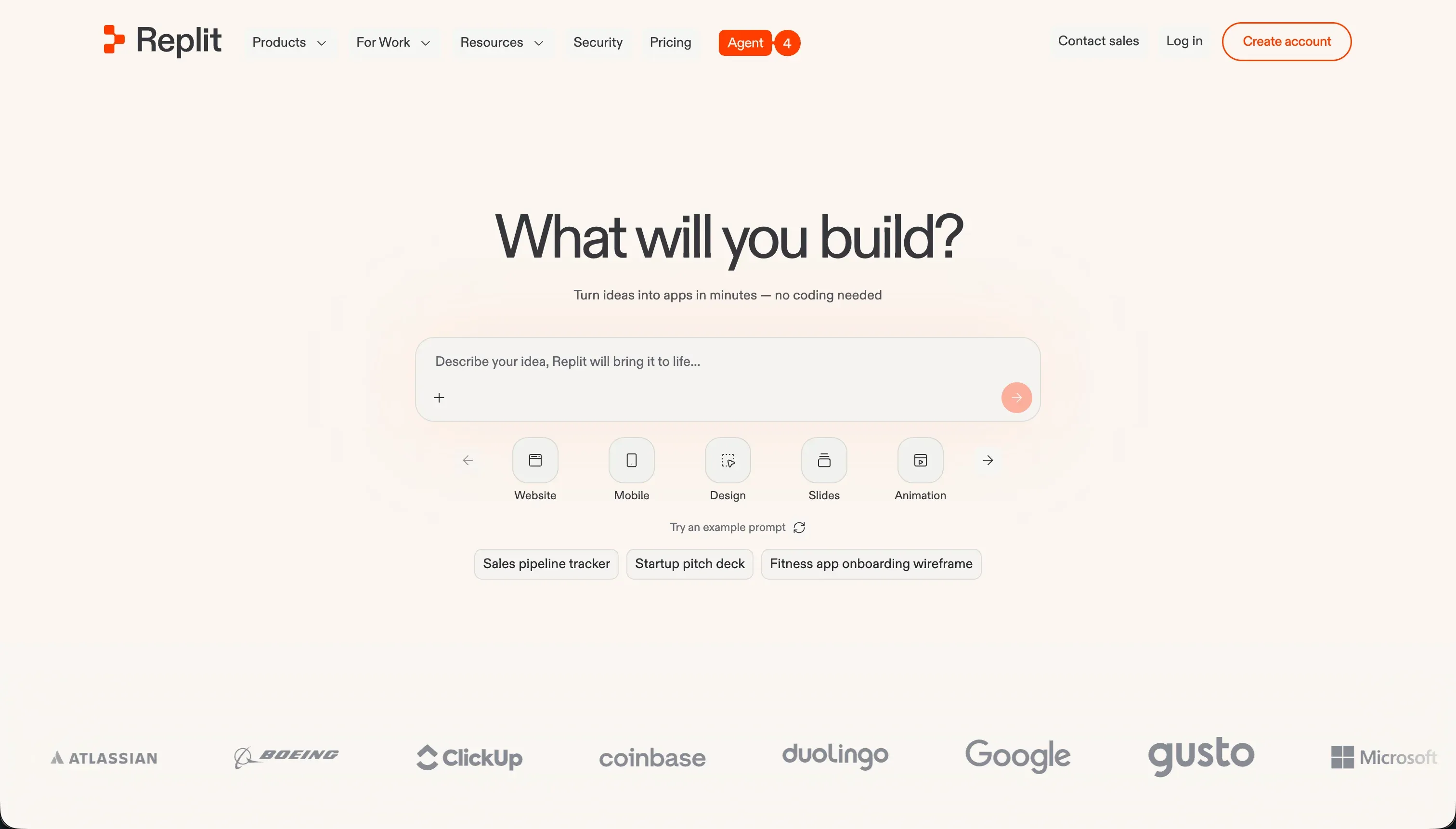 Replit homepage snapshot
If an operations team has dedicated software engineers and wants total code ownership of its custom tools, Replit is an exceptionally strong candidate. The platform scores 8.0 on production readiness and 8.5 on design flexibility, using an autonomous AI Agent to write, compile, and deploy full NodeJS, Python, and Postgres applications directly on managed web servers.
This unconstrained approach comes with a steep maintenance and security trade-off. Replit scores 6.0 on security & access control because roles, row-level filtering rules, and OAuth pipelines are written in code: they must be audited manually file-by-file instead of checked on a visual dashboard panel.
Ease of build scores 6.5 as users must understand container environments, manage client-side state variables, and debug runtime compilation errors. In addition, its effort-priced agent consumption model means debugging loops can trigger unexpected billing overages. Replit is a fantastic development accelerator for engineering groups seek custom app architecture.
It is a risky choice for non-technical managers seeking custom workflows.
6. Bubble - best visual builder for custom logic workflows
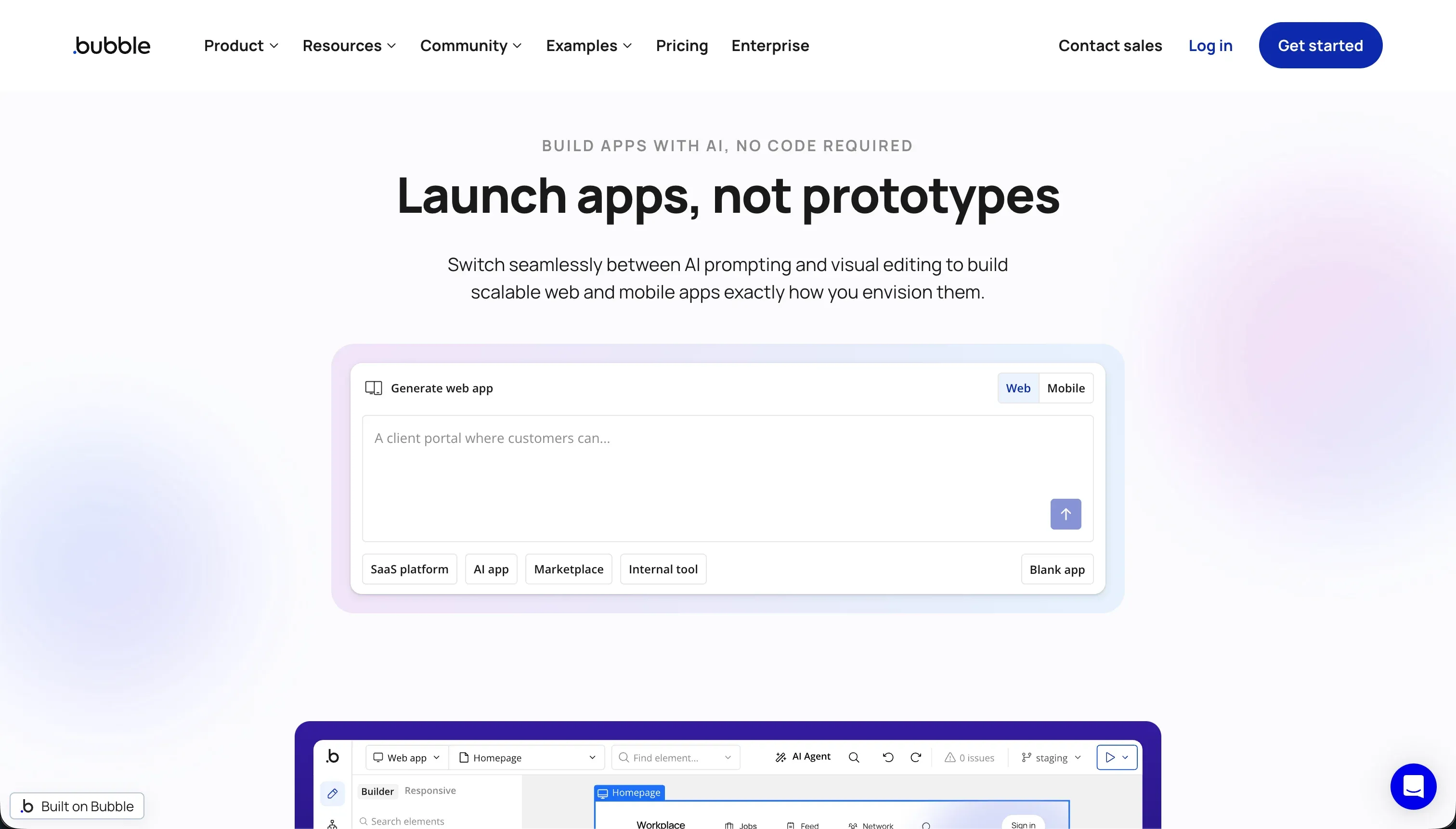 Bubble homepage snapshot
When operations processes require highly customized transactional workflows, Bubble provides deep logical control in the no-code class. It scores 8.5 on design flexibility and 8.0 on data & integrations, coupling a pixel-precise, responsive interface canvas with custom database types, server-side schedulers, and more than 8,000 plugins.
This depth requires accepting major operational overhead. Bubble’s ease of build scores 5.0, as learning its visual syntax, state values, database models, and privacy security rules represents a steep, multi-week learning curve. Security & access control scores 6.5 because a single missing privacy rule fails silently inside the editor, leaving databases exposed to browser queries.
Complex databases also accumulate visual logic clutter that is difficult to audit, and editor latency limits performance on larger workspaces. Furthermore, the workload-unit billing model means unoptimized queries can result in sudden, unpredictable monthly cost increases. Shortlist Bubble when your internal apps require deep, customized process automation and your team has the resources to master the editor.
How to Shortlist Operations Platforms
Operations teams should shortlist software platforms based on technical skill, database location, and long-term operating costs. For operations managers seeking visual permission controls, secure portals, and simple maintainability, shortlist Softr and Glide if your relational data already sits in Airtable or spreadsheets.
For technical teams overseeing raw SQL queries and dense admin views, compare Softr and Retool to choose between visual no-code and developer-grade scripting.
Before running a pilot, operations teams should test three parameters. First, test a secure permission check: verify that an operative in one region cannot query records from another. Second, modify a workflow after launch: determine whether adding a new form step or database column requires re-prompting or breaks other parts of the application.
Third, calculate the 12-month hosting bill at varying user sizes to avoid surprise fees.
Our team details exactly how these platform scores are derived on our methodology page, and you can explore structured implementation guides for related business apps on our specialized guides for internal tools, inventory management apps, and approval workflow apps.