



What an inventory management app actually needs
An inventory app is highly operational business software. Unlike simple view-only dashboards, warehouse staff, dispatchers, and suppliers actively use inventory tools to read and write records under varying conditions.
A picker might be scanning barcodes on a rugged phone in a dark section of a warehouse, while an operations manager updates supplier records at a desktop. Consequently, typical visual design criteria are set aside in favor of data integrity, system security, and offline resilience.
Evaluating these platforms across our six core criteria reveals exactly how each stack behaves in production. First, Ease of build determines how fast you can turn a messy spreadsheet into functional barcode scanners and item logs. Second, Production readiness and Maintainability are the deciding factors for whether your tool can keep running stable under daily catalog syncs without silent database crashes.
In inventory, data security is paramount; Security & access control must guarantee that ground workers can only edit stock quantities while sensitive pricing margins remain locked behind manager authentication. Finally, Data & integrations matters because an operational inventory utility is useless if it connects poorly to your main ERP, shipping platforms, or SQL databases.
While Design flexibility is required for modern responsive mobile displays, generic aesthetic freedom is secondary to transactional reliability.
The use-case comparison
| Platform | Overall | Advantage | Main reason to exclude it |
|---|---|---|---|
| Softr | 8.1 | Pre-built login flows, visual permission groups, server-side data security | No direct code export and limited pixel-precise styling rules |
| Glide | 6.3 | Scaffolds clean mobile-responsive item lists fast from spreadsheet data | Thinner external permissions and seat-based pricing escalations |
| Retool | 6.8 | Direct read-write connections to production SQL servers and REST APIs | Requires coding skills in SQL/JS and charges equally for external seats |
| Replit | 7.4 | AI Agent generates clean, exportable full-stack application code | High code-upkeep responsibility and consumption-based overages |
| Bubble | 6.8 | Pixel-level canvas design matched with a deep custom workflow database | Large workload unit counts can cause unpredictable monthly invoices |
| Airtable | 6.3 | Most intuitive relational system for modeling multiple warehouses | Rigid desktop layouts and a lack of granular item-level filters |
1. Softr - best overall for secure multi-role operations
 Softr homepage snapshot
Softr ranks first for inventory management because its core architecture is built around visual security and user groups. Authentication and role-level visibility are native features, not raw code you have to generate with an AI.
It scores 8.5 on production readiness and 8.5 on security & access control, giving business teams the immediate ability to lock down specific fields - like purchase costs - while exposing stock adjustments to dispatchers. The platform’s native Softr Databases and its AI fields bring automated data enrichment directly to your supply schemas.
Do not buy Softr if you are building native consumer smartphone apps for public app stores, as it compiles strictly to responsive web apps.
- 8.5 production readiness
- 8.5 security & access control
- Field-level lockdown, e.g. purchase costs
- Stock edits exposed to dispatchers
- AI fields enrich supply schemas
- Public app-store distribution
- Compiled as responsive web apps only
- Not what Softr is built for
2. Glide - best for fast spreadsheet-based scanning grids
 Glide homepage snapshot
Glide serves as an exceptionally fast path for translating active stock sheets into clean utility apps. Connecting directly to Google Sheets or Airtable, it instantly matches columns to responsive cards and maps. It scores 8.5 on ease of build and is highly praised for simple field deployments. Its built-in barcode scanning columns keep mobile inventory moves straightforward.
However, it scores 5.5 on security & access control due to thinner partition permissions, and seat-based pricing means adding external supply partners becomes expensive. Exclude Glide if you need robust server-side security rules or a deep relational PostgreSQL backend.
3. Retool - best for engineer-led SQL warehouse dashboards
 Retool homepage snapshot
Retool is the industrial option for logistics teams with technical managers on staff. If your inventory lives in PostgreSQL, MySQL, or enterprise databases, its direct query pathways are best-in-class, earning an 8.5 on data & integrations. Over 100 density-focused components make desktop warehouse consoles clean and powerful.
The caveat is that Retool scores 4.0 on ease of build; any logic past simple lists requires writing raw SQL queries and javascript helpers. Exclude Retool if your operations team is non-technical and need to build and edit features independently of engineering backups.
4. Replit - best for absolute developer control and code export
 Replit homepage snapshot
Replit is optimized for teams wanting native code ownership. The AI agent generates custom server logic, triggers physical scans, and connects to external APIs inside a containerized workspace. It scores 8.5 on design flexibility and 8.0 on production readiness because it produces standard code you can host anywhere.
The tradeoff falls on maintainability (7.5) and security (6.0), as checking your permissions means auditing code rather than clicking toggles. Exclude Replit if you want a visual, click-to-configure editor or require a predictable monthly flat flat bill.
5. Bubble - best for complex retail logic and multi-tier systems
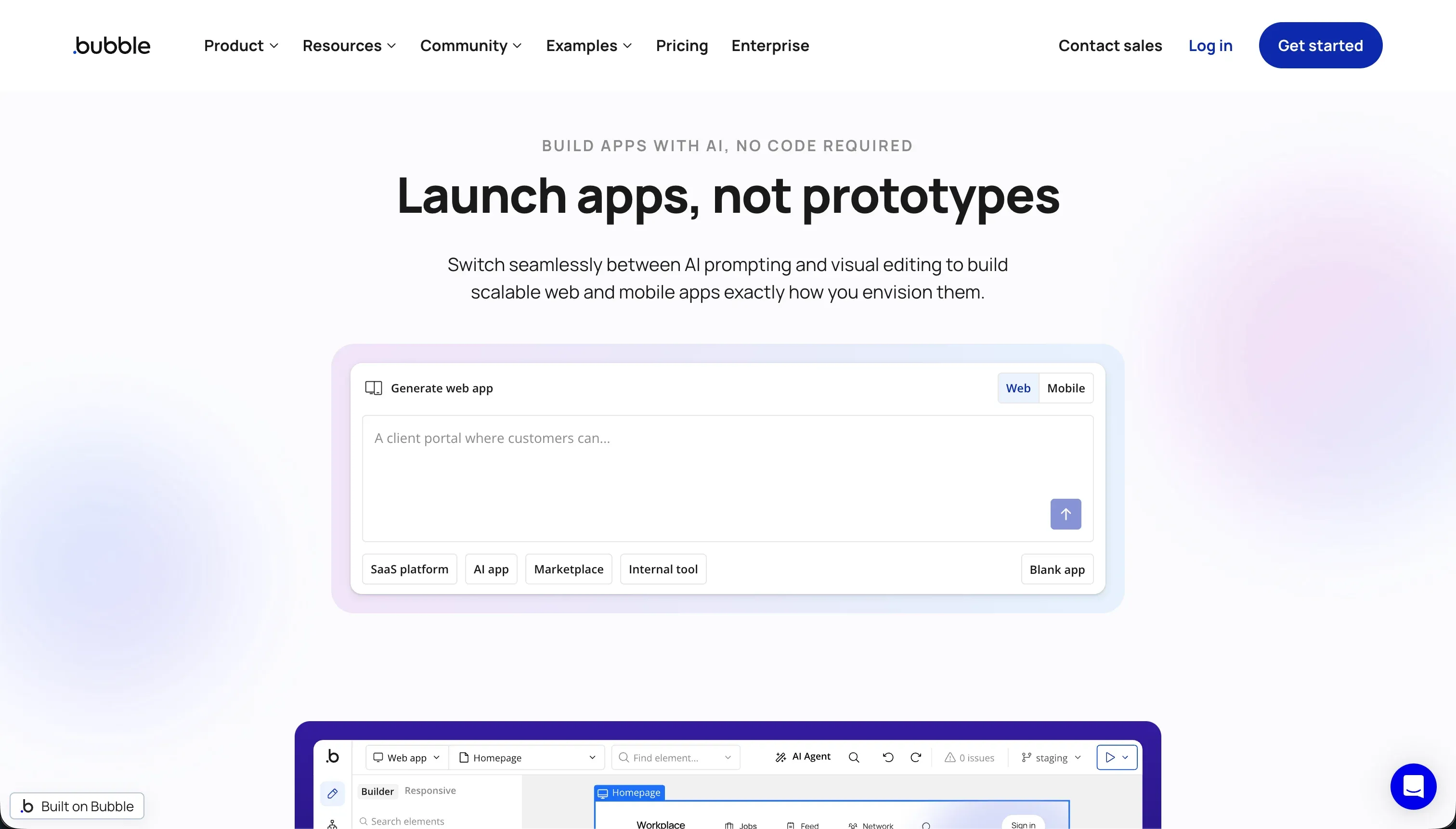 Bubble homepage snapshot
Bubble provides deep database relational structures and responsive layout configurations. Its logic workflow engine accommodates complex multi-warehouse fulfillment programs, scoring 8.5 on design flexibility and 8.0 on data & integrations. Despite this potential, it scores 5.0 on ease of build.
Building, testing, and keeping massive visual workflow trees secure represents a steep learning path that mimics traditional developer training. Exclude Bubble if you are operating on a strict budget, as unoptimized stock queries will consume workload units rapidly, leading to bills that scale poorly.
6. Airtable - best for initial relational data modeling
Airtable remains an approachable staging database. For modeling catalog associations and supplier relations, its grid sheets are highly visual, scoring 8.5 on ease of build. However, its Interface Designer layer is rigid, scoring 4.0 on design flexibility.
Interfaces use blocky, desktop-focused modules that look poorly optimized on phone browsers, and permissions can only be controlled at the base level.
Do not purchase Airtable if you need a mobile-first app, or secure row-level access control for floor operators who should not view other warehouse records.
Establishing your operational shortlist
To establish a clean inventory app pilot, select two platforms that align with your operational staff capacity. If your data currently sits in spreadsheets and you need mobile-responsive tracking with direct visual permission management, select Softr, and compare it with Glide for phone-first layouts.
If your stock is already housed in live databases, use Retool as your starting path alongside Replit if you prefer actual code. For a deeper look into the evaluation frameworks used by our procurement analysts, review our methodology overview or test alternative setups on our guide for operations teams and related order management apps list.