



What an Order Management App Actually Needs
Managing orders requires an app that can bridge internal operations, external suppliers, and buying customers. This complex operational network is why standard visual builders struggle under real-world transactional loads. To help buyers navigate this landscape, we analyze six criteria: ease of build, production readiness, maintainability, security & access control, data & integrations, and design flexibility.
An effective order tracker requires a highly structured data layer. Your system must link product catalogs, line items, and fulfillment stages without manual steps. This maps directly to our data & integrations criterion. At the same time, security & access control takes priority the moment you share updates with partners or clients.
Buyers need visual user groups to build row-level security so that Supplier A can never view the orders belonging to Supplier B. Production readiness determines how securely the tool deploys from day one. In typical supply pipelines, order apps require pre-built logins, password recovery, and invoice submission blocks.
This infrastructure has to be production-ready and SOC 2 compliant rather than left to code-generation assistants that might skip vulnerability checks. Finally, maintainability governs how your operations team handles changing logistics in year two. When you add a shipping field or an automated alert, that change should happen instantly without writing code or introducing platform lock-in.
While design flexibility matters to match exact corporate style guides, it remains secondary to keeping inventory states and transaction logs mathematically accurate across your user screens.
The use-case comparison
| Platform | Overall | Advantage | Main reason to exclude it |
|---|---|---|---|
| Softr | 8.1 | Pre-built customer/vendor auth, visual row-level restrictions, flat tier pricing | No direct code export and limited pixel-precise layout control |
| Glide | 6.3 | Scaffolds fast, mobile-friendly tracking interfaces from spreadsheets | Seat pricing gets expensive past 100 external users |
| Retool | 6.8 | Deep SQL database connectivity with technical admin components | Requires SQL/JS fluency and does not offer native external user portals |
| Bubble | 6.8 | Deep visual relational workflows with infinite design control | High platform-dependent learning curve and complex workload pricing |
| Replit | 7.4 | Real, version-controlled code on scalable system containers | Demands active developer resources and effort-priced credit budgets |
| Airtable | 6.3 | Superb relational structure for catalogs and stock lines | Base-level roles make external login portals difficult to secure |
1. Softr - best for multi-user business portals with supplier access
 Softr homepage snapshot
Building an operational order pipeline with Softr solves the critical challenges of multi-user governance. Because the platform includes native user groups, page routing rules, and passwordless authentication out of the box, you can launch a secure portal that separates internal teams, procurement partners, and clients.
It scores 8.5 on production readiness and 8.5 on security & access control due to server-side visibility rules that operate directly on connected databases. For operations-led workflows, the visual editor integrates with Softr Databases, Airtable, or SQL schemas, enabling real-time status updates and order comments.
However, design flexibility is its honest ceiling at 5.5, meaning you must work with block templates rather than freeform visual grids. If you require self-hosted software or a consumer-facing layout, Softr is not the right fit.
2. Glide - best for fast spreadsheet-based tracking utility apps
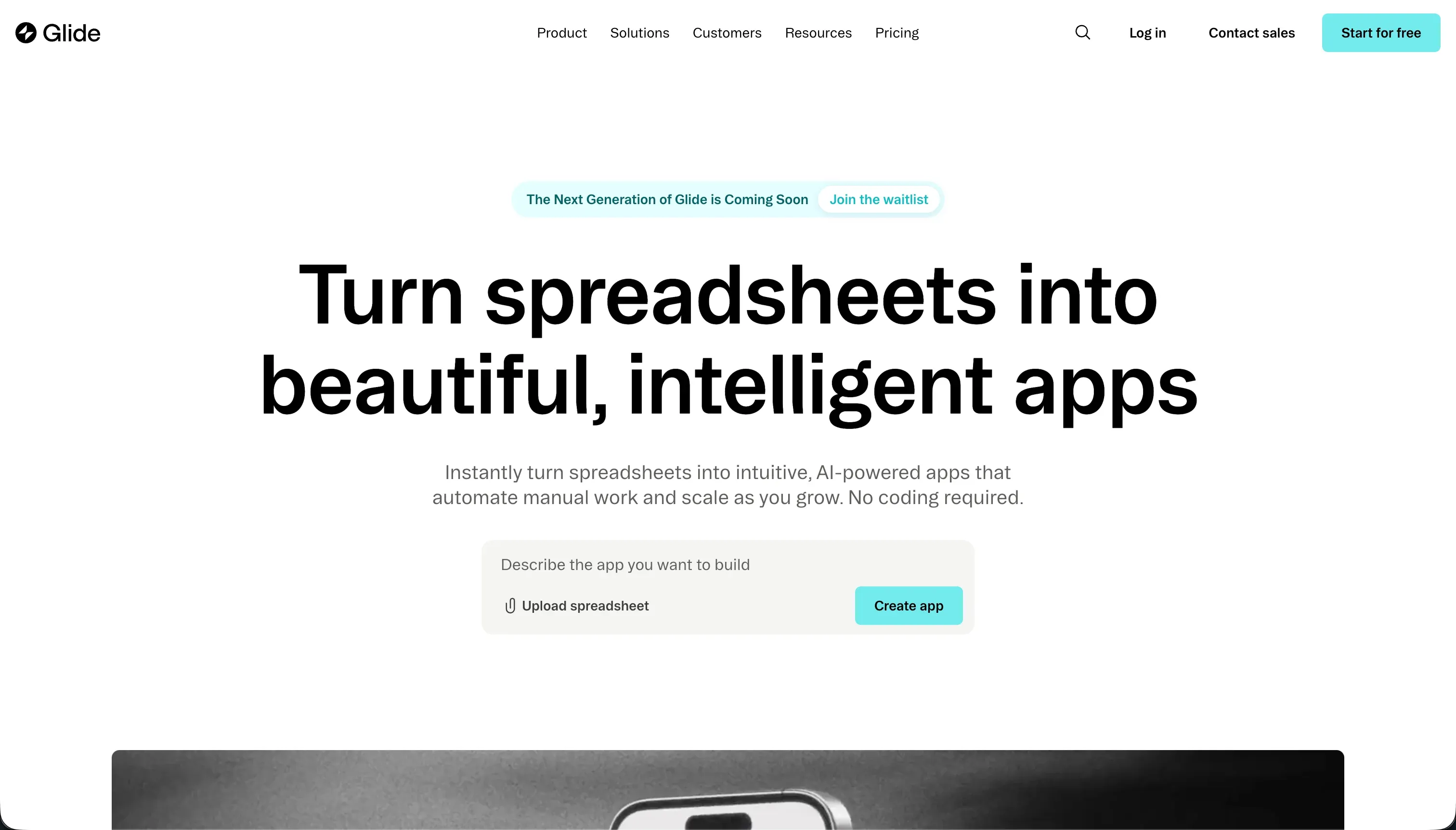 Glide homepage snapshot
If your team already manages inventory inside Google Sheets or Excel, Glide provides an incredibly fast path to build a mobile-first tracking utility. It scores 8.5 on ease of build because it translates spreadsheet tables into clean, responsive lists and action forms with zero visual configuration. This is ideal for internal dispatcher desks or field service operators logging stock movements.
However, security & access control drops to 5.5, indicating a thinner permission layer when exposing transactions to external buyers. More importantly, its pricing is per-user, which becomes a commercial constraint as your order community expands past 100 contacts. Exclude Glide if you need robust multi-tenant vendor isolation or exact brand white-labeling.
3. Retool - best for technical admin desks and database queries
 Retool homepage snapshot
For software engineering teams needing a dense control center over a production PostgreSQL database, Retool is the dominant choice. It scores 8.5 in data & integrations because it handles read-write SQL queries and REST API protocols with a wide array of high-utility tables and charts.
But this is not a no-code system; anything beyond basic layouts requires coding SQL queries and debugging JavaScript responses, resulting in a low score of 4.0 for ease of build. Retool also lacks visual external portal login structures out of the box. Exclude Retool if you want your non-technical back-office managers or shopping customers to edit order forms without ongoing engineering support.
4. Bubble - best for custom marketplace logic and consumer layouts
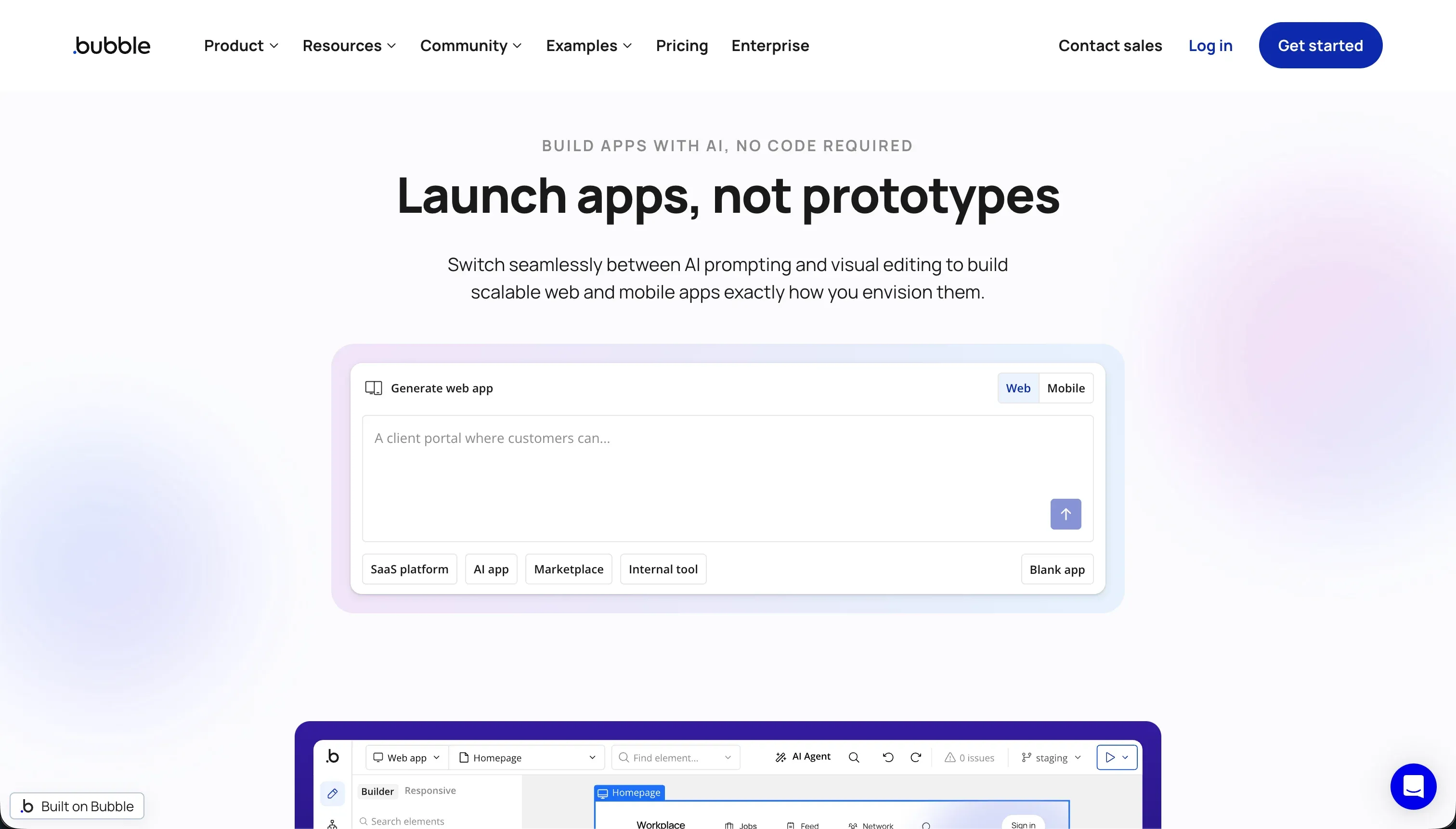 Bubble homepage snapshot
When your order transactions require custom calculations, multi-step shopping carts, or unique delivery matchmaking workflows, Bubble provides the deepest functional capacity. It scores a high 8.5 on design flexibility and 8.0 on data & integrations, offering full layout control and a visual logic builder to schedule backend webhooks.
The trade-off is a steep learning path, scoring 5.0 on ease of build.
Furthermore, security rules are not configure-by-default, meaning a single missed permission rule can fail silently and expose customer logs. Exclude Bubble if you are sensitive to proprietary system lock-in or volatile bills based on unoptimized database search queries.
5. Replit - best for engineering teams seeking absolute code ownership
 Replit homepage snapshot
For logistics businesses requiring true codebase ownership, Replit uses an autonomous AI agent to write, deploy, and host real code. This yields an 8.5 on design flexibility and 8.0 on production readiness, as its deployment dashboard connects straight to cloud database engines.
But ease of build drops to 6.5 because managing secrets and debugging agent-generated code still requires a developer’s mind.
Access control sits in raw code instead of visual dashboards, making security analysis slow. Turn elsewhere if you cannot allocate a dedicated software developer to check for dependency drift and manage consumption-based credit fees.
6. Airtable - best for internal databases and tracking product stock
When organize-first order databases are your main need, Airtable offers an intuitive relational interface that non-technical teams can grasp instantly. It scores 8.5 on ease of build and 8.0 on data & integrations, making it simple to model line items, categories, and inventory totals. However, its Interface Designer is rigid and desktop-focused, scoring 4.0 on design flexibility.
Production readiness is limited at 5.5, as it has no native customer registration or onboarding screens. If your goal is to build secure client facing order portals, skip building directly in Airtable and pair its robust backend with a dedicated frontend option instead.
How to Shortlist and Build Your Pilot
Selecting the right platform depends entirely on who needs access to your order logs. If you are building an internal dispatch monitor or database workspace, study the capabilities listed in our guide for /best/operations-teams. There you will find that developers lean toward Retool’s data density, while operations leads favor Airtable’s relational structure.
For workflows requiring external client or carrier desks, check our analysis for /best/vendor-and-partner-portals. In that category, Softr’s native security rules outperform generic visual tools.
We recommend testing your shortlist with a basic pilot: connect a realistic sample of catalog data, build one status change workflow, and test it as different logged-in users under our /methodology standard.