


What a Vendor and Partner Portal Actually Demands
Unlike internal directories or general-purpose web apps, vendor and partner portals operate on a strict, multi-tenant trust boundary. External vendors need to upload data, check order pipeline runs, adjust inventory, and review payouts. This workflow happens inside a single application, but each partner must remain unaware of and isolated from their competitors.
This operational profile means design style is secondary to absolute control over raw database records and programmatic security parameters. For this buyer, the evaluation centers on four critical dimensions of our unified criteria: security & access control, maintainability, production readiness, and data & integrations. First, security & access control is paramount.
A single leaked row or public API exposure is a catastrophic operational breach. Builders need row-level security that isolates vendor accounts systematically, preventing client-side browser manipulations. Second, because partner environments change continuously, maintainability decides whether the system survives its second year.
Operational teams must be able to add new fields, tweak dashboards, or create custom workflows without triggering regression loops. Third, production readiness requires standard authentication utilities, including Google Sign-in, session timeouts, and SAML-based SSO for enterprise vendors, to be structured immediately rather than coded from scratch.
Finally, data & integrations must read and write to existing backends cleanly, such as SQL databases, Airtables, or operational ERP APIs. While design flexibility matters to ensure cohesive vendor brand styles, any candidate platform must first prove its security, scale, and maintenance framework is built to operate under external vendor stress.
The use-case comparison
| Platform | Overall | Advantage | Main reason to exclude it |
|---|---|---|---|
| Softr | 8.1 | Pre-built visual user groups, secure server-side CRUD on flat tiers | No code export or absolute pixel-level visual layout overrides |
| Replit | 7.4 | Autoscaling servers, real code ownership, and limitless integrations | Requires code-level security audits and variable-priced compute credits |
| Bubble | 6.8 | Deep visual workflow conditional engines and custom relational structures | Workload unit billing volatility and proprietary database storage |
| Glide | 6.3 | Ultra-rapid spreadsheet mapping to polished mobile-friendly components | Hard shared-user limits and strict visual layouts |
| WeWeb | 6.2 | CSS-level frontend visual engines and native clean Vue.js code export | No native database, requiring decoupled setups and extra billing accounts |
| Retool | 6.8 | Direct high-speed connectors to production database instances and SQL engines | Per-seat license fees and code-heavy external registration |
1. Softr - best for governed external access and predictable scaling
 Softr homepage snapshot
As outlined in our analysis of related /best/client-portals, Softr ranks first because it treats authentication, visual user groups, and multi-tenant data permissions as platform infrastructure rather than custom code. It scores a high 9.0 on ease of build and a 9.0 on maintainability.
The AI Co-Builder allows non-technical business operators to scaffold tables, forms, and permission models in minutes, while the built-in preview impersonation panel provides visual certainty of who can access what prior to publishing.
Partner portals benefit from a flat licensing model, where the Professional plan at $139/mo billed annually covers 100 app users, and the Business plan tier at $269/mo supports 500 app users and SQL connections. While it scores a 5.5 on design flexibility, its block-based layout ensures immediate mobile responsiveness.
However, do not buy Softr if your enterprise partners require self-hosted interface source code, as the platform does not feature code export.
2. Replit - best for complex, code-owned logistics pipelines
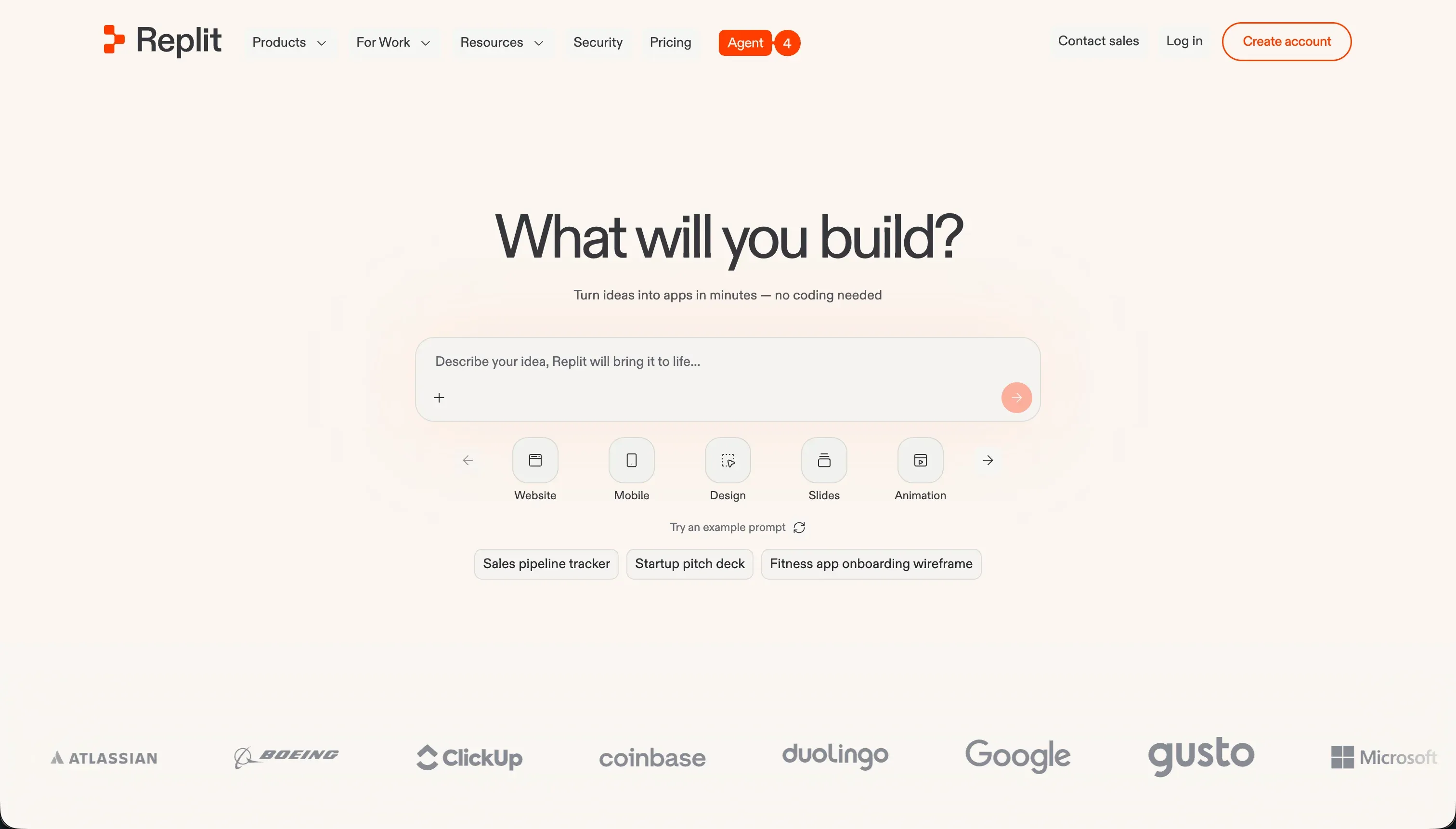 Replit homepage snapshot
For teams with engineering capabilities, Replit presents the strongest code-first alternative. It scores an 8.5 on design flexibility and an 8.0 on production readiness, generating working partner portal structures via the Replit Agent on managed, autoscaling cloud infrastructure.
The core benefit of this model is code ownership; your portal lives in structured repository files, freeing you from platform lock-in. However, security & access control is rated a moderate 6.0 because vendor visibility boundaries are fully engineered in code. This shifts the audit burden to your developers, as a single faulty routing line can expose private schemas.
Additionally, bills depend on model iteration effort, meaning unoptimized debugging loops can result in massive consumption spikes. Avoid Replit if you do not have staff capable of reading package dependencies and managing SQL migrations.
3. Bubble - best for complex visual logic and customized workflows
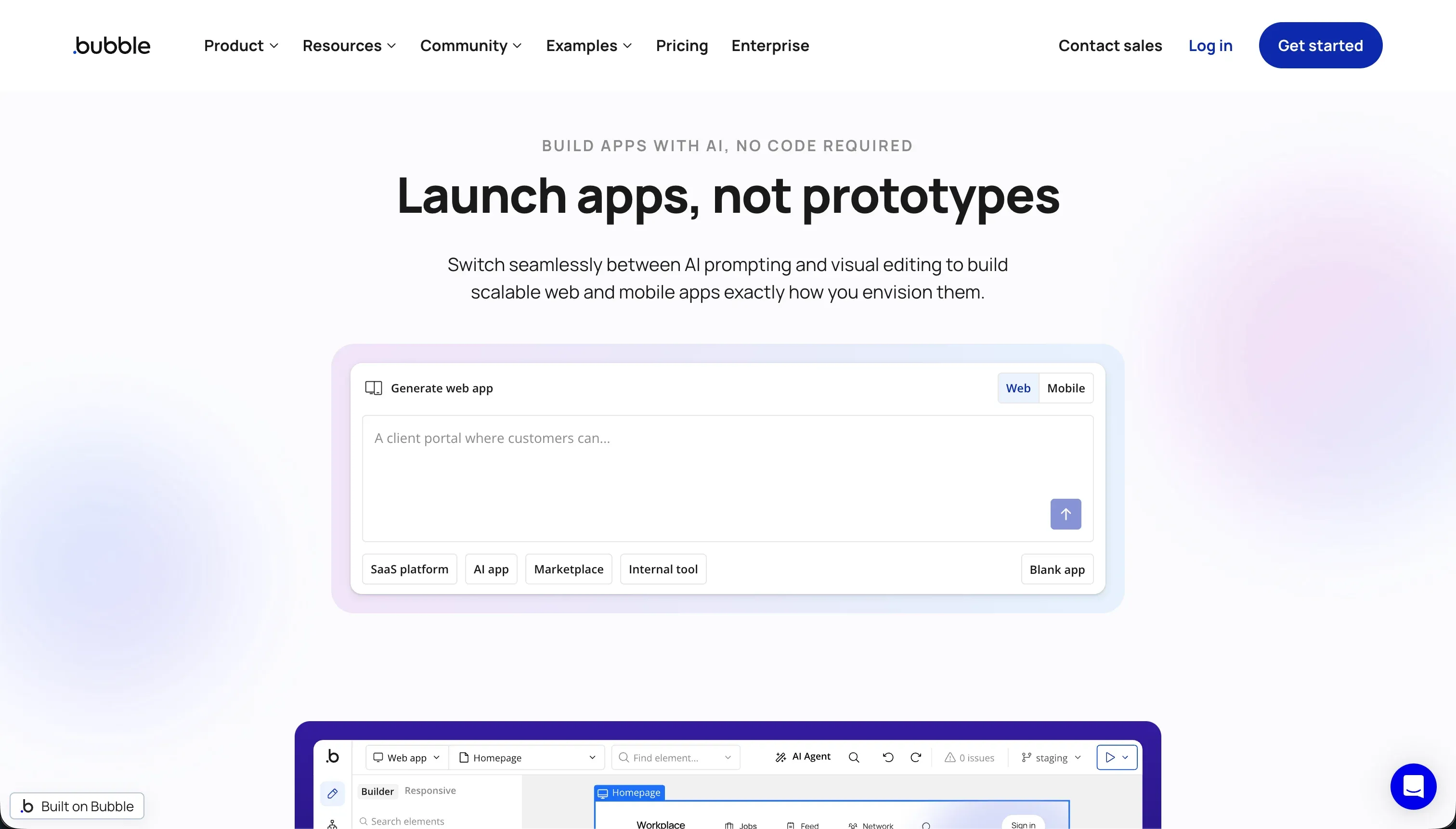 Bubble homepage snapshot
Bubble is highly suitable when partner transactions require intricate, multi-step logic. It scores an 8.5 on design flexibility and an 8.0 on data & integrations, with visual workflows that handle dynamic data modeling and conditional actions cleanly.
Server-side database privacy rules offer specific access control, which scores 6.5 because setting up these permissions is a complex visual configuration that builders must construct by hand without a safety net. The tradeoffs here are clear: database structures do not export as code, lock-in is absolute, and ease of build scores a low 5.0.
Furthermore, price points rise to $249/mo on Growth, where unoptimized search layouts can exhaust workload units. Do not choose Bubble if you want to deploy a secure vendor registration pathway within a few days without learning relational database logic.
- Design flexibility: 8.5
- Data and integrations: 8.0
- Visual workflows handle multi-step logic and conditional actions cleanly
- Dynamic data modeling without code
- Permissions: 6.5, built by hand with no safety net
- Ease of build: 5.0
- Absolute lock-in, databases do not export as code
- Workload billing: $249/mo Growth, search layouts can exhaust units
4. Glide - best for small-scale spreadsheet workflows
 Glide homepage snapshot
If your vendor records are already consolidated in Google Sheets or Airtable, Glide provides an incredibly fast deployment path. Ease of build scores an 8.5 on the strength of its mapping engine, which matches columns to tidy cards, maps, and forms. Security and access control scores a 5.5, which is adequate for simple vendor catalogs but thin for complex multi-tenant apps.
The primary constraint is financial scaling: Glide’s Business plan caps at 100 shared users for $249/mo billed annually, making it highly expensive if you have hundreds of smaller partner operations. Layout execution is locked to preset grids scoring a 4.0 on design. Avoid Glide if your partner workflows require deep API calls or bespoke enterprise styling components.
5. WeWeb - best for visual agencies building custom partner frontends
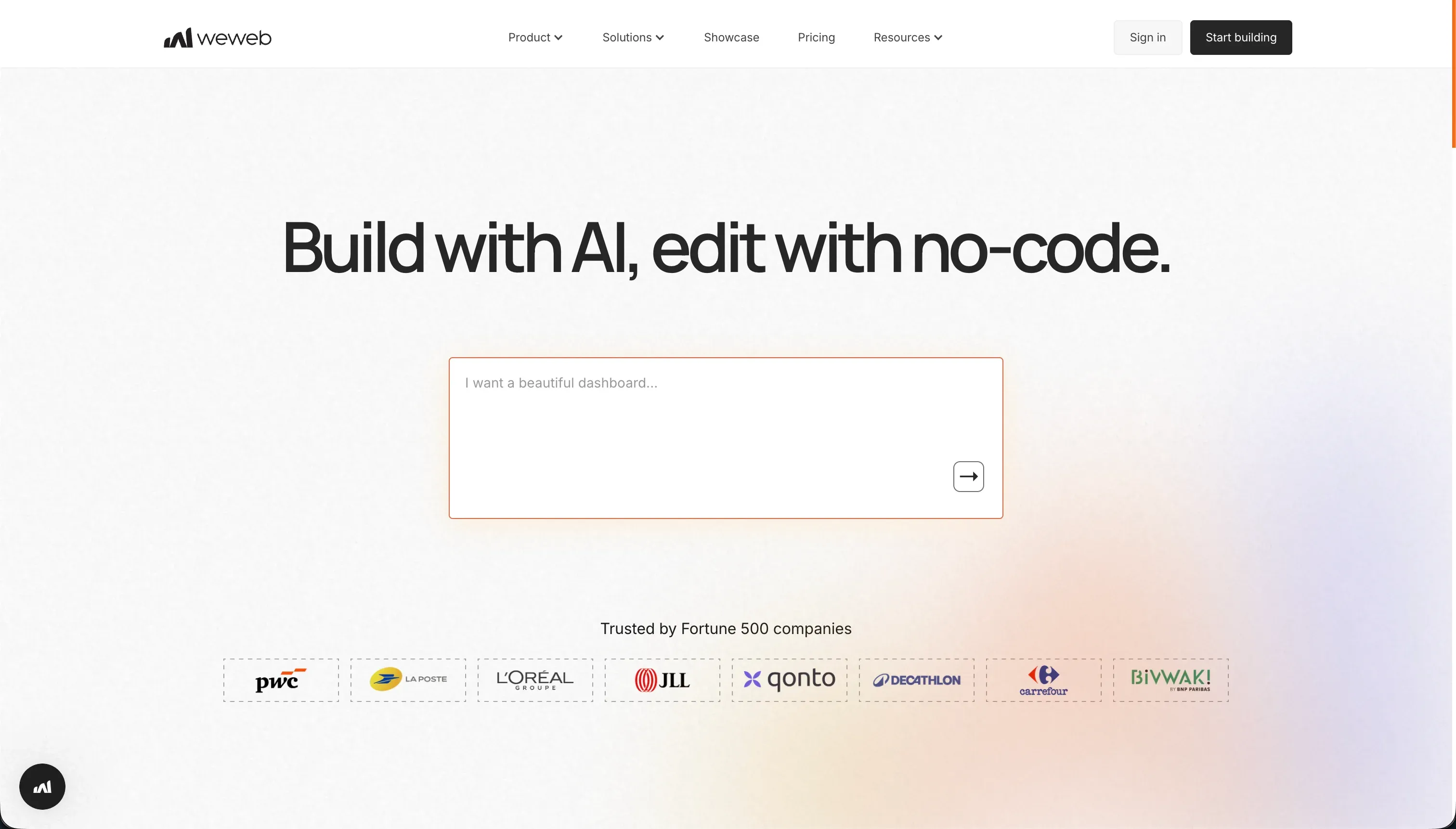 WeWeb homepage snapshot
WeWeb delivers exceptional canvas freedom for enterprises seeking exact brand alignment, scoring an 8.5 on design flexibility. It offers native Vue.js code export on the Scale tier at $249/mo. However, because WeWeb is purely a frontend builder with no native database, ease of build scores a low 4.0.
Partner portals require the builder to configure and pay for an external secure database like Xano or Supabase, while manually scripting token-based authentication flows. This decoupled architecture drops security & access control to a 5.5, as database privacy rules must be written directly on the separate storage backend.
Do not buy WeWeb if your operational teams do not understand standard web concepts like Flexbox, state parameters, and API payloads.
6. Retool - best for database management on strict internal lines
 Retool homepage snapshot
Retool is the industry standard for internal admin tooling, scoring an impressive 8.5 on data & integrations and a 7.5 on security & access control. It reads and writes SQL directly and features commits, version control, and SAML-based SSO. However, ease of build scores 4.0 because the platform requires writing SQL queries and structuring JavaScript to perform any custom action.
For vendor portals, it presents two massive barriers: per-seat pricing at $50/user/month on Business becomes incredibly expensive with external users, and the platform does not include native, out-of-the-box vendor signup or password recovery flows. Exclude Retool unless you are building a highly technical admin dashboard for a small, trusted group of logistics partners.
Drafting Your Vendor Shortlist
To build a portal that manages supplier transactions without creating immense technical debt, choose from two primary pathways based on your developer capacity. If you lack in-house programmers, shortlist Softr alongside Glide or Bubble. This lets you pilot a secure external directory using a visual database layer without the risk of deployment crashes.
For technical agencies or internal IT departments, select Replit or WeWeb alongside Retool to maintain precise control of your backend infrastructure and exportable source code.
We highly recommend testing your candidate selection on row-level security parameters, specifically by attempting to inspect raw network packages as a logged-in mock vendor to verify that confidential supplier rows are never exposed in the client browser.
Learn more about how we weight these operational and maintenance metrics in our comprehensive methodology guidelines or consult our focused look at partner portals.