




What Finance Workflows Actually Demand
Financial applications form a highly sensitive class of operational software. Whether you are constructing custom invoice approval pipelines, tracking department-wide budgets, deploying external partner tools, or building corporate compliance ledgers, the underlying stack cannot afford to fail.
This is why our evaluation of the best app builders for finance teams prioritizes structural reliability and data governance over custom design flexibility. We judge platforms using six strict criteria, each carrying different weights for this specific use case. To begin with, security & access control is paramount.
Finance builders need to configure bulletproof row-level restrictions and verify that sensitive bank logs or user directories execute strictly server side. Production readiness is almost as critical. The platform must offer stable, SOC 2 compliant storage, dependable user sign-up controls, and predictable hosting.
This is the difference between a prototype that looks functional and an app that handles real corporate budgets.
Maintainability determines whether modifications in month six require technical resources or a simple configuration sweep. Data & integrations is also vital: financial apps must connect smoothly to live databases, spreadsheet backends, or existing CRMs without breaking data pipelines.
Finally, ease of build determines how fast operations managers get a working pilot running, whilst design flexibility helps polish the internal dashboard. When evaluating these options, remember that the lowest-priced starting plan rarely represents the lowest total cost of ownership once you account for development bottlenecks and system administrative labor.
The use-case comparison
| Platform | Overall | Advantage | Main reason to exclude it |
|---|---|---|---|
| Softr | 8.1 | Pre-built security, visual user groups, and rapid database creation path. | No code export and block-level layouts instead of freeform design canvas. |
| Retool | 6.8 | Direct read-write SQL access, developer tools, and dense data layouts. | Requires SQL and JS skills, and seat-based pricing hurts external portals. |
| Airtable | 6.3 | Approachable relational database with friendly spreadsheet-style interface views. | Base-level permissions, rigid desktop templates, and expensive guest pricing. |
| Glide | 6.3 | Fastest way to turn a spreadsheet into an adaptive web or mobile app. | No custom CSS on lower tiers and per-user limits on external scale. |
| Replit | 7.4 | Full code ownership, managed deployment, and robust AI agent code generation. | Requires technical developers, manual debugging, and effort-priced credits. |
| Bubble | 6.8 | Deep custom-logic workflows, managed data types, and responsive design engine. | Steep learning path, visual workflow sprawl, and proprietary environment lock-in. |
1. Softr - best for governed internal tools and vendor portals
 Softr homepage snapshot
Softr ranks first for finance teams because it transforms spreadsheet data into structured internal tools and secure external workspaces without exposing your raw backend. It scores 8.5 on production readiness and 8.5 on security & access control because infrastructure options like login flows, custom domain hosting, and user permissions are completely pre-built.
For businesses building custom invoicing pages or structured portals, Softr helps administrators organize secure viewer layers. The visual preview impersonation tool lets builders instantly review what each team member or external vendor sees in one click. Maintainability scores 9.0 because there is no code repository to debug; you adjust your budget checkers visually or prompt the AI inside the editor.
Integrate your Softr Databases with external sources to feed clean figures into other tools, or implement workflows directly with its native logic engine. However, design flexibility is its logical deduction at 5.5, meaning developers seeking a freeform visual layout will hit a wall. Do not buy Softr if you must export the interface’s actual front-end code to your own developer servers.
2. Retool - best for engineering-led internal db utilities
 Retool homepage snapshot
Retool is the dominant choice for tech-heavy teams whose financial records already live in raw SQL databases or proprietary APIs. Its high score in data & integrations of 8.5 directly reflects its ability to connect developers straight to PostgreSQL orREST endpoints, creating custom database administration utilities and dense dashboards.
However, ease of build is its strict limit at 4.0; this is a low-code utility, and non-technical staff will quickly struggle with raw SQL commands or client-side JavaScript formatting. Production readiness scores 7.5, offering helpful developer tools like code release management and version archiving.
Avoid using Retool for external vendor portals, as its per-user pricing model charges equally for your staff and external guests, compounding your subscription fees rapidly as your partner base extends.
- Connects straight to PostgreSQL and REST endpoints
- Data & integrations score: 8.5
- Production readiness 7.5 with release management
- Ease of build limited to 4.0
- Per-user pricing charges guests like staff
- Fees compound as partners extend
3. Airtable - best for approachable spreadsheet database organization
Airtable delivers an incredibly intuitive relational database for administrative teams who need to move past standard Excel files. It scores 8.5 on ease of build because organizing rows, linking records, and establishing calculations inside a visual table is approachable for any business operator. The platform’s integrated automation triggers can run simple internal alerts.
But its security & access control score sits at a low 5.0 because permissions are configured at the base level rather than the record level. This restriction means you cannot easily hide specific column rows from logged-in users. This structural limitation makes it a dangerous fit for sensitive finance pipelines.
Do not build on Airtable if your tool needs secure external client logins, unless you pair it with a visual portal builder to handle user permissions safely.
4. Glide - best for swift mobile inventory and field tracking
 Glide homepage snapshot
Glide excels at instantly turning corporate spreadsheets into responsive, mobile-optimized tools. It scores 8.5 on ease of build, allowing non-developers to link Google Sheets or Excel files to polished visual layouts in minutes. It is a fantastic choice for mobile operators tracking corporate resources or checking regional purchase details.
Yet design flexibility scores a low 4.0 because the visual interface strictly conforms to pre-configured templates. Security & access control scores 5.5; building intricate row-level filters for varying internal manager tiers is complex. Avoid Glide if you want to deploy a large-scale partner portal, as the per-user pricing model can become cost-prohibitive at scale.
5. Replit - best for custom code ownership on cloud servers
 Replit homepage snapshot
Replit is optimized for development teams who want to build a bespoke financial application from scratch using automated AI agent prompts. The platform scores an excellent 8.5 on design flexibility and 8.0 on production readiness because it hosts applications as clean, version-controlled repository code on managed sandboxes. You can export your Dart or Python code to any external server.
The main warning sits with ease of build at 6.5 and maintainability at 7.5. Debugging generated coding bugs or setting up security middlewares requires engineering diagnostics. If database permissions are not coded correctly, your application risks catastrophic leaks. Do not buy Replit if your non-technical operations team is responsible for manually maintaining the security of the script codebase.
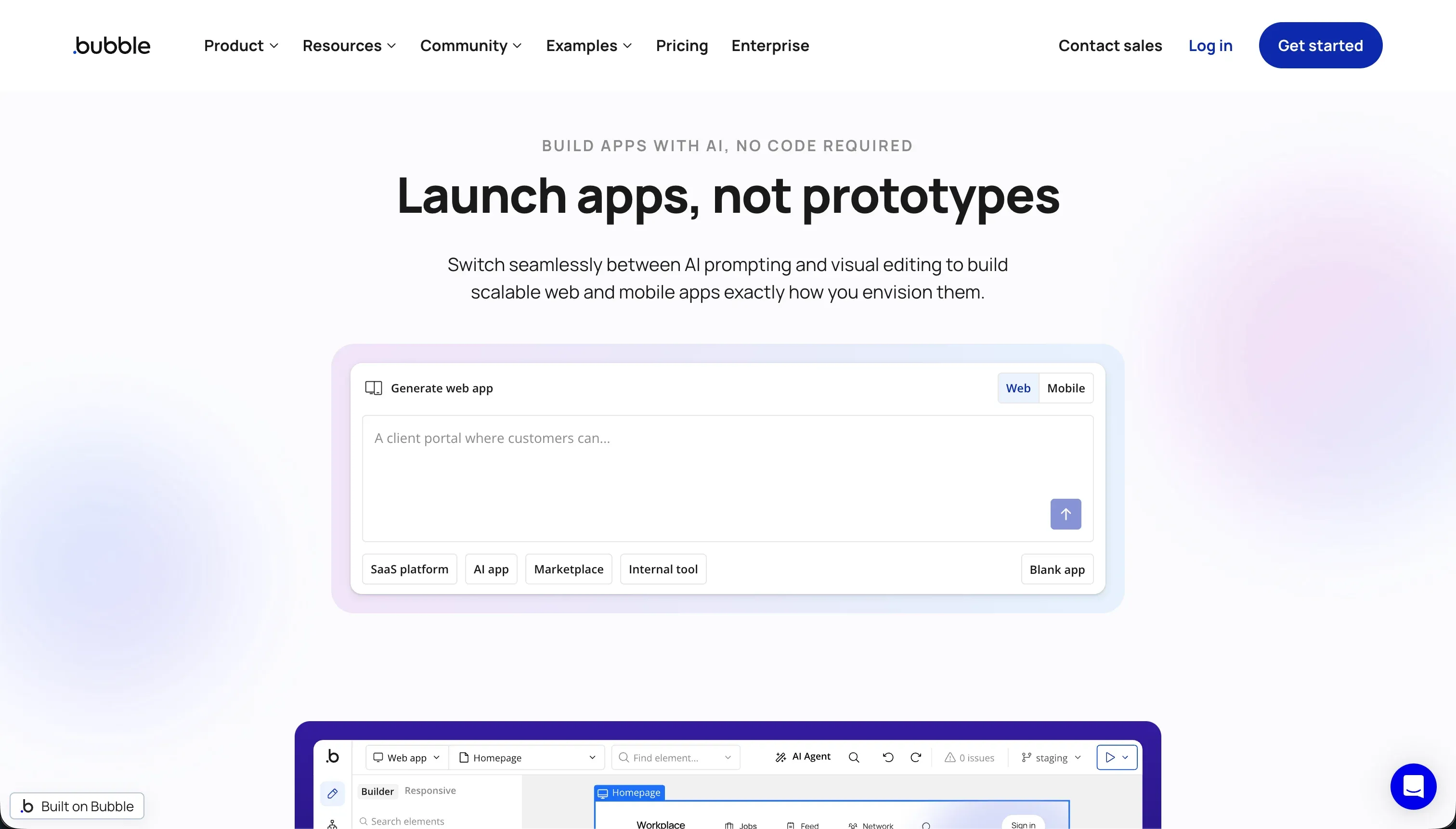
6. Bubble - best for complex, bespoke calculation logic
 Bubble homepage snapshot
Bubble provides the deepest functional visual logic and database design flexibility in the no-code ecosystem, scoring 8.5 on layout control. Its workflow conditional engine handles complex parent-child relations and multi-stage financial approval parameters visually. But this flexibility results in a steep learning path, scoring 5.0 on ease of build.
Reviewers complain of editor lag and heavy browser memory consumption on larger business projects. Maintainability scores 6.0 because complex applications accumulate sprawling visual workflow maps that are difficult to debug or audit. Unoptimized database searches also run up your chargeable workload units.
Do not build on Bubble if you need predictable monthly pricing or require your database code to be exported later.
How to Shortlist the Right App Builder
When shortlisting platforms for your financial operations, avoid chasing visual aesthetics first. We recommend picking two candidates to pilot your workflows. If your goal is to build secure approval steps, track corporate budget allocations, or deploy vendor spaces, test Softr. You can easily connect a secure workspace straight to your operational data and visually establish custom user logins.
Review our guide on approval workflow apps to see how dynamic forms accelerate these pipelines. If your data operations are managed strictly by software engineers who prefer direct SQL connections and high-density panels, pair that check with a trial on Retool.
Look at our analysis on internal dashboards and reporting to compare data layouts. If you want to connect external suppliers directly into your database to upload invoices safely, evaluate how dedicated templates handle data security on our vendor and partner portals index.
Run your pilots by creating a multi-role user environment (such as an Associate, a VP Approver, and an External Vendor) to review exactly what each user can see and do. To learn how we weight these scores, check out our methodology page.