

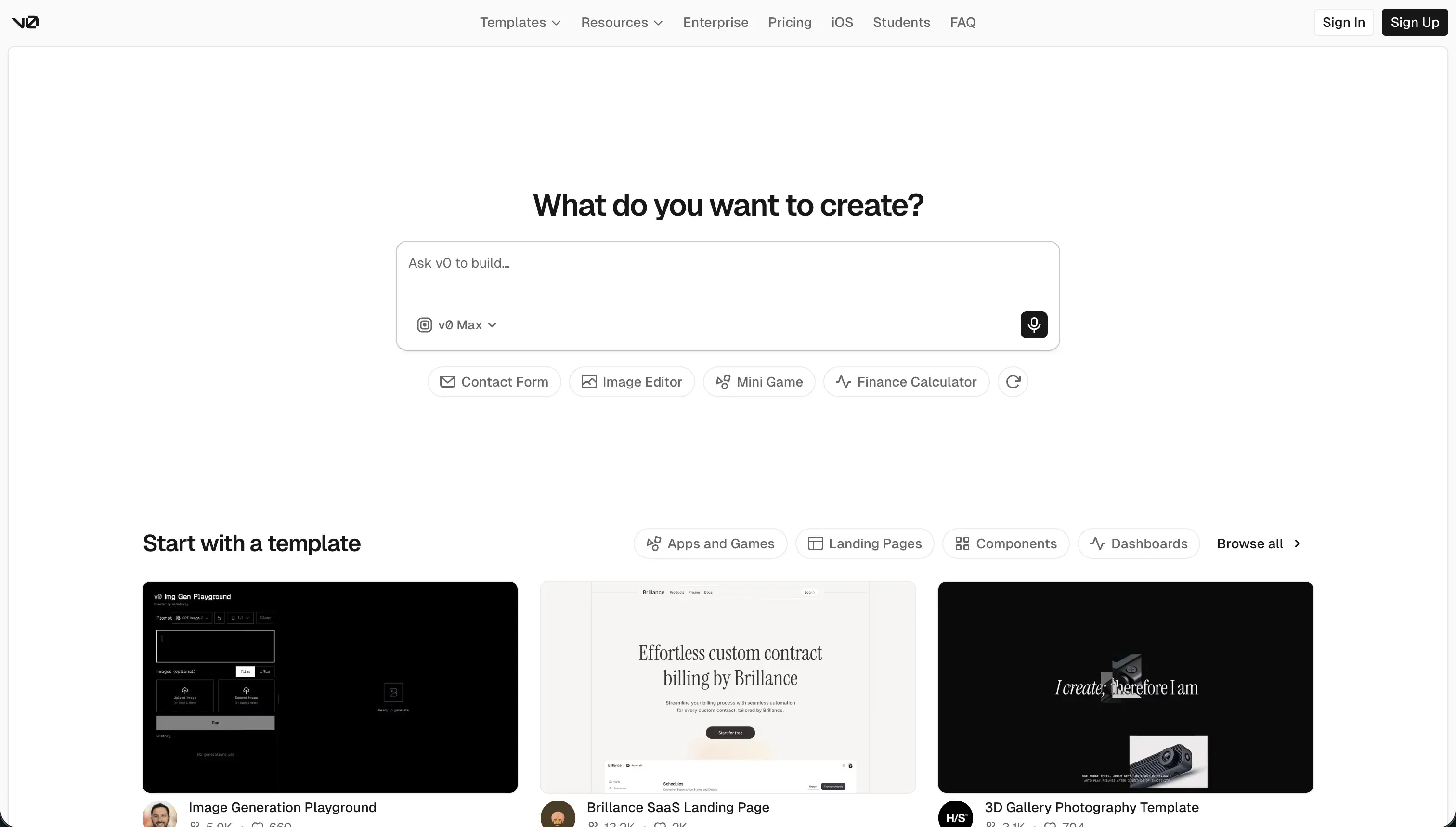

Choosing between v0 and Zite represents a fundamental choice between two distinct procurement paths.
On one side sits a high-fidelity frontend generator designed to spit out clean, inspectable React and Tailwind code; on the other is an AI-first, fully hosted no-code application builder meant to generate databases and workflows alongside interfaces.
The decision centers on whether your team can manually supply the backend infrastructure or if you require the platform to construct the database for you.
Our structured evaluation crowns v0 as the aggregate winner with a 5.8/10 score compared to Zite at 5.2/10. The frontend polish and clean exported code of v0 offer a stronger foundations for scaling and developer integration.
This outcome flips if you are a non-technical builder working alone; Zite’s all-in-one database and promptable workflow engine let you launch without a software engineer on staff.
The decision in 30 seconds
| If your priority is… | Pick | Why |
|---|---|---|
| Modern, custom-styled React and Tailwind components | v0 | v0 scores a high 8.5 on design flexibility, producing beautiful custom interfaces |
| No developer available to wire up database or backend logic | Zite | Zite automatically provisions a built-in relational SQL database from your prompt |
| A clean, inspectable codebase with no hosting lock-in | v0 | v0 syncs directly to GitHub and exports standard code |
| Multi-tenant business portals with row-level security | Neither | v0 completely lacks a backend, while Zite has basic and rigid role controls |
| Minimizing active build iteration and credit costs | Neither | Both tools rely heavily on conversational prompt-credit consumption schemes |
What each platform is
What is v0?
v0 is an AI-driven frontend prototyping and interface generation assistant built by Vercel. Rather than compiling full-stack, transactional business software, v0 restricts its generation boundary to the user interface. It translates natural-language prompts, layout sketches, or digital mockups into responsive React code styled with Tailwind CSS and structured around the shadcn/ui library components.
Because the tool is strictly frontend-focused, its native features prioritize developer workflow integration, including GitHub sync and one-click Vercel deployment pipelines. Community developers use it as an advanced digital scratchpad to bypass writing boilerplate styling.
The ideal target audience is technical teams, product designers, and founders who want to accelerate their interface design while maintaining complete programmatic control over subsequent database and logic integrations.
What is Zite?
Zite, previously known as Fillout, is an AI-first, all-in-one no-code platform designed to generate complete, run-ready business applications from natural-language descriptions. When a user submits a prompt, the platform’s generator simultaneously scaffolds a relational database, visually maps multi-step automated workflows, and constructs front-end forms and display tables.
Its key features include a spreadsheet-like built-in SQL database, staging environments, Plan Mode - where users can review and modify the AI’s markdown step plan before execution - and deep integration with mature visual form components.
The platform is designed specifically for operational managers, small business owners, and solopreneurs looking to deploy utility tools, directories, or simple portals quickly without managing servers or code repos.
- Generates responsive React, Tailwind, shadcn/ui
- Prompt, sketch or mockup as input
- GitHub sync and one-click Vercel deploy
- Database, logic and hosting left to the developer
- Built for technical teams keeping programmatic control
- One prompt scaffolds relational database, workflows and UI
- Spreadsheet-like built-in SQL database
- Plan Mode to review the AI's steps before execution
- Staging environments and visual form components
- For managers and owners shipping tools without servers
The core difference
The division between these two platforms lies on a single structural axis: whether the AI generates static front-end code or assembles an interactive hosted runtime.
- v0 acts as an AI interface designer that exports clean React code, leaving the backend and database architecture entirely in the developer’s hands.
- Zite acts as a self-contained no-code system that configures and hosts both the UI and the relational database, removing the need for external code altogether.
Where the scores diverge
Design flexibility: v0 8.5, Zite 4.5. v0 scores a dominant 8.5/10, whereas Zite scores a 4.5/10. v0 excels at using AI to turn prompts or designs into sleek shadcn/ui and Tailwind CSS layouts, although its Design Mode is largely limited to color scheme adjustments.
Zite, conversely, produces rigid, corporate-looking interfaces that are tightly coupled to the generator’s grid layouts. Moving elements or adjusting styling outside the standard layout structures is difficult and causes prompting friction.
Maintainability: v0 5.5, Zite 4.0. v0 scores a 5.5/10 while Zite drops to a 4.0/10. v0’s advantage is that its code is standard, inspectable React and TypeScript, which developers can customize locally.
It loses points because design quality drifts past 5 to 10 prompts, often bloating Tailwind code or recreating elements instead of reusing existing libraries. Zite struggles more because user updates must route through rigid prompting loops.
Changes are locked tightly to generated structures, and the total lack of GitHub sync or code export makes future code handoffs and platform migrations extremely difficult.
Security & access control: v0 4.0, Zite 5.0. Zite’s 5.0/10 edges past v0’s 4.0/10. Because v0 only outputs frontend presentation code, there is no native security or permissions layer; developers must architect, code, and deploy their own access control in a separate backend.
Zite provides basic, out-of-the-box user groups, roles, and SSO integration derived from Fillout features. It remains low on our scale because permissions rely on basic prompted workflows rather than a granular, visually configured role-level data engine.
Data & integrations: v0 5.0, Zite 5.5. Zite scores a 5.5/10 compared to v0’s 5.0/10.
Zite’s score reflects its built-in SQL database that natively supports linked records, REST API, and webhooks, though it is limited by simple connections to external tools like Google Sheets or Airtable. v0 offers outstanding developer utilities, including GitHub sync and Vercel hosting integration, but has zero native database, data-binding, or relational modeling.
Any data connection in v0 is manual development work.
Ease of build: v0 7.5, Zite 7.5. Both tools tie at 7.5/10 on this line, but they achieve their speed through different vectors. v0 is incredibly fast at generating responsive, modern frontend interfaces from code or screenshots in seconds, though it requires developer effort afterward to connect data and hosting.
Zite matches this generation speed by provisioning a complete database, interface, and starter workflows in one shot. Zite’s Fillout form roots make transactional data entry fast, while its Plan Mode provides helpful markdown guardrails before executing changes.
Production readiness: v0 4.5, Zite 4.5. Both platforms score a low 4.5/10. For v0, the deduction represents the fact that its output is not a running application; it provides no built-in database, authentication, or business logic, leaving full-stack architecture to the user.
Zite also scores 4.5 because, despite its hosting and staging environment support, the built-in database lacks advanced SQL views, formula fields, and complex roll-ups, while users report the platform feels more suited for MVPs than scaled enterprise workloads.
Cost comparison
v0’s pricing starts on a Free plan with $5 of monthly credits (roughly 7 messages per day), scaling to a Team plan at $30/user/month and a Business plan at $100/user/month. Each plan operates on a token usage-based model where inputs and outputs consume variable credits.
This means active development, complex UI debugging, or refactoring in v0 can deplete credit pools rapidly, making software costs difficult to forecast.
Zite offers a Free plan with 50 credits, a Pro plan at $19/month (100 credits), and a Business plan at $69/month (200 credits). These paid tiers allow credit package scaling to support active AI iterations, with costs climbing systematically up to $3,799/month for massive token users.
While Zite offers unlimited app users, buyers must watch for hidden workflow-run counts: because the platform counts page reloads and standard database CRUD operations as workflow executions, highly active projects can trigger unexpected limit overages.
Lock-in and the exit path
v0 provides an exceptionally clean exit pathway; its generated code belongs entirely to you, allowing you to easily sync with Git, copy the React/Tailwind TypeScript output, and host it anywhere. Zite exhibits high platform lock-in.
Because there is no GitHub sync or code-export utility, any application built within Zite’s native SQL database, workflow automation workspace, and front-end layout engine must be entirely rebuilt from scratch to migrate away from their infrastructure.
- SQL database: rebuild from scratch
- Generated React/Tailwind code is yours
- Workflow automation: rebuild from scratch
- Copy the exported TypeScript
- Front-end layout: rebuild from scratch
- Sync with Git
- No GitHub sync or code export
- Host anywhere
Who should pick v0
Pick v0 if:
- Technical teams who want to bypass writing CSS and React boilerplate when designing complex frontends
- Builders with a pre-existing backend architecture who only need polished interface wrappers and views
- Software projects requiring absolute ownership of the source code and complete freedom of hosting platforms
Do not pick v0 if you lack the software development skills required to connect databases, build backend security layers, and host an active app.
Who should pick Zite
Pick Zite if:
- Operational managers who need a simple database tool, CRM, or catalog generated in under an hour
- Non-technical teams looking to build functional internal software with zero deployment or server configuration
- Projects requiring high end-user volumes where paying standard per-seat licenses would be cost-prohibitive
Do not pick Zite if you need highly polished, brand-specific UI designs or require an exit path that includes code ownership and Git sync.
What neither platform answers
Both v0 and Zite require you to make major development tradeoffs. v0 hands you beautiful code but leaves you with the complex task of building a backend from scratch, while Zite delivers an all-in-one system wrapped in a highly rigid design canvas.
But many buyers are simply trying to build standard business software - such as a secure client portal, an internal directory, or a custom team tracker. For this class of operational software, you need advanced role-based permissions, automated workflows, and a secure relationship between your data and interface.
An AI-powered operational platform like Softr solves this ‘day two’ tension. Softr connects natively to your company’s data in Airtable or its own fast Softr Databases, and ships with secure authentication, custom user groups, and layout-responsive blocks out of the box.
Every feature the AI Co-Builder configures can be edited directly in a visual, drag-and-drop studio, giving you visual certainty and a zero-lock-in system that is ready for production on day one.
Analyst verdict
v0 wins this head-to-head on scored criteria, securing an aggregate 5.8 to Zite’s 5.2. v0 takes design flexibility with an 8.5/10 and maintains a 5.5/10 for its clean, inspectable code exports. Zite remains highly competitive on data structure with its integrated SQL database and workflow engine, but struggles with a layout engine that yields corporate, rigid designs scoring only 4.5/10.
However, the aggregate victory for v0 is strictly conditional. It remains the correct buy only if you have a developer on standby to wire up authentication and write the backend. If your team has no technical support and needs an interactive database, Zite’s 5.2 package provides the immediate, all-in-one utility needed to get a project off the ground.
Related reading: the v0 scorecard, the Zite scorecard, and our scoring methodology.