

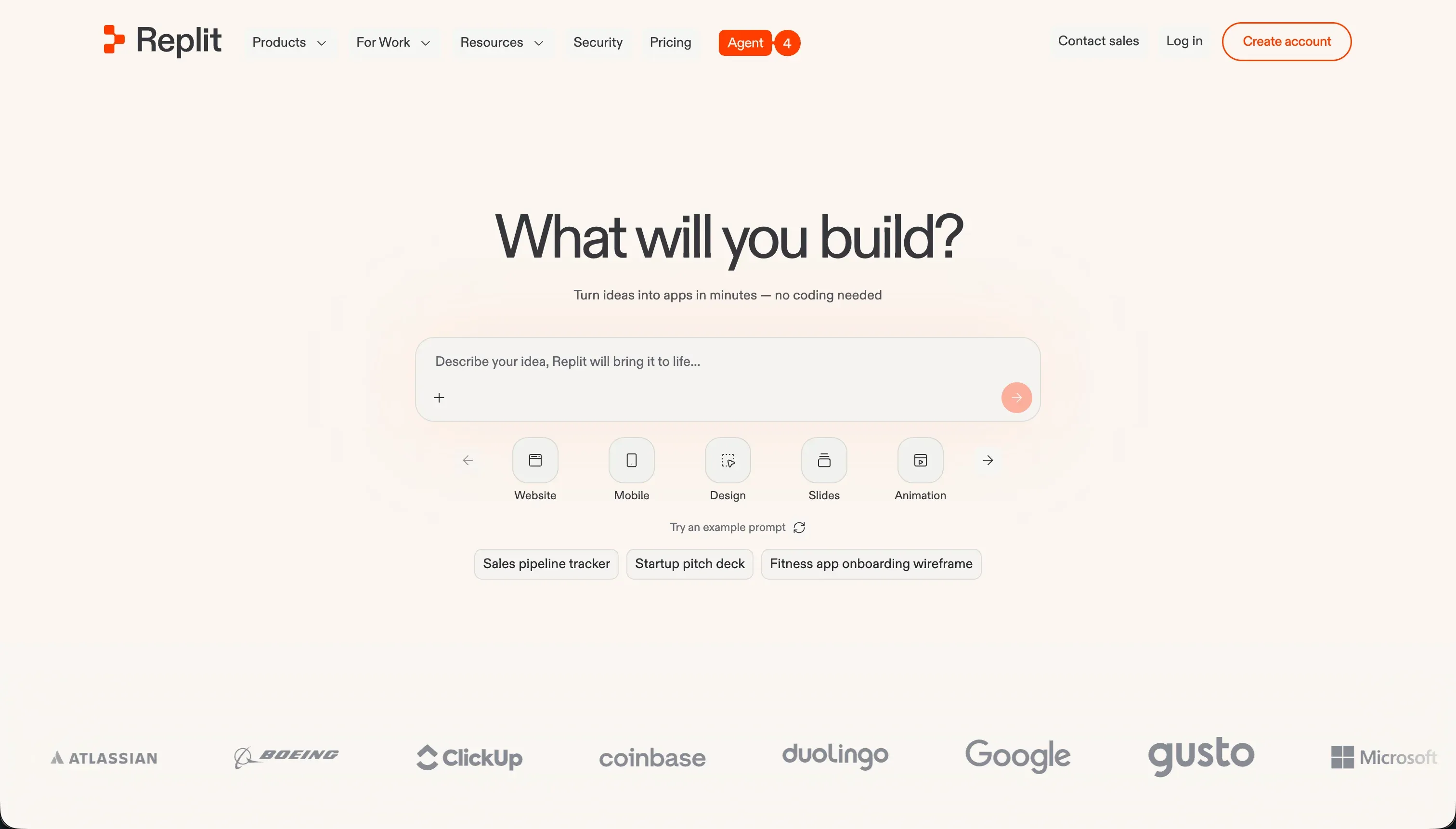

This comparison evaluates two platforms trying to solve different procurement problems in the AI-native application development space. Replit is a collaborative development environment that utilizes Replit Agent to build and host functional applications from natural language prompts.
Emergent operates as an AI-powered scaffolding engine designed to generate full-stack backend, database, and front-end architectures directly from chat inputs.
Replit wins the general application decision with an aggregate score of 7.4/10 compared to Emergent’s 5.0/10. Replit wins on five of our six evaluation criteria, leaving Emergent as the optimal choice only when the builder’s priority is a low-friction prompt-to-app skeleton that requires zero technical baseline to launch.
The decision in 30 seconds
| If your priority is… | Pick | Why |
|---|---|---|
| Professional hosting, backups, and production infrastructure | Replit | Scores 8.0 vs. Emergent’s 3.5 with managed Postgres, rollback support, and autoscaling |
| A clean, human-editable codebase without platform lock-in | Replit | Outputs real, version-controlled repository files that can be edited inside any modern IDE |
| Non-technical prototyping from a single prompt | Emergent | Scores 7.0 vs. Replit’s 6.5 by building frontend, routing, and schema in minutes |
| Low billing risk and predictable, flat software spend | Neither | Both depend on credit consumption during prompt iteration and debugging loops |
| Secure enterprise portals and custom client permissions | Neither | Security and access control must be manually verified or written into raw code |
What each platform is
What is Replit?
Replit is a browser-based collaborative development environment supporting over 50 programming languages. Through Replit Agent, builders use natural language prompts to model databases, generate complete files, install required dependencies, and launch applications.
The platform operates on a containerized infrastructure, allowing teams to collaborate in real time with shared cursors, terminals, and instant deployment.
Replit features a managed relational database layer based on PostgreSQL with rollback recovery, custom domain routing, and automated scaling parameters. It is natively built for professional developers looking to accelerate scaffolding, as well as collaborative business teams and learners who want direct access to the code-level files behind their applications.
What is Emergent?
Emergent is an AI-powered development platform that scaffolds full-stack web and mobile applications from continuous chat updates. A builder describes their software need, and the agent generates the corresponding database routing, backend schemas, and user interfaces inside a managed environment, providing immediate public preview links.
Emergent features conversational revisions for styles or copy, code container hosting, and GitHub integration. It is designed primarily for non-technical startup founders, operations managers, and rapid prototype builders looking to validate interface concepts without provisioning separate backend containers or managing hosting configurations.
The core difference
The core operational difference lies in the underlying architecture of the editing experience.
- Replit exposes a fully fleshed multi-language IDE where developers can edit, compile, and run real, version-controlled code manually or via AI assist.
- Emergent relies on abstract chat-to-code containers where edits are executed entirely by agents, shielding builders from the code at the cost of control.
Where the scores diverge
Production readiness: Replit 8.0, Emergent 3.5. Replit scores 8.0/10 with autoscaling deployments, managed PostgreSQL databases with up to 28 days of rollback support on the Pro tier, and custom domain mapping.
Emergent scores 3.5/10 due to development containers displaying stability latency and recurring ‘Error Waking Up Agent’ messages, with some users reporting blocked backend access during deployment failures alongside slow support.
Maintainability: Replit 7.5, Emergent 3.5. Replit scores 7.5/10 because it builds standard, accessible file structures that can be downloaded, versioned, or handed directly to a developer, preventing platform lock-in.
Emergent scores 3.5/10 since its edit agent fires on code changes as small as two lines, frequently triggering circular debugging loops where the AI attempts to solve bugs it introduced and undoes previous work, draining credits in the process.
Data & integrations: Replit 8.0, Emergent 5.5. Replit scores 8.0/10 as it handles managed SQL databases and allows builders to integrate any API or library that is supported by its 50+ programming languages, though database schema modifications still assume a Postgres structural baseline.
Emergent scores 5.5/10 by generating database routing automatically, but the platform suffers from documented stability challenges once data structures and codebases expand past simple skeletons.
Design flexibility: Replit 8.5, Emergent 6.0. Replit scores 8.5/10 because it supports custom React frontends, Figma imports, and arbitrary design frameworks with code-level tweak capability. Emergent scores 6.0/10, producing custom web interfaces from prompts, but the styling controls remain dependent on chat feedback loops, and mobile deployments are reported as less mature than the web canvas.
Security & access control: Replit 6.0, Emergent 4.5. Replit scores 6.0/10, making secrets management, managed database backends, and standard auth imports available, though role permissions must still live inside agent-written logic rather than an visual admin dashboard.
Emergent scores 4.5/10; while it ships with scaffolded authentication pages, permissions are generated within code blocks rather than visually configured, and container failures have caused blocked backend environments, making security verification unreliable.
Ease of build: Replit 6.5, Emergent 7.0. Emergent scores 7.0/10 because a beginner can construct a working full-stack scaffold and sample routing from a single prompt within minutes. Replit scores 6.5/10 as the Agent still assumes a basic development vocabulary to handle container settings, manage database keys, and troubleshoot environment errors in the console panel.
Cost comparison
Replit Core starts at $20/month base pricing with $25 in credits, scaling to Replit Pro at $100/month with $100 in database and agent credits, with optional tiered credit packages reaching $2,050/month for active development teams.
Emergent pricing is similarly credit-based, offering a Standard plan at $20/month for 100 credits and a Pro plan at $200/month for 750 credits, with extra credit bundles costing $10 per 50 credits.
For cost forecasting, both platforms carry high risks of unexpected overages: Replit agent iteration loops, database checkpoints, and backup sizes can cause bills to spike, while Emergent users report heavy credit consumption on minor tasks. Buyers must budget for recurring credit replenishment during intense feature debugging cycles, as both platforms treat code iteration as a consumable utility.
Lock-in and the exit path
Replit is the cleaner exit path, syncing directly with GitHub and producing standard files that can be run on any cloud platform or local developer machine.
Emergent features GitHub push capabilities on paid tiers, but because database schemas and routing logic are deeply woven into its container backend, moving an app out of Emergent requires technical decoupling and database migration.
Replit allows builders to leave with their full code asset at any moment, whereas leaving Emergent frequently leads to backend rebuilds.
- Sync repo to GitHub
- Standard files anywhere
- Run on any cloud or locally
- Push from paid tier
- Decouple schema and routing
- Migrate the database
- Rebuild the backend
Who should pick Replit
Pick Replit if:
- Technical founders and software teams who want to speed up application scaffolding but require direct terminal access and real repository files.
- Builders who require PostgreSQL databases with reliable multi-day rollbacks, custom domains, and production-grade autoscaling.
- Organizations planning a future developer handoff where AI code must be reviewed, audited, or expanded locally.
Do not pick Replit if you are non-technical and cannot parse server errors, database migration logs, or package dependency warnings when the agent runs into a compile loop.
Who should pick Emergent
Pick Emergent if:
- Non-technical founders looking to validate a startup idea by shipping a full-stack mockup with real forms in a single afternoon.
- Product managers who want a quick interface prototype with basic database routing purely to gather stakeholder design feedback.
- Solo builders seeking a very low barrier to entry for mobile and web screens without configuring container environments manually.
Do not pick Emergent for complex databases, large codebases, or applications where you cannot afford database locking, credit-draining bug loops, or variable developer support turnaround times.
What neither platform answers
Many corporate buyers reviewing this matchup do not actually need custom code files or developer terminal screens. They are trying to deploy a secure business tool, such as an internal project portal, a customer-facing CRM, or a partner database.
In these cases, Replit hands the team a container to manage, while Emergent introduces credit consumption risks and debugging loops. For these operational scenarios, a dedicated business app builder is more appropriate.
Softr scores 8.0/10 on production readiness, 7.5/10 on maintainability, and 6.0/10 on security on our scorecard precisely because authentication, row-level sharing permissions, and database operations are managed visually.
Softr supports native relational databases and has official business connectors for Stripe, HubSpot, and Google Calendar. Unlike pure custom code, Softr lets non-technical teams maintain and refine live applications visually, preventing accidental system breaks.
For specialized custom frontends requiring native mobile configurations, FlutterFlow is a stronger alternative.
Analyst verdict
Replit wins this comparison, scoring 7.4/10 over Emergent’s 5.0/10 aggregate. Replit takes production readiness, maintainability, data integration, security, and design flexibility, while Emergent takes ease of build for absolute non-programmers.
If the project requires real, scalable infrastructure backends that can survive past year one, Replit is the only viable procurement choice. Emergent remains a fast prototyping engine for early concepts but carries too much stability, support, and billing risk for running production workloads.
For business tools that require secure logins and drag-and-drop database connections, buyers should bypass both tools and explore Visual No-Code options.
Related reading: the Replit scorecard, the Emergent scorecard, and our scoring methodology.