

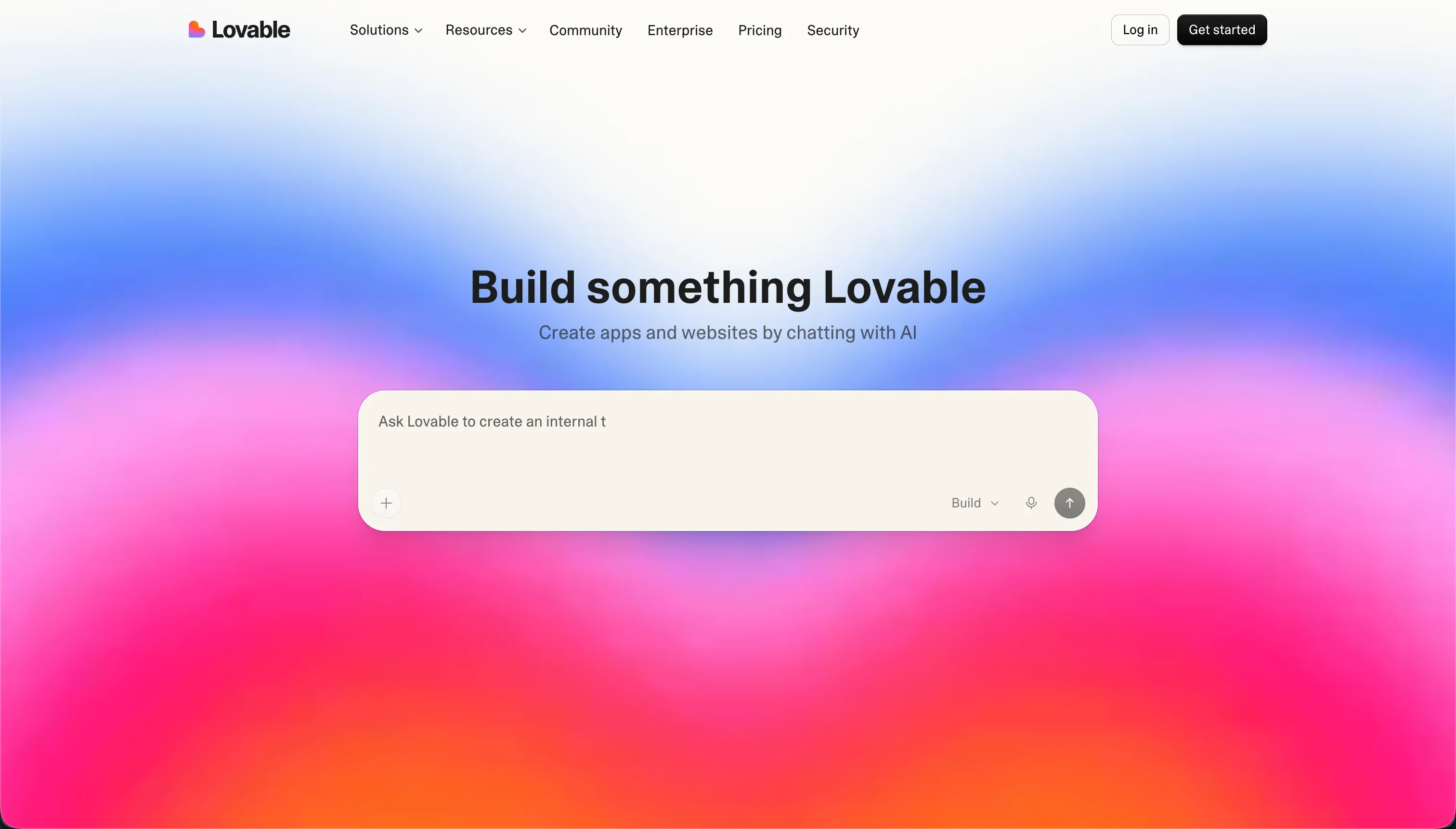
Lovable and Softr address different software procurement objectives. Lovable operates as an AI-powered full-stack application builder that turns natural language descriptions into custom React codebases, Node.js backends, and Supabase databases.
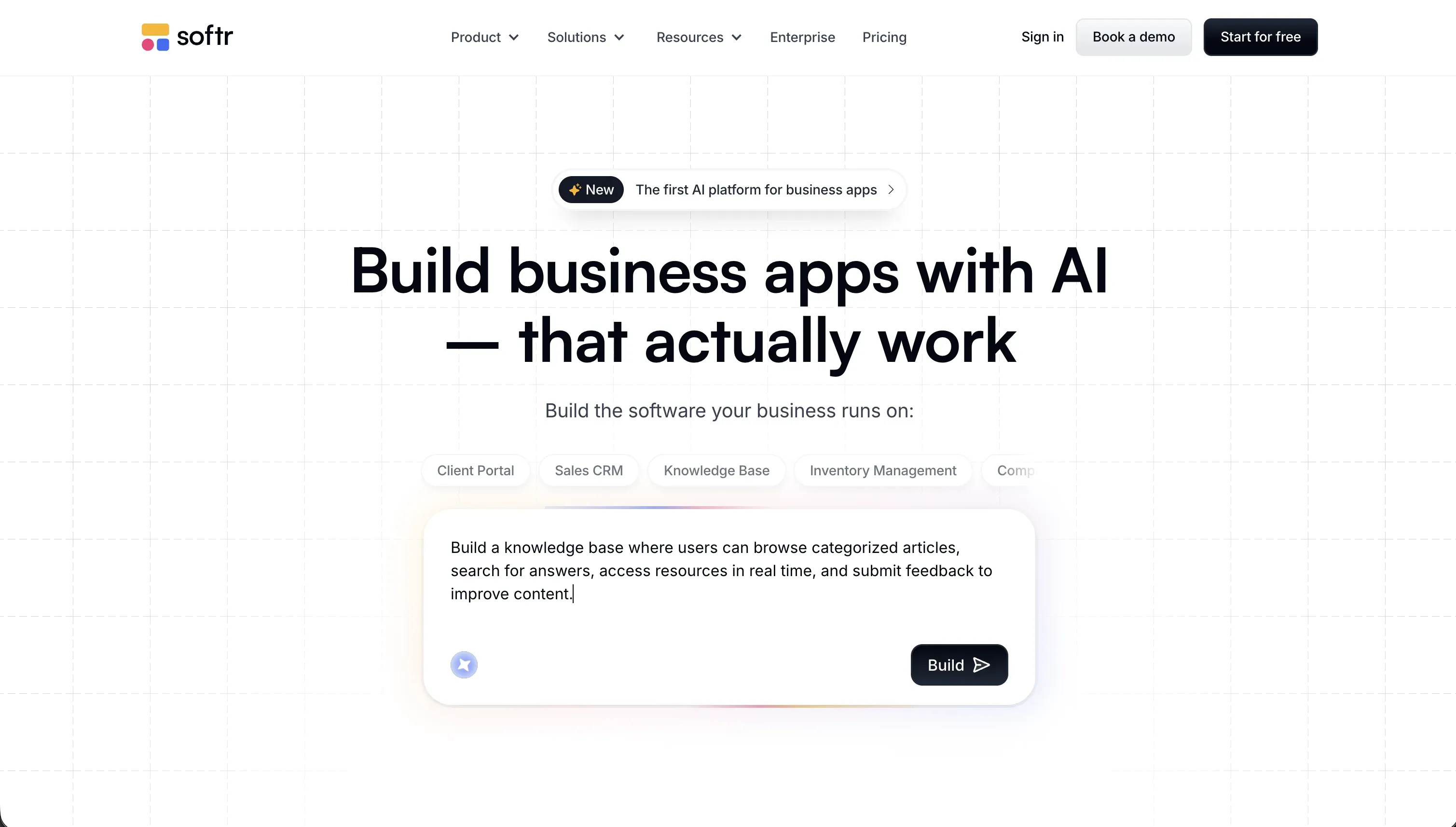
Softr is an AI-powered business application platform designed to assemble operational software such as client portals, internal tools, and CRMs over its own database or existing business data sources without managing code.
Softr wins the general business-app decision with an aggregate score of 8.1 out of 10, compared to Lovable’s 5.5. This score gap reflects the transition from raw AI generation to stable day-to-day operations. Lovable remains the appropriate choice only when the requirement is a prototype destined to be handed off to a development team for direct codebase ownership.
The decision in 30 seconds
| If your priority is… | Pick | Why |
|---|---|---|
| Portals, internal tools, or operational CRMs | Softr | Auth, roles, rows-level security, and responsive layouts are pre-built, platform-backed infrastructure rather than hallucinated code |
| Visual and pixel-level layout ceiling | Lovable | Generated React frontends can take any form described, allowing Figma import for design-led builds |
| Predictable billing without credit anxiety | Softr | Flat-rate pricing tiers mean ongoing manual visual updates never consume credits or prompt limits |
| True code ownership and GitHub synchronization | Lovable | Generates a standard React and TypeScript codebase that lives in a real git repository |
| Security auditability for client-facing apps | Neither | Sensitive client data should run on fully auditable server-side logic like Softr, whereas Lovable’s client-side Supabase configurations carry high exposure risks if un-audited by a developer |
What each platform is
What is Lovable?
Lovable is an AI-powered, full-stack application builder that operates through natural language prompts. It compiles natural language descriptions into custom React frontends, Node.js backends, and integrated Supabase databases, generating clean visual prototypes in a unified interface.
Lovable synchronizes projects directly with GitHub to let builders continue development in local IDEs or pass the code to a human engineer.
Built for founders and prototyping teams, Lovable includes capabilities like Figma design token import and pre-publish security scans. However, because application updates rely entirely on prompt-based generation, builders must interact with an AI model for every change, which can introduce regression loops where fixes reintroduce previously patched bugs.
What is Softr?
Softr is an AI no-code app builder designed specifically for operational business software. Its AI Co-Builder allows builders to describe an application and instantly generates a connected relational database, responsive page layouts, distinct user groups, and custom permissions.
Unlike code-generation platforms, Softr allows builders to transition freely between conversational prompting and direct manual editing within a visual interface.
Softr is built for business operators, COOs, and IT departments looking to run workflows like client portals, vendor hubs, and internal directories. It features native, pre-configured connectors with platforms like Stripe, HubSpot, Google Calendar, and its own high-performance local database.
It also features a secure Vibe Coding block for adding isolated custom React components without risking the stability of the core system.
The core difference
The fundamental difference lies in how they implement the transition from natural language description to operational application.
- Lovable functions as an AI developer that writes, publishes, and updates a custom frontend and database codebase on your behalf.
- Softr operates as an orchestrator that composes and configures reliable, pre-assembled visual components on a secure, managed runtime.
Where the scores diverge
Maintainability: Lovable 3.5, Softr 9.0. Softr scores 9.0 out of 10, leaving Lovable at 3.5. Lovable’s prompt-only iteration model introduces severe long-term maintenance liabilities: platform updates frequently break existing apps, and month-six builders report massive schema debt from AI-designed databases.
Softr eliminates the code maintenance layer entirely. Because there is no generated codebase to preserve, you can manually update user permissions, add fields to a native database, or rearrange layout blocks with visual certainty and zero risk of code regressions.
Security & access control: Lovable 3.5, Softr 8.5. Softr scores 8.5 out of 10, while Lovable scores 3.5. On Softr, database connections, authentication, and user permissions run entirely server-side, with visual group mappings that developers and business teams can immediately verify.
On Lovable, security depends on manually writing and auditing Row-Level Security rules inside Supabase. A non-technical builder has no reliable way to read the compiled code to verify what data is exposed to the browser, representing a critical liability for client-facing applications.
Production readiness: Lovable 4.0, Softr 8.5. Softr scores 8.5 out of 10, whereas Lovable scores 4.0. For real-world business portals, production readiness means stable user roles, secure data restriction, and platform compliance. Softr provides SOC 2 Type II compliance, European data hosting, and pre-built authentication systems out of the box.
Lovable relies on generated code that must run on custom hosting and requires manual architecture for complex business logic, creating a complexity ceiling that builders describe as a wall at the final 30% of their build.
Design flexibility: Lovable 8.0, Softr 5.5. Lovable wins this criterion with an 8.0 out of 10, while Softr scores 5.5. Because Lovable generates custom React layout templates, it can achieve highly specific and customized visual interfaces, particularly when importing designs from Figma.
Softr’s design ceiling is bounded by its structural, native business blocks. You can style fonts, colors, border radii, and custom CSS, but layouts must conform to a standardized block model unless you build custom components using the Vibe Coding block.
Ease of build: Lovable 7.5, Softr 9.0. Softr scores 9.0 out of 10, while Lovable scores 7.5. Lovable’s prompt-to-app workflow generates a working full-stack prototype exceptionally fast, but continuing the build requires constant text instruction. Softr’s AI Co-Builder sets up the first version in minutes, but then exposes direct visual controls.
You are never stuck in an iteration loop trying to explain a visual layout bug or button mapping to an AI agent, which removes prompting fatigue and speeds up the path to a finished, working layout.
Data & integrations: Lovable 6.5, Softr 8.0. Softr scores a strong 8.0, while Lovable sits at 6.5. Lovable connects natively to Supabase PostgreSQL, but expanding integrations beyond that stack requires the AI to successfully wire up custom API calls via prompt instructions.
Softr delivers its own high-performance native database along with out-of-the-box, secure connectors to Airtable, HubSpot, Stripe, and Google Sheets, though its custom SQL and REST API connectors require moving to the Business plan.
Cost comparison
The pricing models of these platforms operate on completely different economic logic. Softr operates on a predictable flat-rate plan structure, with tiers ranging from Free to Business ($329/month billed annually) that scale by defined limits like records, user groups, and active app users.
AI credits are provided for the Co-Builder, but when they run out, you are never locked out of building or editing because visual manual tools are always fully active.
Lovable’s pricing is structured around AI credit consumption tiers. Under Lovable’s model, credit consumption can inflate rapidly when you are stuck in debugging and regression loops, where every repeated instruction to patch an error burns credits. Additionally, buyers running on Lovable must budget for Lovable Cloud compute charges alongside private Supabase hosting costs once they scale beyond basic limits.
Lock-in and the exit path
Lovable provides code ownership via GitHub sync, allowing developers to export the raw React and TypeScript files, although builders report that the exported code can be bloated and difficult to port cleanly. Softr does not support interface code export; if you choose to leave the platform, the frontend layout must be recreated.
However, because Softr can connect to external backends like SQL, HubSpot, or Airtable, your business data can live completely outside the platform, allowing for an easier data migration compared to Lovable’s ‘Hotel California’ Supabase migrations.
- Export React and TypeScript via GitHub sync
- Exported code can be bloated
- Hard to port cleanly
- Data migration is painful, Supabase is Hotel California
- No interface code export
- Frontend layout must be recreated
- Data can live in SQL, HubSpot or Airtable
- Business data stays outside the platform
Who should pick Lovable
Pick Lovable if:
- Software founders who need to launch a rapid frontend SaaS prototype to prove a concept to investors
- Product teams that intend to hand the compiled React codebase over to professional developers for custom local builds
- Design-led projects that want to translate Figma visual assets into code through and AI workflow
Do not pick Lovable if you are building a long-term production business app that needs to live past 18 months without accumulating unmanageable database schema debt or breaking during platform updates.
Who should pick Softr
Pick Softr if:
- Operations managers and COOs seeking to deploy client portals, partner directories, or internal ERP modules inside of a week
- IT departments looking to give business divisions a secure, governed environment to deploy utilities without creating shadow IT risks
- Teams requiring visual access controls and row-level data security that can be verified and audited without looking at code
Do not pick Softr if your product success depends on unique consumer-grade visual layouts or if you have a non-negotiable requirement to self-host and export the compiled application code.
Where neither platform fits
If your business objective requires distributing native mobile applications through the iOS App Store or Google Play Store, neither of these platforms is the right fit. Softr runs as web applications and PWAs, while Lovable produces React web outputs. Buyers looking to compile and publish client-facing mobile experiences should evaluate FlutterFlow, which outputs native mobile codebases.
If your organization enforces strict data governance that mandates full self-hosting of the application instance alongside complete, readable source-code ownership, you should bypass both options. Instead, look to a code-first development environment like Replit.
Replit uses conversational AI to write standard software on a fully open stack that you can inspect, migrate, and export without platform constraints.
Analyst verdict
Softr wins the comparison on aggregate score, defeating Lovable 8.1 to 5.5. This difference is driven by operational realities. Softr wins four of the six criteria, establishing decisive leads in maintainability, production readiness, and security.
The platform’s block-based runtime model removes code deployment bugs, keeps user permissions visible, and ensures that non-technical operators can maintain the application for years without generating technical debt.
Lovable holds its advantage in design flexibility. By generating React layouts directly from Figma or text descriptions, it achieves visual outcomes that block-based tools cannot replicate.
However, because its iterate-by-prompt model introduces regression loops and security configuration risks inside Supabase, it is better suited for temporary visual prototypes than permanent operations. Choose Softr to run your business; choose Lovable to draft a prototype meant to be rewritten in code.
Related reading: the Lovable scorecard, the Softr scorecard, and our scoring methodology.