


The procurement path between mobile and web-based applications frequently forces a choice between native execution speed and raw generative velocity. This head-to-head separates FlutterFlow, a visual IDE designed to generate and compile native iOS and Android codebases, from Zite, an AI-first, prompt-powered web software and database builder.
FlutterFlow wins this comparison with an aggregate score of 6.3/10 against Zite’s 5.2/10. While Zite offers an aggressive conversational creation speed, FlutterFlow takes the decision by delivering the design ceiling and structural maintainability necessary to keep mobile applications alive in production.
The decision only flips to Zite for operations teams building simple, prompt-designed web portals where unlimited user seats are needed on a tight budget.
The decision in 30 seconds
| If your priority is… | Pick | Why |
|---|---|---|
| Genuinely native iOS & Android mobile apps | FlutterFlow | Compiles straight to native Dart packages with direct App Store deployment pipelines |
| Rapid database setup via conversational prompts | Zite | A single prompt generates the UI, workflows, and a relational SQL database |
| Granular design control and visual widget trees | FlutterFlow | Underpinned by a design flexibility score of 9.0/10 and complete layout control |
| A fully exportable and maintainable codebase | FlutterFlow | Enables raw Dart code export to avoid platform dependency |
| A predictable business software invoice | Neither | FlutterFlow requires manual backend setup, while Zite features hidden workflow billing and credit burn traps |
What each platform is
What is FlutterFlow?
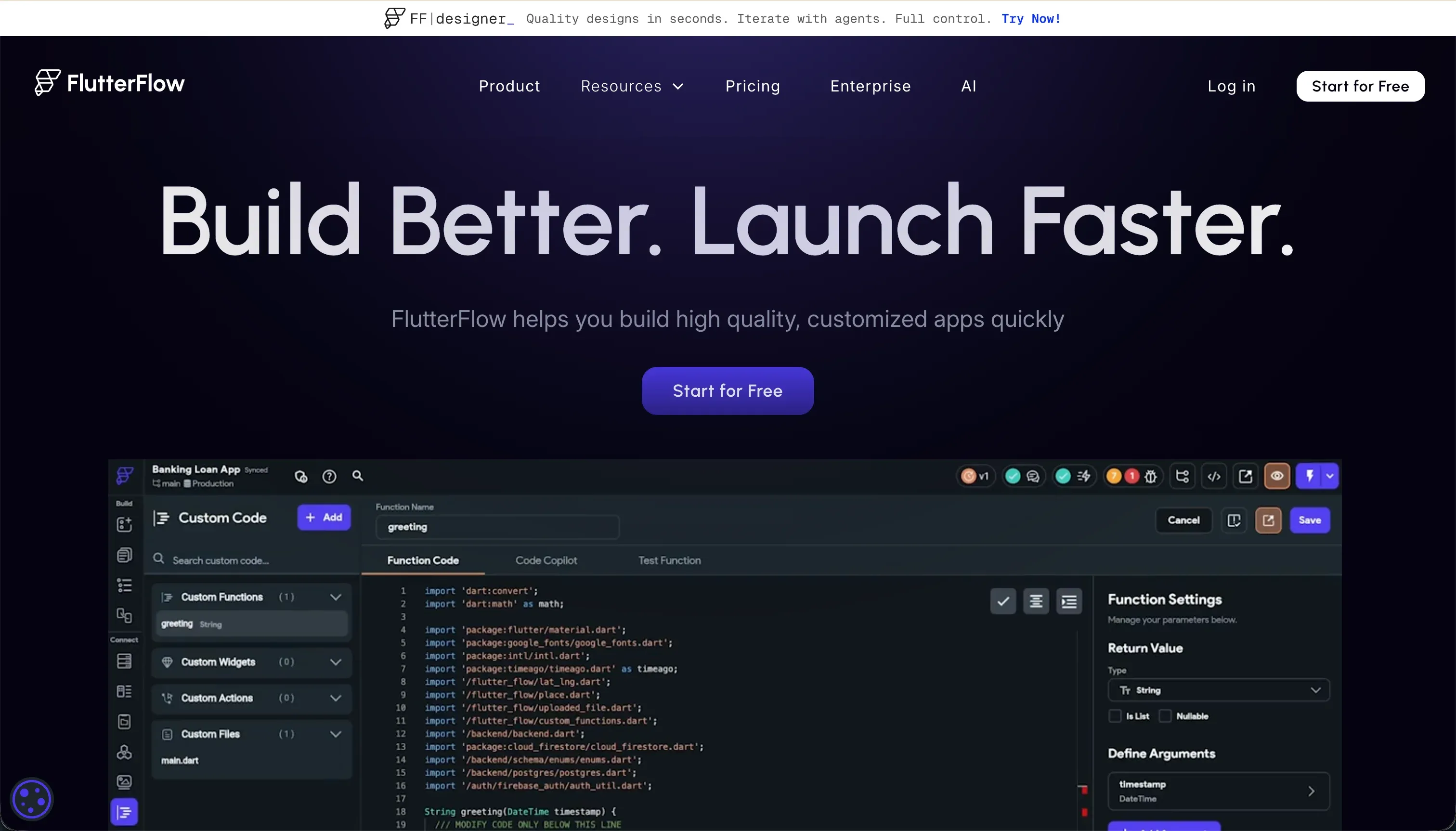
FlutterFlow is a visual development platform powered by Google’s Flutter framework. It represents interface designs as visual widget trees - incorporating containers, rows, columns, and stacks - while compiling everything into production-grade Dart source code.
Unlike basic drag-and-drop web builders, FlutterFlow requires developers to architect their layout rules, manage frontend and global states, and link external services manually.
FlutterFlow is engineered specifically for developers, agencies, and designers building cross-platform native iOS and Android applications. Key structural features include its visual action configuration editor for setting state variables and API calls, native integrations for Google Firebase and Supabase, and codeless deployment pipelines that push compiled builds straight to Apple TestFlight and Google Play.
What is Zite?
Zite, formerly known as Fillout, is an AI-first, conversational application builder designed to construct web software from text descriptions. The platform works by interpreting a single prompt to simultaneously generate dynamic user interfaces, automated backends, and a spreadsheet-like relational SQL database.
It relies heavily on conversational prompt-tuning, where builders use Chat and Plan modes to refine their layouts or correct system behaviors.
Zite is built for operations managers, business teams, and early-stage startup founders who need to launch lightweight tools without managing hosting infrastructure. Key capabilities inherited from its Fillout heritage include advanced visual form logic, native translations, multi-language support, and a built-in SQL database supporting linked records and bulk data modifications.
The core difference
The primary operational trade-off in this matchup centers on developer control versus conversational generation.
- FlutterFlow acts as a visual IDE that constructs a real, compiled mobile framework requiring structured manual setup.
- Zite functions as an AI-steered orchestration engine that converts text prompts directly into finished hosted web pages.
Where the scores diverge
Design flexibility: FlutterFlow 9.0, Zite 4.5. FlutterFlow scores a dominant 9.0/10, offering fine visual control over native mobile layers. Its canvas acts as the strongest mobile visual interface builder on the market, with Flutter Web compilation being its only weak spot due to heavy resource loading and poor search engine crawl performance.
Zite scores 4.5/10 because its frontend components are locked into rigid, generated structures. Attempting custom designs outside the AI’s templates requires exhausting prompting loops, and reviewers complain that the default output looks generic or overly corporate.
Ease of build: FlutterFlow 4.5, Zite 7.5. Zite wins this criterion cleanly with a score of 7.5/10 against FlutterFlow’s 4.5/10. Zite uses generative prompts to create databases, components, and workflows in seconds, while its helpful Plan Mode allows builders to check the AI’s markdown before committing to a credit-consuming build.
FlutterFlow has a steep learning curve that demands a developer’s mindset to navigate constraints, layout structures, and state logic. Debugging in FlutterFlow is notoriously difficult for non-engineers due to a lack of detailed visual error logging, making it hard to troubleshoot logic bugs.
Production readiness: FlutterFlow 7.0, Zite 4.5. FlutterFlow leads with a score of 7.0/10, compiled directly into native iOS and Android packages with deployment pipelines running directly to the App Stores.
However, FlutterFlow loses points because connecting authentication and setting up database rules requires manual Firebase or Supabase backend configuration.
Zite scores a low 4.5/10; while its staging environments and unlimited user tiers are strong on paper, its database lacks critical production requirements like roll-up fields, advanced analytical formula fields, or custom SQL views.
Additionally, Zite’s core billing model is highly problematic, counting standard page loads and record reads as workflow executions, which can exhaust basic limits quickly.
Maintainability: FlutterFlow 5.5, Zite 4.0. FlutterFlow’s score of 5.5/10 reflects its visual editing model, which is structured directly via widget trees and keeps a clean exit path open through Dart export.
It falls short of a higher score because its browser-based developer interface lags when draft projects grow past a dozen screens, and native Flutter logic becomes increasingly complex as features accumulate. Zite scores 4.0/10 because edits must be routed through conversational prompting loops that can easily break existing UI blocks.
Zite also creates an excessive number of workflows behind the scenes, making large workspaces hard to manage, and lacks GitHub sync or code exports, leaving builders completely dependent on its platform.
Data & integrations: FlutterFlow 6.5, Zite 5.5. FlutterFlow scores 6.5/10 due to native support for Firebase and Supabase database architectures, alongside custom REST APIs. Linking these data stores requires manually setting up database rules, authentication endpoints, and index schemas. Zite scores 5.5/10.
Its built-in SQL database handles relational structures and webhooks easily, but it is restricted to its own storage with basic, external linkages to Sheets and Airtable. It lacks the advanced calculation and formula structures needed to support heavy data operations.
Security & access control: FlutterFlow 5.0, Zite 5.0. Both tools tie at a lukewarm 5.0/10, but for opposite reasons.
FlutterFlow offers the hooks for proper security, but it provides none of the actual protection; all authentication rules, row-level database security policies, and credential variables live in the Firebase or Supabase backends and must be coded manually. Zite brings over Fillout’s secure single sign-on roots, but its logical access control is basic.
User groups and page visibility are defined by conversational workflows rather than standard visual security configurations, creating a high risk of misconfiguration if the prompting instructions are slightly off.
Cost comparison
FlutterFlow’s pricing is straightforward, starting at $22/mo for its Standard plan and $50/mo for its Pro plan (billed annually), which adds code export and direct App Store deployment. Zite is priced at $15/mo for Pro and $55/mo for Business, but its cost of ownership is highly unpredictable.
Zite scales its billing on monthly credits, meaning active development, design revisions, and chat modifications consume credits quickly.
Furthermore, Zite gates critical design elements, custom login screens, and automated schedule triggers behind its $55/mo Business tier. Combined with Zite counting record reads and page reloads as workflow actions, active apps face severe overage risks.
Budgets on Zite should be calculated based on maximum credit use, whereas FlutterFlow budgets must account for external Firebase server costs and developer time spent on setup.
Lock-in and the exit path
FlutterFlow has an exceptionally clean exit path, providing a full export of its raw Flutter (Dart) source code on its Pro plan, which allows teams to self-host or hand off the project to a traditional engineering team. Zite has complete platform lock-in: there is no codebase export, GitHub synchronization path, or server-side transfer options.
Moving away from Zite requires rebuilding the front-end layouts, logical workflows, and database tables from scratch.
- Full Dart source export on Pro
- Self-host or hand off to engineers
- Fits a traditional dev team
- No codebase export
- No GitHub sync
- No server-side transfer
- Rebuild layouts, workflows, tables from scratch
Who should pick FlutterFlow
Pick FlutterFlow if:
- Mobile-first product teams who require genuinely native iOS and Android applications published directly to the App Stores.
- Professional designers and developers who want unlimited visual control over the widget tree (9.0/10 design flexibility) without strict layout limits.
- Organizations that mandate code ownership and require a clean path to export raw source code (Pro plan) to a repository.
Do not pick FlutterFlow if your team has no technical experience with databases, layout constraints, or state management logic.
Who should pick Zite
Pick Zite if:
- Solopreneurs and small operations teams looking to build early prototypes and web directory MVPs in hours using conversational prompts.
- Builders who need to launch high-volume form-gathering web utilities relying on Fillout’s powerful conditional form structures.
- Teams that need staging environments and unlimited user collaborators on a tight budget without per-seat software fees.
Do not pick Zite if you want to export your application code, host on your own infrastructure, or build a scalable business application that requires complex relational databases.
What neither platform answers
Both FlutterFlow and Zite assume your application is the product, forcing builders choice-by-choice into either deep mobile development logic or conversational, credit-consuming prompt cycles. If you are trying to deploy a secure client portal, a vendor portal, an internal CRM, or a company intranet, both options introduce severe overhead.
FlutterFlow will hand you an steep development loop to configure raw mobile widgets, while Zite will trap you in prompting loops to get basic layouts to align while consuming workflow quotas on standard page reloads.
For operational business software, Softr represents a reliable, high-scoring alternative. Scoring 8.5 on production readiness, 9.0 on maintainability, and 8.5 on security & access control, Softr provides pre-built database connections, secure user authentication out-of-the-box, and drag-and-drop building block layouts.
This structures your software on proven enterprise infrastructure, so your security rules and page layout configurations are visually deterministic instead of being left to AI hallucination. To evaluate another low-overhead alternative, compare Glide for data-driven, device-native portal layouts.
Analyst verdict
FlutterFlow wins on aggregate, scoring 6.3/10 against Zite’s 5.2/10. By dominating design flexibility (9.0 to 4.5) and securing a clear path for production deployment (7.0 to 4.5), FlutterFlow is the only legitimate selection in this matchup for a business app intended to operate for more than a few months.
Zite holds a significant win in ease of build, but its lack of code export, rigid layout limitations, and hidden workflow consumption fees make it a risky choice for anything beyond a simple prototype.
The final choice depends on your target form factor. If your product needs to sit natively on a user’s mobile screen and you have the technical resources to configure database and authentication rules, FlutterFlow is the correct allocation. If you need a simple, single-prompt internal web portal that functions primarily as a form-capture interface and has zero scaling requirements, pick Zite.
Related reading: the FlutterFlow scorecard, the Zite scorecard, and our scoring methodology.