

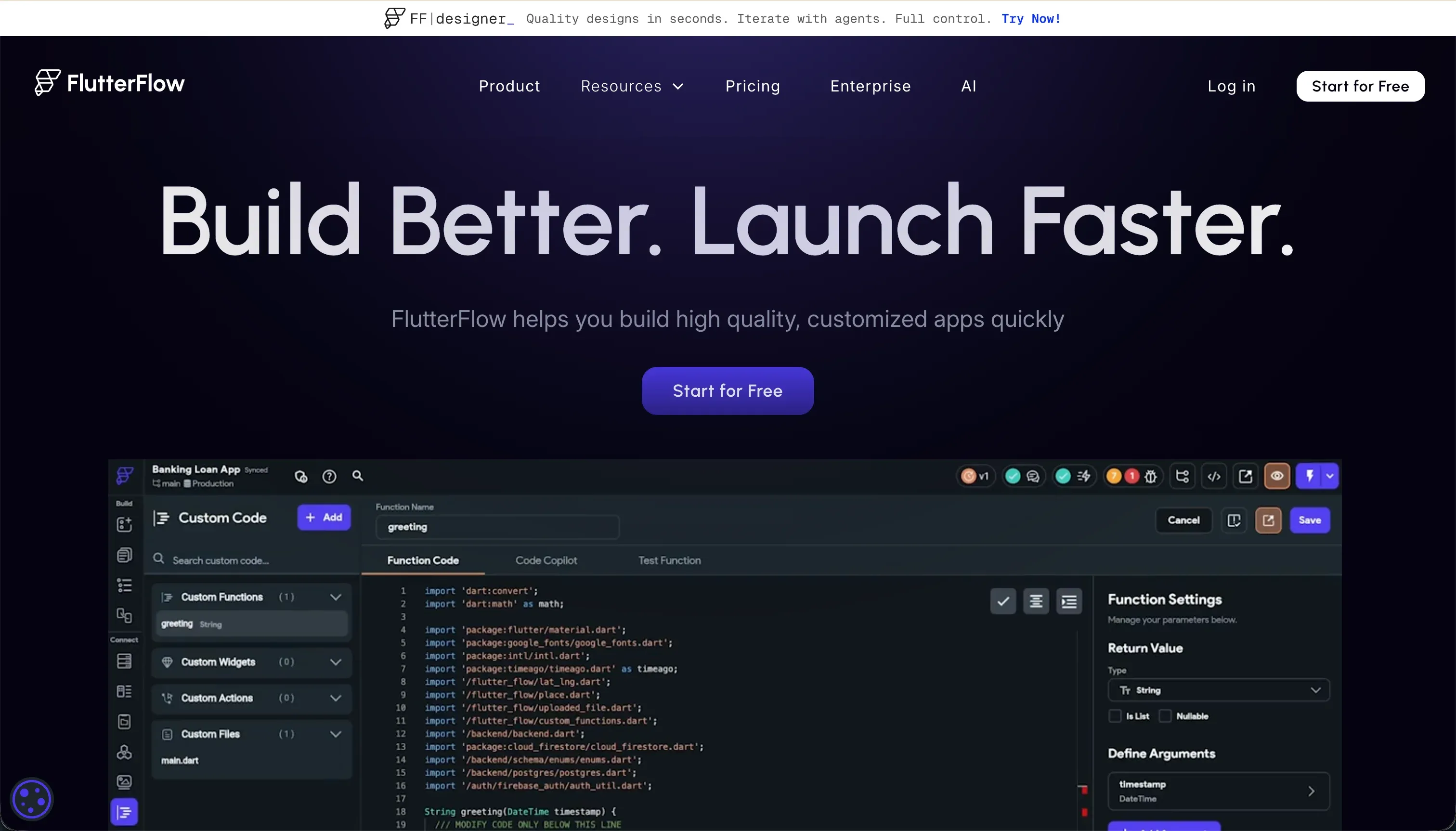
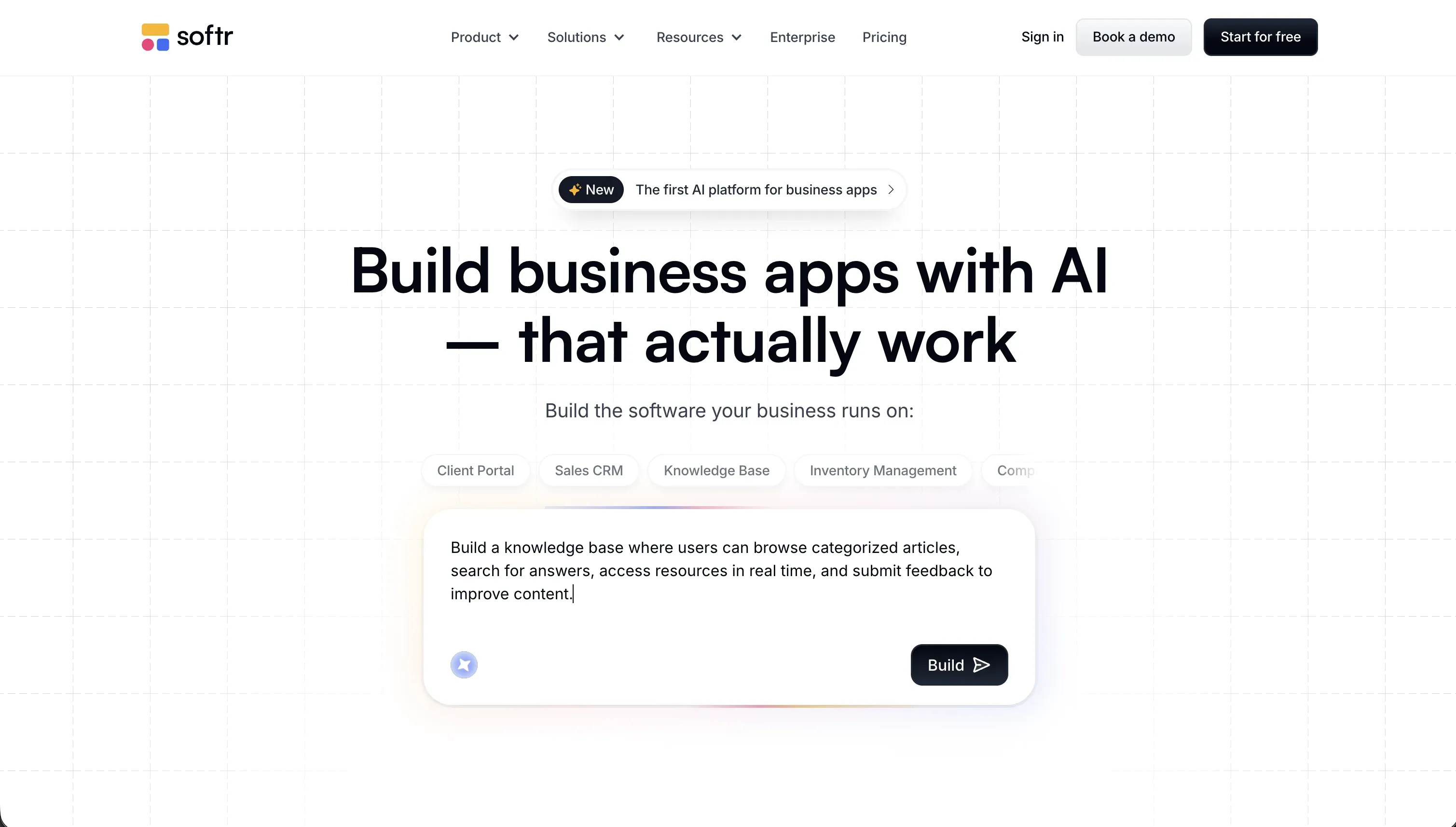
FlutterFlow and Softr address entirely different software delivery targets. FlutterFlow is a visual IDE powered by Flutter, designed to build native mobile and web interfaces with full code export. Softr is an AI app builder designed to compose secure, business-grade software like portals and internal tools without code.
Softr wins the aggregate business-app decision 8.1 to 6.3, offering pre-built login, user groups, and relational database layers standard on every plan. FlutterFlow becomes the required choice only when compiling native iOS and Android installation packages for app store distribution is a non-negotiable project constraint.
The decision in 30 seconds
| If your priority is… | Pick | Why |
|---|---|---|
| Client portals, partner directories, or internal CRMs | Softr | Its pre-built user authentication, roles, and database integrations deploy visually |
| Native iOS and Android app storefront packages | FlutterFlow | Compiles directly to Dart packages with native deployment pipelines to Google Play |
| Non-technical operational team looking to launch in hours | Softr | The AI Co-Builder generates database, roles, and pages from a single text prompt |
| Exportable source code ownership | FlutterFlow | Full Dart code export keeps a standard development path open on Pro plans |
| Pixel-level UI alignment and layout control | FlutterFlow | Visual widget-tree editing delivers absolute mobile design freedom |
| Predictable software spend and unlimited end users | Softr | Flat platform tiers include unlimited internal collaborators to build the app |
What each platform is
What is FlutterFlow?
FlutterFlow is a visual development platform that compiles screens directly to native mobile and web applications using the Flutter framework. Unlike simple layout tools, its build model utilizes a visual widget tree (Containers, Rows, Columns, and Stacks) where builders directly configure logic, state variables, and conditional action paths.
Reviewers highlight native compilation and Dart code export as key operational traits, letting developers escape platform lock-in on Standard or Pro plans. It supports native deployment pipelines to Google Play and Apple TestFlight, and is designed primarily for developers and visual designers who need native mobile performance but want to accelerate front-end delivery.
What is Softr?
Softr is an AI app builder designed to assemble operational software such as client portals, internal directories, inventory trackers, and CRMs. The building interface uses battle-tested, pre-built visual blocks (calendars, dynamic tables, forms, charts) linked directly to data sources.
Instead of writing custom logic, builders configure user groups, page routing, and visibility settings visually in a managed online studio.
Key features include its high-performance native Softr Databases, multi-step standalone forms, and an in-editor AI Co-Builder that can configure blocks and database relations in real time. It is built explicitly for business operations teams, founders, and IT departments who need to deliver secure, transactional web applications without managing servers or code repos.
The core difference
The core difference lies in whether the builder is managing visual code primitives or configuring a pre-assembled application architecture.
- FlutterFlow acts as a visual IDE for Flutter, exporting native code files that require manual assembly of backend resources and database security rules.
- Softr acts as a fully hosted business-runtime environment, providing native authentication, user permissions, and server-side CRUD handling out of the box.
Where the scores diverge
Ease of build: FlutterFlow 4.5, Softr 9.0. Softr scores 9.0 by collapsing the gap between prompting and publishing. When a buyer uses the AI Co-Builder, the platform instantly outputs linked databases, permissions, and responsive navigation tables that are manually adjustable in the editor.
FlutterFlow scores 4.5 due to a steep learning curve that requires a visual engineer to master Dart states, layout constraints, and relational database paradigms just to get a basic screen to function correctly.
Maintainability: FlutterFlow 5.5, Softr 9.0. Softr scores 9.0 because there is no generated codebase to maintain. Features are edited via native block settings, meaning an update cannot introduce broken syntax or custom dependency drift.
FlutterFlow’s 5.5 score reflects the reality of visual code trees: the local browser builder begins to experience lag past roughly a dozen mobile screens, and as state management logic expands, the overall system complexity mirrors that of a custom-coded software repository.
Security & access control: FlutterFlow 5.0, Softr 8.5. Softr scores 8.5 because password parameters, OTP logins, and magic links are standard UI toggles with server-side database CRUD protection. FlutterFlow scores 5.0 on this criterion.
While the platform provides UI hooks for security, the actual authentication rules, database row protection, and file security variables live entirely on the Firebase or Supabase instances and must be meticulously maintained there by a technical administrator.
Design flexibility: FlutterFlow 9.0, Softr 5.5. FlutterFlow achieves a 9.0 on design flexibility. It offers pixel-level visual layout editing, absolute control over custom widget structures, and native mobile container output. Softr’s 5.5 score is a transparent limitation: applications are composed of pre-built responsive blocks.
While custom CSS and its AI-powered Vibe Coding custom components offer flexibility, builders are restricted from creating freeform, non-standard visual structures.
Production readiness: FlutterFlow 7.0, Softr 8.5. Softr’s 8.5 score is anchored to its infrastructure. Authentication, user roles, row-level search restrictions, and EU hosting ship pre-built, meaning they do not consist of generated code that could break during deployment.
FlutterFlow’s 7.0 score reflects its power to push native Android APKs and iOS containers codelessly to App Stores, but it receives a deduction because authentication setups and relational database rules still require manual, external configuration in Firebase or Supabase.
Data & integrations: FlutterFlow 6.5, Softr 8.0. Softr scores 8.0 by providing a native relational database workspace along with painless connectors to 17 external services including Airtable, Google Sheets, and Notion.
FlutterFlow scores 6.5; though it natively integrates with Supabase and Firebase, building the connection requires the manual assembly of relational API frameworks and external authentication security schemas.
Cost comparison
The billing models of these platforms are structured differently. Softr charges flat monthly subscription tiers with defined limits on database rows, user count, and workspace features, which makes the monthly spend predictable even during heavy traffic periods.
The pricing starts at $49 per month billed annually for Basic, and ranges up to $269 per month for Business, with unlimited builders allowed inside the workspace.
FlutterFlow plans are billed per builder seat, starting at $22 per month for Standard and $50 per month for Pro. While subscription pricing is comparatively lower, buyers must project the external hosting bills for Firebase, Supabase, or AWS infrastructure, as well as the specialized visual developer rates required to resolve interface assembly issues in FlutterFlow’s visual IDE.
- $19/mo Basic to $329/mo Business, billed annually
- Unlimited builders in the workspace
- Defined limits on rows, users, features
- Spend stays predictable in heavy traffic
- $22/mo Standard, $50/mo Pro per builder seat
- External hosting bills for Firebase, Supabase or AWS
- Visual developer rates to fix IDE assembly issues
- Lower sticker, higher projection work
Lock-in and the exit path
FlutterFlow provides a clean exit path on its Pro plans, letting builders export standard Dart code files to continue development in any standard code editor. Softr does not support code export, meaning leaving the platform requires rebuilding the interface entirely.
However, Softr permits straightforward exports of all data from its native database and supports running visual apps directly on external databases like Airtable, maintaining clear data portability.
Who should pick FlutterFlow
Pick FlutterFlow if:
- Mobile-first product teams that require native iOS and Android distribution through the App Store and Google Play
- Teams demanding absolute pixel-level interface control and custom mobile page animations
- Visual developers who require clean Dart code export to avoid vendor lock-in
Do not pick FlutterFlow if you are building internal administrative tools or web-only client portals where database speed, automatic logins, and low maintenance matter more than native mobile app packages.
Who should pick Softr
Pick Softr if:
- Business operations teams needing to deliver functional portals, intranets, or CRMs to real clients within days
- Organizations requiring granular user group permissions that can be visually configured and tested via impersonation
- Teams seeking a single hosted subscription that provides pre-built servers, native relational storage, and SSO security
Do not pick Softr if the primary business outcome requires compiling native mobile app store packages or exporting a functional application source code repository.
Where neither platform fits
If you require true code ownership, self-hosting flexibility, and an automated generative environment that yields standard, human-readable code repositories, neither of these visual runtime platforms will fit. They both require configuring within structured visual editors to preserve deployment paths.
For teams demanding real web code ownership alongside speed, a code-native workspace such as Replit or Bubble should be shortlisted, where programmatic outputs are managed straight to developer pipelines. Alternatively, if building complex relational backend systems without visual code trees is the goal, check out Glide as an alternative.
Analyst verdict
Softr wins the aggregate comparison 8.1 to 6.3. It earns this margin by absorbing the technical complexities of authentication, role permissions, and database routing into visual platform settings. It is the more reliable choice for enterprise hubs, client portals, and Operations systems.
FlutterFlow remains the necessary platform choice for native mobile apps. Its 9.0 design flexibility score reflects its strength in crafting tailored mobile screens, but buyers must be prepared to allocate visual developer hours to manage backend configurations and design state trees.
Related reading: the FlutterFlow scorecard, the Softr scorecard, and our scoring methodology.