


The modern mobile-responsive landscape creates two very different procurement problems for technical and non-technical software buyers.
Visual development teams are deciding between FlutterFlow, a high-control visual IDE that compiles native mobile packages, and Emergent, an AI-agent platform that scaffolds full-stack web applications conversationally. These represent fundamentally opposing bets on code ownership vs. conversational generation.
FlutterFlow wins the aggregate decision 6.3 to 5.0 on our scorecard. This verdict is clear, not conditional: FlutterFlow provides predictable visual state trees and a stable compilation path, whereas Emergent’s code agent remains unstable for production runtimes. Do not buy Emergent for any application intended to survive beyond week one without a highly technical team on hand to manage container failures.
The decision in 30 seconds
| If your priority is… | Pick | Why |
|---|---|---|
| Pixel-level native mobile interface control | FlutterFlow | It secures a 9.0/10 on design flexibility with widget-level visual mapping for native iOS and Android |
| Conversational prompt-to-app scaffolding | Emergent | It scores 7.0/10 on ease of build by generating a backend schema and database routes in minutes |
| A client portal or internal business tool | Neither | Both platforms impose developer overheads; Softr provides a zero-setup alternative with visual authentication |
| Long-term codebase maintainability | FlutterFlow | It scores 5.5/10 with direct widget edits rather than exposing clients to Emergent’s infinite debugging loops |
| Codeless app store distribution pipelines | FlutterFlow | It handles native packaging and direct deployments to Google Play and Apple TestFlight cleanly |
What each platform is
What is FlutterFlow?
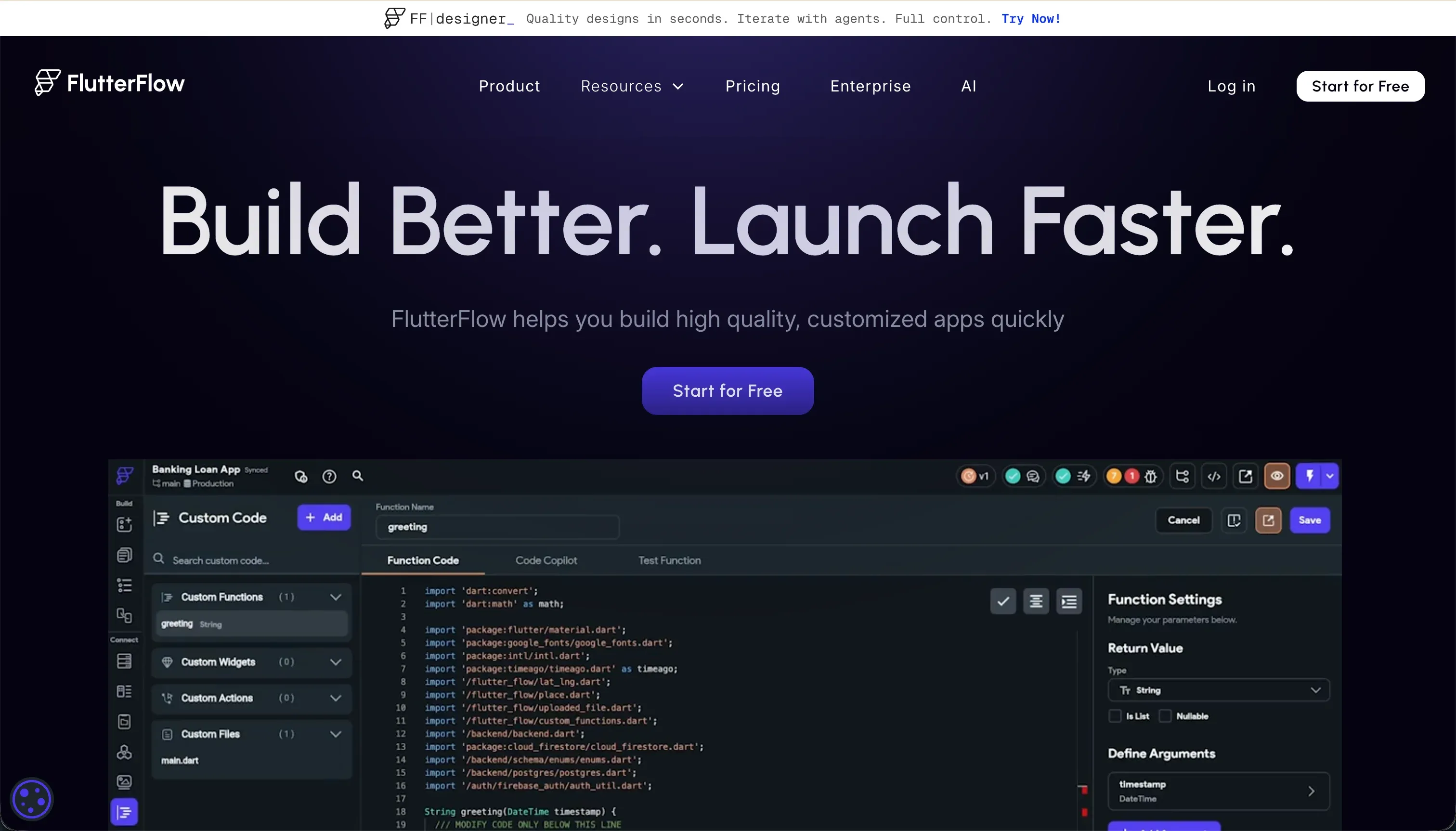
FlutterFlow is a visual IDE designed to turn drag-and-drop actions into clean, exportable Dart code. It represents app screens using a visual representation of Flutter widget trees - including Containers, Stacks, Rows, and Columns - which developers manipulate directly in the browser.
Unlike page-generation engines, it is a structural workspace engineered to streamline cross-platform mobile development.
The system integrates natively with Google Firebase and Supabase, supporting variables, custom action configurations, and visual state management. It is designed for design teams, agency developers, and technical founders who require the performance of a compiled native application without writing boilerplate frontend code from scratch.
What is Emergent?
Emergent is a full-stack, AI-agent application builder designed to convert natural language prompts into live software. Rather than supplying a visual canvas, Emergent works by deploying autonomous edit agents that generate backend schemas, implement database routing, and compose frontend React components inside sandboxed development containers.
Revisions and styling corrections are executed conversationally by interacting with a chat interface. The system is built for operations leaders and early-stage founders seeking to launch functional skeletons quickly, bypassing the setup phase of traditional hosting, routing, and database configuration.
The core difference
The primary dividing line between these platforms is the mechanism of change: visual layout assembly vs. conversational code generation.
- FlutterFlow acts as a structured visual translation layer over native Flutter layout rules, keeping developers firmly in control of the underlying widget tree.
- Emergent abstracts away the layout editor completely, utilizing autonomous agent pipelines that write and refactor full-stack code on your behalf.
Where the scores diverge
Production readiness: FlutterFlow 7.0, Emergent 3.5. FlutterFlow scores 7.0 while Emergent collapses to 3.5. FlutterFlow compiles to standard native packages and uses structured codeless pipeline hooks to deploy smoothly.
Emergent is hampered by container vulnerabilities; users frequently document a gap where the interactive preview displays successful builds while production environments block execution. Furthermore, development containers regularly throw ‘Error Waking Up Agent’ messages, making the hosting foundation unreliable.
Design flexibility: FlutterFlow 9.0, Emergent 6.0. FlutterFlow secures a dominant 9.0, while Emergent scores 6.0. FlutterFlow provides the strongest native mobile formatting ceiling on the market, matching pixel-level UI requirements with native Android/iOS styling. Its only weakness is that its public web output loads heavily.
Emergent has a decent core web generation capability, but its native mobile deployments are described as less mature and unfinished.
Ease of build: FlutterFlow 4.5, Emergent 7.0. Emergent holds its only direct match winning score here at 7.0, outperforming FlutterFlow’s 4.5. Emergent allows non-technical users to write a single paragraph and watch a functional full-stack web skeleton spin up in minutes.
FlutterFlow, by contrast, enforces a steep, developer-style learning curve that demands a prior understanding of Flutter layout logic, relational state management, and manual configuration of backend services in Firebase or Supabase.
Maintainability: FlutterFlow 5.5, Emergent 3.5. FlutterFlow’s 5.5 outclasses Emergent’s 3.5 on day-two reliability. FlutterFlow allows deep, direct, visual widget tree editing and supports structured git versioning. Emergent relies entirely on an edit agent that fires on modifications as tiny as two lines of code.
This agent-driven refactoring often fails, creating infinite debugging loops where the system claims to fix a single bug five or more times while progressively degrading application quality and exhausting builder budgets.
Data & integrations: FlutterFlow 6.5, Emergent 5.5. FlutterFlow scores 6.5, leading Emergent’s 5.5. FlutterFlow has native SDK drivers for Supabase and Google Firebase, although setting up permissions requires developer knowledge.
Emergent is impressive initially because the AI creates database routing and API plumbing out of a text prompt, but the database architecture degrades and breaks down once a codebase becomes reasonably large.
Security & access control: FlutterFlow 5.0, Emergent 4.5. FlutterFlow secures a 5.0, while Emergent scores 4.5. Both platforms push security tasks back to the builder, but they present different threat profiles. FlutterFlow provides safe connection hooks, but database rules and authentication configurations must be manually set up on external servers.
Emergent generates permissions abstractly within the code, making audit verification difficult; this is further complicated by users reporting blocked backend access during container failures.
Cost comparison
The billing models of these two platforms are fundamentally different. FlutterFlow pricing is flat and highly predictable, starting at $22/month for custom domain hosting, with code export unlocking on the Pro plan at $50/month. Because it runs locally and relies on flat pricing structures, developers can build indefinitely without worrying about unexpected subscription shifts.
Emergent operates on an unpredictable, agentic credit-burn model starting at $20/month. Every single conversational edit, prompt, or automated bug-fixing loop consumes AI credits.
Because the edit agent frequently struggles to fix bugs, custom software builds can become incredibly expensive; multiple users have reported credits being consumed rapidly to resolve platform-generated bugs, with one founder spending close to $10,000 AUD on repeated iterations.
Lock-in and the exit path
The escape paths are incredibly uneven. FlutterFlow scores high on data portability; users can export complete, clean Dart code on Standard and Pro tiers, taking their codebase to any local editor without platform lock-in.
Emergent supports a basic GitHub sync on paid tiers, but because the full-stack architecture is generated as a custom, undocumented monolith, porting the code elsewhere requires a substantial developer rewrite. FlutterFlow has the cleaner exit path.
- Clean Dart code export
- Standard and Pro tiers
- Runs in any local editor
- No platform lock-in
- Basic GitHub sync
- Paid tiers only
- Undocumented monolith
- Substantial rewrite to port
Who should pick FlutterFlow
Pick FlutterFlow if:
- Mobile-first design teams who require visual control over native iOS and Android widget structures without coding the frontend by hand
- Developers planning an exit path where they need to export production-ready Dart code for custom hosting
- Agencies that require predictable, flat software subscriptions during long design and development phases
Do not pick FlutterFlow if your project requires a public, fast-loading, SEO-indexed web application as the primary customer interface.
Who should pick Emergent
Pick Emergent if:
- Non-technical founders looking to build a conversational, full-stack concept prototype in under an hour
- Operations leads needing quick, disposable web forms connected to simple backend routers to test internal ideas
- Teams comfortable with conversational refactoring who have access to a developer to audit resulting code
Do not pick Emergent if you cannot afford developer time or if you have a tight, unyielding cash budget that cannot tolerate unpredictable credit overages.
What neither platform answers
Both options are engineering-heavy paths: FlutterFlow is a specialized visual IDE that requires you to understand database architectures and widget hierarchies, and Emergent is an unstable AI playground that forces you to manage buggy, generated codebases.
Most business users are not trying to ship a custom mobile OS package or a conversational code experiment. Instead, they are trying to deploy standard operational tools: secure client portals, internal team dashboards, or customer CRMs defined by ironclad logins and permissions.
For this class of software, Softr is the superior, highly rated purchase. Softr scores 8.5 on production readiness, 9.0 on maintainability, and 8.5 on security precisely because authentication, user groups, and layout responsiveness are handled by secure, native blocks, rather than visual widgets or generated code.
Softr allows teams to assemble secure databases and custom interfaces in hours using its native Softr Databases or Airtable, avoiding the technical debt of both compared platforms. Teams looking to establish professional, secure client environments should choose Softr for portals, or Retool if they require raw SQL database interfaces.
Analyst verdict
FlutterFlow wins this comparison with an aggregate score of 6.3/10, while Emergent struggles with an aggregate score of 5.0/10. FlutterFlow claims every major category, winning on production readiness (7.0 vs. 3.5), maintainability (5.5 vs. 3.5), security (5.0 vs. 4.5), data depth (6.5 vs. 5.5), and design flexibility (9.0 vs. 6.0). Emergent’s only win on our scorecard is in ease of build (7.0 vs. 4.5).
The choice between these platforms comes down to a simple trade-off. Choose FlutterFlow if you are building an actual mobile product that needs to be hosted on the Apple App Store or Google Play Store and you want to maintain a clean code export path. Pick Emergent only if your timeline is measured in days, your objective is a pre-production web prototype, and you are prepared to manage unstable hosting containers.
Related reading: the FlutterFlow scorecard, the Emergent scorecard, and our scoring methodology.