

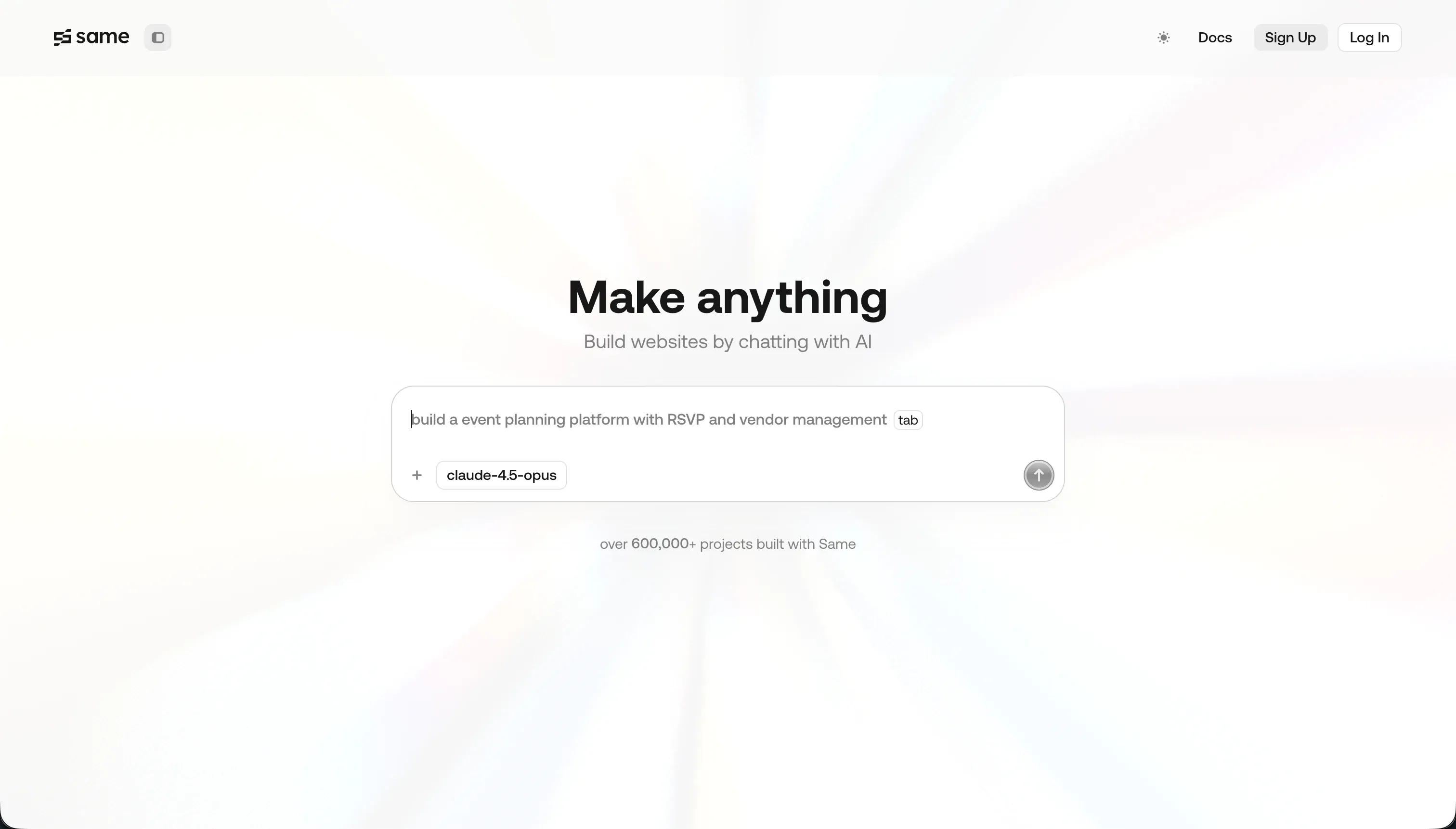
Emergent and Same.new solve 2 different procurement problems: Emergent is an AI full-stack app generator, while Same.new is an AI frontend cloning and prototyping tool. One is bought to stand up a working application skeleton with backend and data included. The other is bought to copy and iterate on UI patterns from an existing site as React code.
Emergent wins the general decision at 5.0/10 versus 4.1/10 because it covers more of the application stack and scores better on the operational criteria that matter after the demo. Same.new only takes the matchup when your team already has backend plans settled and needs the fastest route to a cloned visual frontend. That is the 1 condition that flips the recommendation.
The decision in 30 seconds
| If your priority is… | Pick | Why |
|---|---|---|
| Scaffolding a full app with frontend, backend, and database from one prompt | Emergent | Its 7.0/10 ease of build comes from generating data models and app structure together |
| Cloning the look of an existing website into React quickly | Same.new | It wins design flexibility at 6.5/10 through URL-based visual cloning |
| Secure client portals, internal tools, or CRMs | Neither | Both score poorly on production readiness and maintainability for long-lived operational software |
| Built-in auth and data handling without wiring everything manually | Emergent | Same.new has no native backend or roles, while Emergent at least scaffolds auth and data |
| Predictable editing without AI loops burning time or credits | Neither | Users report destructive revisions in Same.new and repetitive debugging loops in Emergent |
What each platform is
What is Emergent?
Emergent is an AI full-stack app generation platform that turns prompts into a working application skeleton. Its build model is conversational: you describe the product, and the system scaffolds frontend code, backend logic, database structure, and a hosted development environment around that prompt.
The platform is documented as generating authentication, database routing, and live preview deployments, with changes made through follow-up prompts rather than manual setup first. It is genuinely built for founders, operators, and developers who want to stand up an early web app concept quickly and are willing to accept AI-generated code and platform instability during iteration.
What is Same.new?
Same.new is an AI frontend cloning tool that recreates the look of an existing website and outputs editable React code. Its build model starts from a URL or visual reference, then uses conversational edits to reshape the generated frontend inside a sandbox rather than building a full application stack.
The product is documented around React and Tailwind output, local code export, and visual cloning of typography, spacing, and layouts from live sites. It is genuinely built for designers and frontend engineers who need a fast visual starting point and already expect to supply their own backend, auth, and production architecture elsewhere.
The core difference
The biggest divide is full-stack generation versus frontend replication. Emergent tries to assemble a runnable app system, while Same.new is mainly a fast way to copy and reshape UI code.
- Emergent is defined by generating a coordinated app scaffold that includes interface, backend behavior, and database structure in one workflow.
- Same.new is defined by copying visual frontend patterns into React and Tailwind without owning the backend problem at all.
Where the scores diverge
Ease of build: Emergent 7.0, Same.new 5.0. Emergent pulls ahead because a single prompt can produce more of the stack at once, including data structure and app logic instead of only screens. That makes early assembly faster when the buyer is starting from a blank sheet.
The score is still capped because users report agent wake-up failures and debugging loops that interrupt otherwise simple edits. Same.new is easier only for narrow visual work, not for getting a real application standing end to end.
Security & access control: Emergent 4.5, Same.new 3.0. Emergent wins because it at least scaffolds authentication and gives buyers a starting point for protected app behavior. The deduction remains meaningful because access control is still generated by AI, not managed through a mature permission model buyers can audit visually.
Same.new trails because it has no native auth, roles, or permission system and expects builders to bolt those on elsewhere. For teams handling sensitive data, that absence is a material limitation.
Data & integrations: Emergent 5.5, Same.new 4.0. Emergent’s advantage comes from treating data as part of the app build rather than an external concern. It can generate schemas and wire frontend flows to them, which is a major difference from a tool that only clones screens.
The score is not elite because larger or more complex projects reportedly strain the platform and reduce reliability. Same.new effectively stops at the UI layer, so real data work must be designed and integrated outside the product.
Production readiness: Emergent 3.5, Same.new 3.0. This is a weak area for both tools, so the criterion explains caution more than confidence. Emergent at least attempts a hosted app workflow, but reports of broken containers, deployment mismatches, and blocked access keep it from scoring like a dependable production platform.
Same.new sits lower because it is fundamentally a frontend sandbox and leaves core operational layers to the buyer. Even where the gap exists, neither score makes this matchup a strong answer for mission-critical software.
Maintainability: Emergent 3.5, Same.new 3.0. The divergence is small because both products create upkeep risk in different ways. Emergent can over-edit, trigger repeated fix cycles, and consume time or credits chasing the same issue, which makes later changes unpredictable.
Same.new also fares poorly because users report prompts that can wipe or damage working interface code during seemingly minor changes. Since both workflows depend heavily on AI rewriting generated output, this criterion does not rescue either option.
Design flexibility: Emergent 6.0, Same.new 6.5. Same.new keeps this criterion because visual copying is its core strength, and URL-based cloning gets teams to a styled React starting point quickly. That said, the score is not near-perfect because revisions can still be brittle and more complex structures may need manual cleanup.
Emergent loses here because its value is broader app assembly, not precise frontend craft, and its mobile and visual workflows are less mature. This is the one lane where the narrower tool is the better fit.
Cost comparison
The pricing models differ in the way spend moves. Emergent uses credit-based subscriptions from $20 to $200 per month, so the bill is driven by how often the AI edits, retries, and debugs your app. Same.new moved from pay-as-you-go pricing of $10 per 2 million tokens to fixed-tier plans, so its model is more frontend-session oriented and less about paying for a whole hosted app stack.
The hidden costs are less about sticker price than about iteration waste. With Emergent, forecast builder time spent managing loops, failed edits, overages, and eventual rebuild work if the generated stack becomes unstable.
With Same.new, forecast cleanup time after destructive revisions, extra spend on whatever backend or auth stack you pair with it, and migration work when the cloned frontend has to be hardened outside the tool.
Lock-in and the exit path
Same.new has the cleaner exit because it exports React and Tailwind code that can be taken into a local development workflow, even if the rest of the system still has to be built elsewhere.
Emergent’s exit is murkier: the hosted full-stack environment, generated backend behavior, and internal routing may get you started faster, but leaving means rebuilding and re-verifying much of that application logic outside the platform.
In plain terms, Same.new lets you take the frontend with you; Emergent leaves more of the important system to be recreated.
- Exports React and Tailwind code
- Code fits a local dev workflow
- Rest of the system still built elsewhere
- Hosted full-stack environment
- Generated backend behavior is tied in
- Internal routing must be replaced
- Rebuilding means re-verifying app logic
Who should pick Emergent
Pick Emergent if:
- Founders who need a fast proof of concept with UI, backend, and data scaffolding in one prompt-driven workflow
- Teams comparing ideas quickly and willing to trade reliability for broader stack coverage and a 7.0/10 ease-of-build score
- Builders who need a starting point for auth and database structure rather than a frontend-only mockup
Do not pick Emergent if you need dependable production operations, predictable maintenance, or a tool that will not burn credits and time in repeated AI repair loops.
Who should pick Same.new
Pick Same.new if:
- Frontend engineers who want to clone an existing site’s look into React and Tailwind as fast as possible
- Design teams that already have backend ownership elsewhere and only need a visual scaffold to hand off
- Buyers whose top priority is the matchup’s best design flexibility score, not full application depth
Do not pick Same.new if the product needs built-in authentication, database modeling, access control, or any credible path to shipping a complete app from the platform alone.
What neither platform answers
Many buyers reading this matchup do not actually need an AI code generator or a frontend cloner. They need a business app: a client portal, internal tool, CRM, or operations system defined by logins, permissions, data views, and low maintenance after launch.
In that lane, Softr is the more sensible recommendation because its research scores are materially stronger on production readiness, maintainability, and security & access control, and those are the criteria that decide whether a business app survives real use.
Choose Softr when the requirement is a secure, low-maintenance business application with user groups and operational workflows rather than generated code. Pair that with Replit for the opposite case: teams that must own code and accept more engineering responsibility in exchange for a cleaner self-managed path.
That split is more honest than forcing either Emergent or Same.new into jobs they are not built to handle.
Analyst verdict
Emergent wins 5.0 to 4.1 on aggregate. It takes Ease of build, Production readiness, Maintainability, Security & access control, and Data & integrations, while Same.new keeps Design flexibility.
That does not make Emergent a blanket endorsement. Its lead comes from covering more of the stack, not from being especially mature, and the low overall scores still signal meaningful risk around reliability and upkeep.
The decision flips only when the job is specifically to clone and tweak a frontend fast, especially if your backend plan already exists. In that one case, Same.new’s 6.5/10 Design flexibility score is the criterion that matters more than Emergent’s broader but shakier app-generation advantage.
Related reading: the Emergent scorecard, the Same.new scorecard, and our scoring methodology.