




What HR Teams Actually Need in an App Platform
HR software has a different job from a marketing site or lightweight client portal. It needs to manage employee records, internal approvals, onboarding steps, policy acknowledgements, document collection, and manager-only workflows without exposing private information.
In practice, that means an HR app builder must be strong at permissions first, then usable enough that operations staff can keep the system current without waiting on engineers for every small change.
Our first criterion is security and access control. HR teams need reliable authentication, role-based visibility, and ideally row-level restrictions so employees only see their own records while managers or HR admins see broader datasets. Second is production readiness.
A platform should support stable login flows, password recovery, domain setup, and the practical features that make an internal app usable on day one.
Third is maintainability. HR processes change often, so the builder has to make edits to forms, workflows, and approval steps easy to deploy without creating fragile logic.
Fourth is data and integrations. Most HR teams already store information in spreadsheets, Airtable, HRIS tools, or SQL databases, so the chosen platform should connect cleanly to those systems and preserve relationships between employees, departments, managers, and requests. Fifth is ease of build.
A strong HR app platform should let a small operations team launch an onboarding tracker, policy hub, or internal directory quickly. Sixth is design flexibility. This matters, but it is less important than safety and clarity. HR apps do not need extreme visual freedom if the result is harder governance or weaker access control.
That framework favors platforms that can securely publish internal portals, employee self-service tools, and approval flows while remaining manageable over time. The best options below score well not because they are the flashiest builders, but because they reduce the risk of data exposure and workflow sprawl in real HR operations.
The use-case comparison
| Platform | Overall | Advantage | Main reason to exclude it |
|---|---|---|---|
| Softr | 8.1 | Strong built-in auth, user groups, and row-level data visibility for internal portals | Layout freedom is limited compared with more open visual builders |
| Glide | 6.3 | Very fast mobile-friendly app creation from sheets and simple data sources | Per-user pricing and lighter permissions make it weaker for sensitive HR use cases |
| Airtable | 6.3 | Excellent relational data model for personnel records and workflow tracking | Native interfaces and permissions are not ideal for broad employee self-service |
| Retool | 6.8 | Powerful direct integrations with SQL, APIs, and enterprise systems | Requires technical skills and is not well suited to non-technical HR ownership |
| Bubble | 6.8 | Highly flexible UI and workflow engine for bespoke HR applications | Complex apps become harder to govern, maintain, and migrate |
| Replit | 7.4 | AI-assisted full-stack development with exportable code and infrastructure control | You still need developers to secure, debug, and maintain the codebase |
1. Softr - best overall for employee portals and internal HR apps
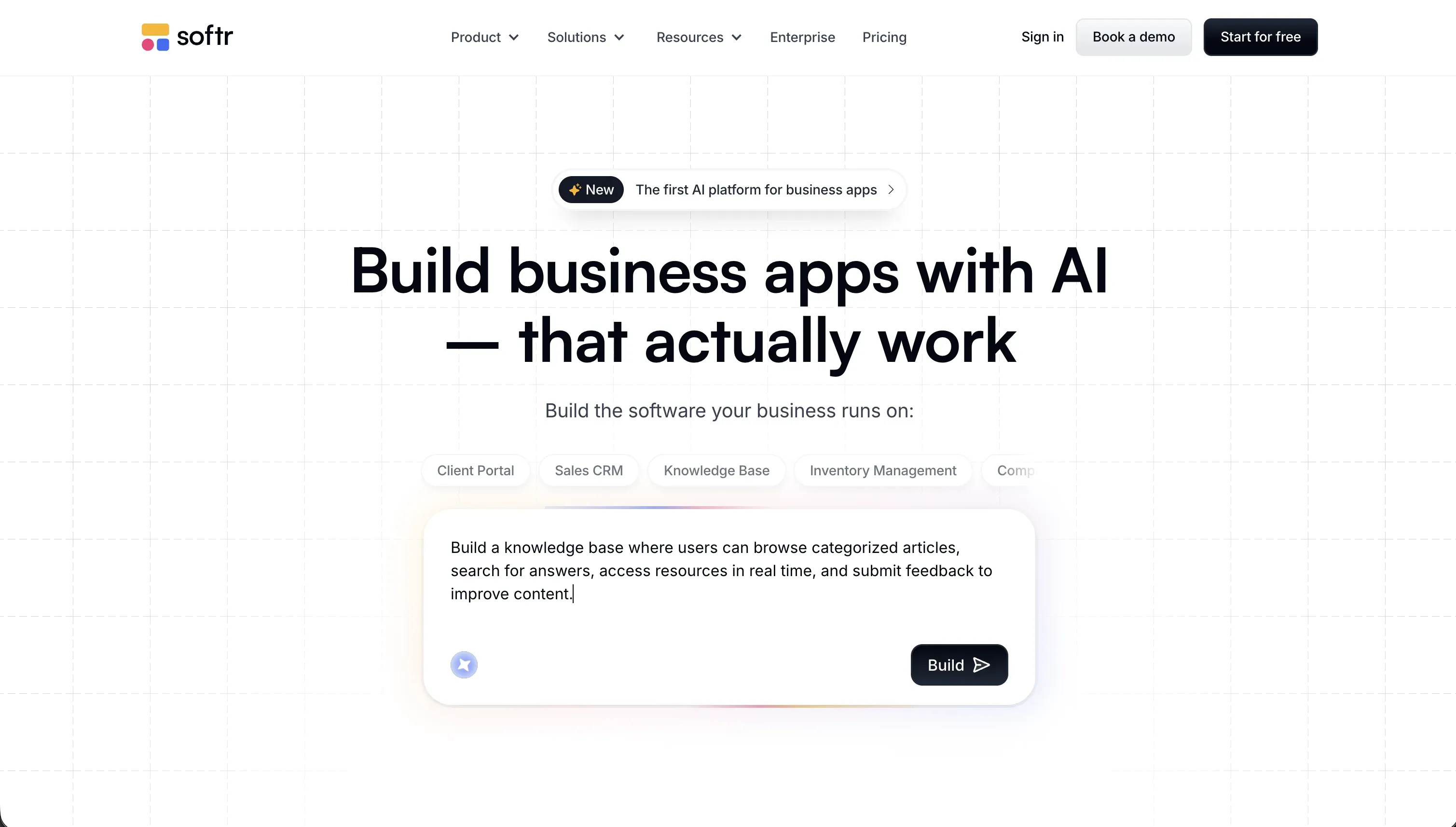 Softr homepage snapshot
Softr is the best fit for most HR teams because it aligns closely with the practical needs of internal people operations. Its strongest area is security and access control, where it scores 8.5 thanks to built-in authentication, user groups, and row-level visibility rules.
That matters for apps like employee directories, onboarding hubs, benefits information portals, and manager review workflows, where different users must see different records. It also scores 9.0 for maintainability because HR teams can update forms, pages, and content without touching code.
Softr is especially effective when Airtable or Google Sheets already hold the underlying data. HR staff can ship useful tools quickly while keeping governance understandable for future admins. Production readiness is also strong because login, domain, and user management flows are already part of the product rather than something the team has to design from scratch.
The main exclusion is design freedom. Softr’s design flexibility is closer to 5.5 than to the top tier, so teams that need completely custom interfaces or unusual workflow patterns may find its block system restrictive. If your project is a highly bespoke HR system with unusual UI requirements, Bubble or a coded stack may be a better fit.
2. Glide - best for simple workforce tools and mobile-first HR utilities
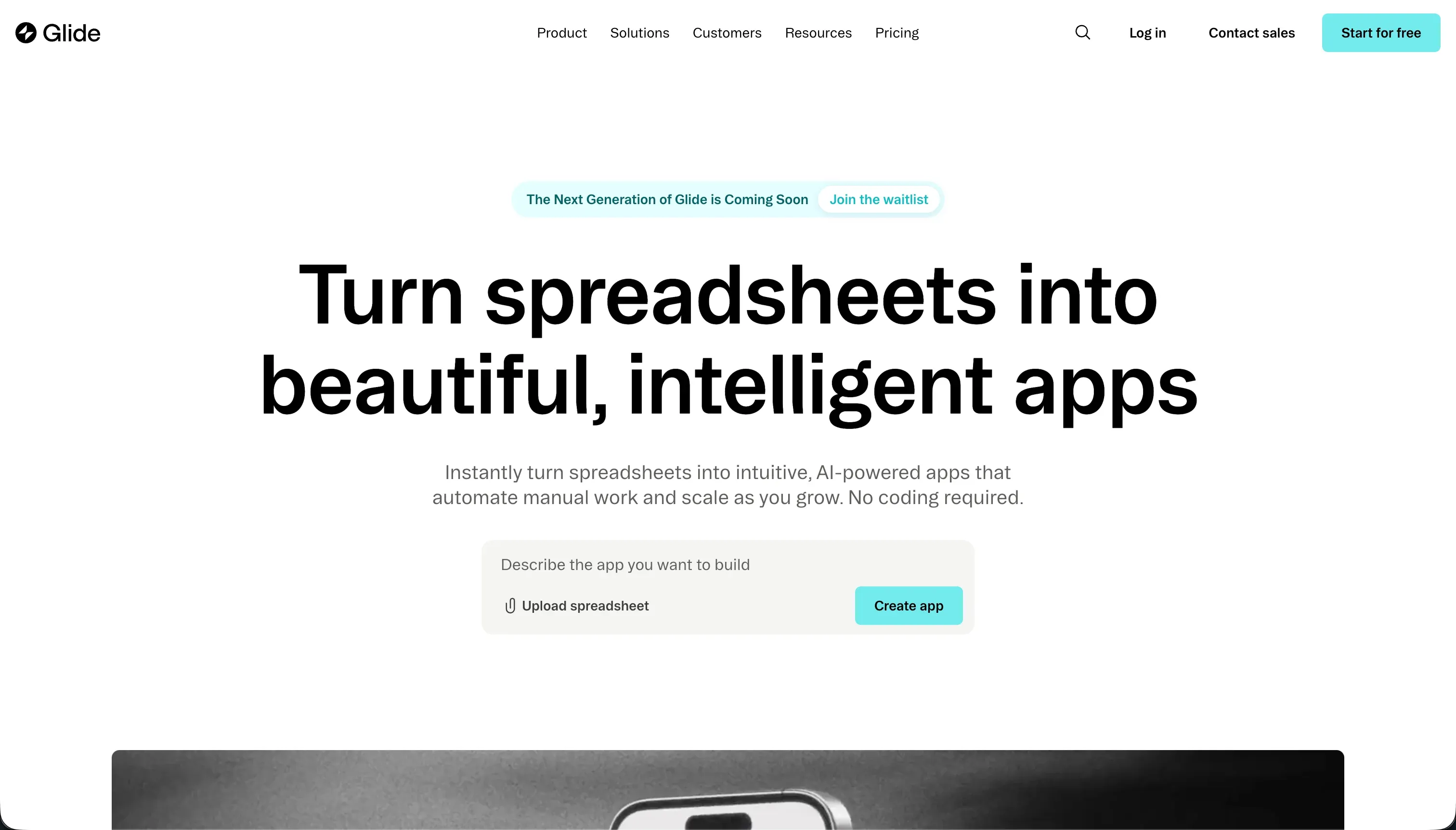 Glide homepage snapshot
Glide is one of the quickest ways to turn spreadsheet data into an internal HR app. It performs best when the use case is narrow and operational, such as staff directories, shift lookups, simple onboarding checklists, equipment acknowledgements, or field workforce communications.
Its ease of build score of 8.5 is deserved because non-technical teams can assemble a usable app very quickly. The mobile experience is also a major advantage for distributed teams that need phone-friendly access.
For HR teams already living in Google Sheets or Airtable, Glide can feel very natural. Simple edits happen in familiar data sources, which improves day-to-day maintainability for lightweight workflows. That makes it attractive for pilots and departmental tools.
The concrete reason not to choose Glide for some HR projects is access complexity. Its security and access control score of 5.5 reflects a thinner permissions model than the top option here. If you need sensitive document handling, manager-only records, or highly segmented employee views, Glide can become limiting. Cost is the other exclusion.
Because pricing scales with users, it can become poor value for larger organizations compared with flat-tier internal portal builders.
3. Airtable - best as a relational HR backend with light internal interfaces
Airtable remains one of the strongest platforms for organizing HR data. It is excellent for building relational structures across employees, managers, departments, policies, leave requests, equipment, and onboarding tasks. That strength supports its 8.5 score for ease of build on the data side.
HR teams can usually model complex operational processes in Airtable faster than in a traditional database, and the collaboration features are familiar enough for operations users to maintain.
Where Airtable falls behind is as the full employee-facing application layer. Its production readiness is weaker for broad internal app deployment, and its native interfaces are more rigid than purpose-built portal builders. Security and access control also lag, with a score around 5.0, because permissions are not as granular or intuitive for many self-service HR scenarios.
The practical exclusion is this: do not choose Airtable alone if employees or managers need secure, polished, role-based portals at scale. It is better used as the data backbone paired with a frontend such as Softr. On its own, Airtable works best for internal admin teams rather than wide workforce access.
4. Retool - best for engineering-supported HR operations tooling
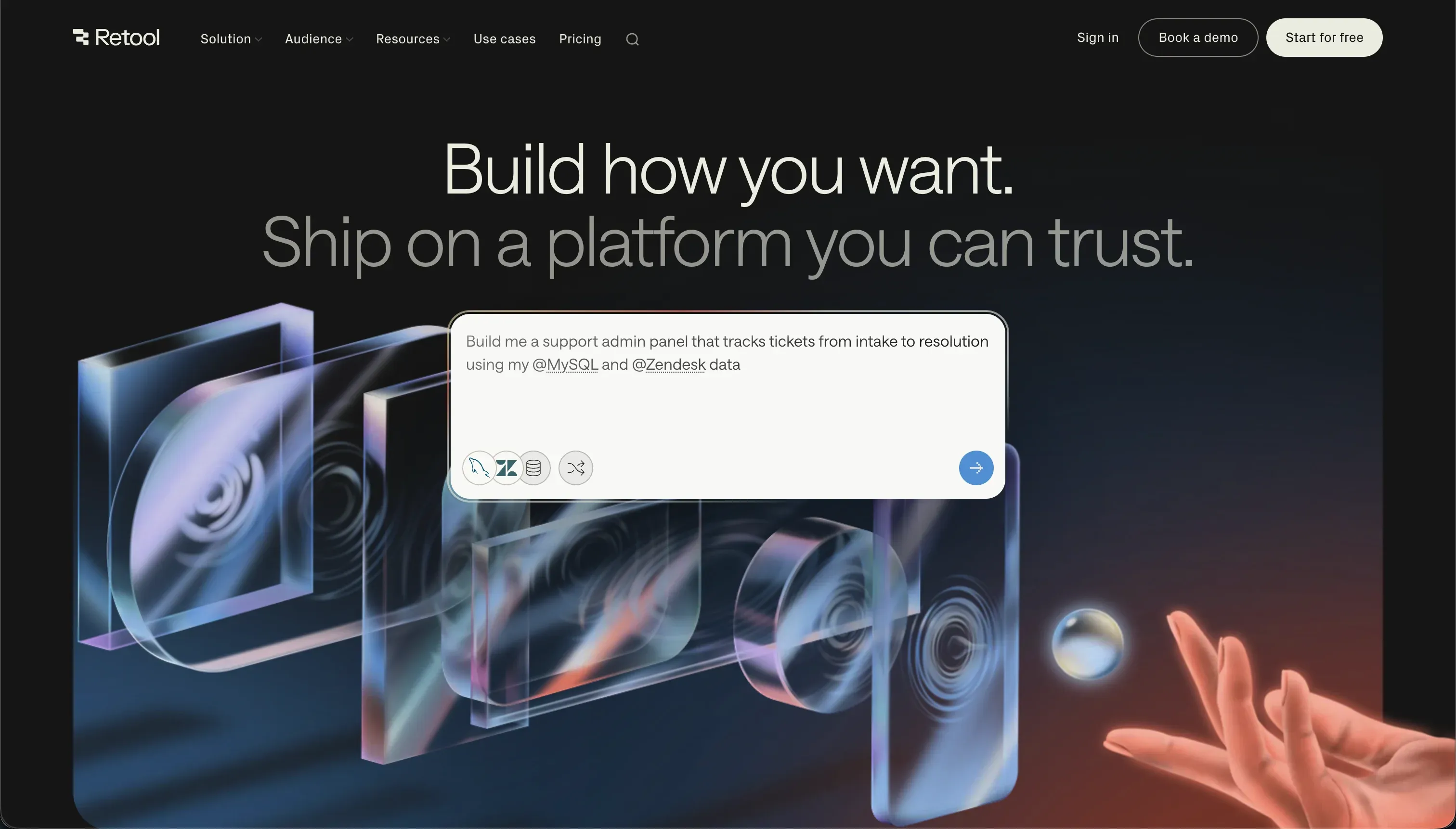 Retool homepage snapshot
Retool is a strong option when HR needs robust internal tooling and can rely on engineering support. Its biggest advantage is data and integrations, where it scores 8.5 thanks to direct SQL access, API connectivity, and flexible component logic. That makes it very good for admin dashboards, exception handling tools, approval consoles, and internal operations systems that pull from multiple company sources.
Security is also respectable, with enterprise features such as SSO and auditing available on higher plans. For organizations that already centralize employee data in SQL databases or internal services, Retool can be much more powerful than a no-code portal product.
The exclusion is straightforward: ease of build is low, around 4.0, because Retool expects users to understand queries, API payloads, and JavaScript logic. Most HR teams cannot independently build or maintain it.
It is also not the best fit for broad employee self-service experiences, since the product is geared more toward internal admin tooling than friendly workforce portals. Choose Retool when technical depth matters more than self-serve simplicity.
5. Bubble - best for bespoke HR systems with unusual workflow needs
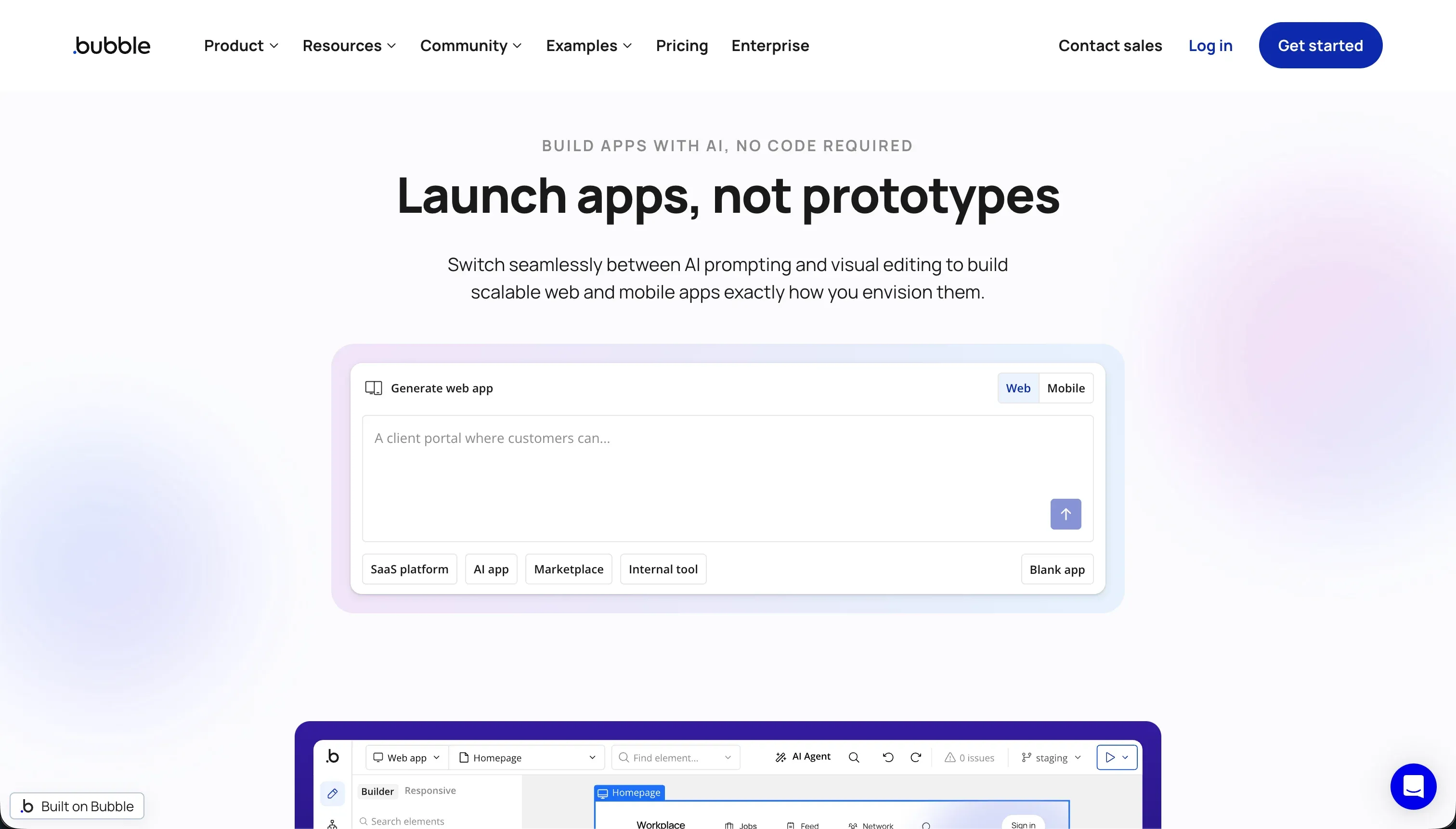 Bubble homepage snapshot
Bubble is the most flexible no-code option in this list for teams that need a truly custom HR application.
It scores 8.5 for design flexibility and around 8.0 for data features, which gives teams freedom to build specialized systems such as internal learning tools, complex approval chains, custom review workflows, or policy-driven employee portals with nonstandard UX.
If the goal is to create something unique rather than assemble standard blocks, Bubble is compelling.
Its downside is operational complexity. Ease of build is closer to 5.0 because even visual development in Bubble requires serious logic design, testing discipline, and careful privacy rule configuration. Security can be solid, but it depends heavily on correct setup, which raises governance risk for HR teams handling sensitive records.
The concrete exclusion is long-term maintainability. Once workflows and conditions grow, Bubble apps can become difficult for new admins to understand. There is also no straightforward code export path, which increases lock-in. Bubble is best when the app requirements are too custom for Softr or Glide and the team accepts a heavier ownership burden.
6. Replit - best for teams that want full-stack control with AI assistance
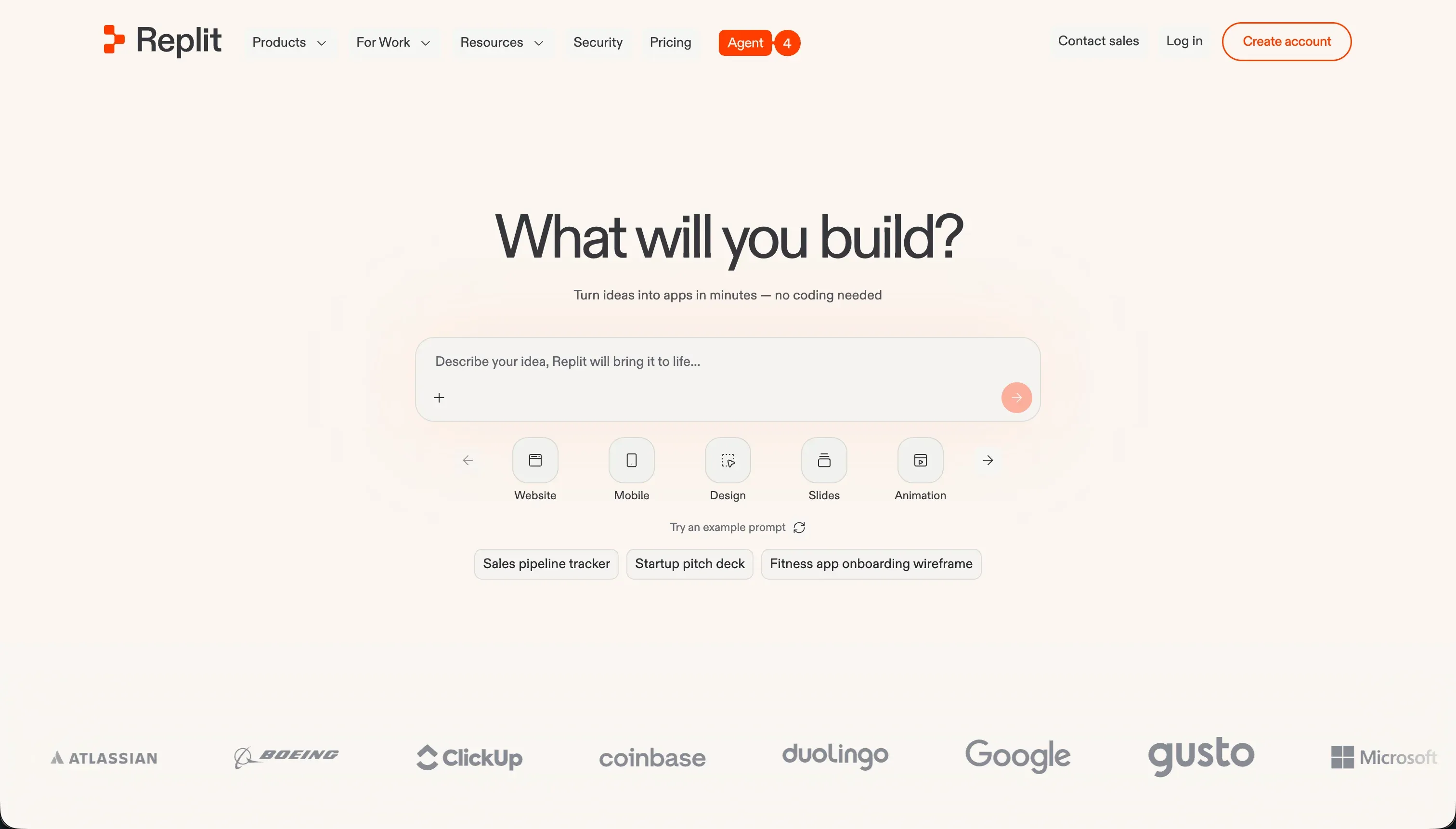 Replit homepage snapshot
Replit earns a place here because some HR software buyers do not want a no-code abstraction at all. They want real code, infrastructure control, and the ability to extend the application however they choose.
Replit supports that model with AI-assisted generation, deployment workflows, and exportable code, which helps explain its stronger production readiness and design flexibility scores. For technical teams, this can be the most future-proof path.
This approach is useful if your HR stack requires very specific integrations, custom security logic, or ownership beyond the limits of packaged builders. A skilled team can produce employee systems that are more tailored than anything available in a block-based platform.
The clear exclusion is technical overhead. Security and access control are only as strong as the code your team writes and reviews, and maintainability depends on internal engineering discipline. If you do not have developers who can inspect dependencies, patch issues, and validate permission logic, Replit is not a safe shortcut.
It is a strong option only when code ownership is a deliberate requirement, not when the goal is to avoid engineering effort.
How to Shortlist the Right Builder
Start your shortlist by separating employee-facing portals from admin-only tooling. If employees, managers, and HR staff all need different access levels, prioritize platforms with strong built-in permissions and clear maintenance workflows. For most buyers, that means beginning with Softr.
If your use case is lighter and mobile-first, such as a directory or checklist app, add Glide. If your biggest problem is structuring relational HR data, include Airtable as a backend candidate.
Technical teams should also evaluate Retool for operational dashboards and Bubble only when the workflow or interface is too custom for simpler builders. To compare options properly, test one onboarding or leave-request workflow across two user roles and one admin role. That reveals permission gaps quickly. For scoring details, review our methodology.
You may also want related guides for employee intranets and HR apps, employee onboarding apps, and learning management apps.