




What an Employee Intranet Actually Needs
Building a custom intranet or internal HR app introduces strict administrative requirements. Unlike public-facing marketing portals, internal company platforms exist to organize sensitive personnel records, distribute dynamic resources, and host interactive workflows cleanly.
The core of this challenge lies in access control and day-two upkeep: a single leaked salary row or broken onboarding form can compromise team operations immediately. To evaluate the category, buyers must analyze how platforms tackle the six core criteria. First, Ease of build and Production readiness are paramount because internal tools must deploy fast without taxing engineering resources.
Second, Security & access control must protect employee records server-side, preventing staff members from viewing restricted details. Maintainability is critical: as company structures shift, updating an organizational chart, permission level, or dynamic directory must be simple.
Finally, Data & integrations must bridge your new interface to pre-existing corporate files, while Design flexibility ensures standard forms remain easy to read on mobile and desktop layouts. For standard intranets, directories, and resource guides, prioritizing visual security over blank-canvas coding is the compromise that delivers the highest return.
The use-case comparison
| Platform | Overall | Advantage | Main reason to exclude it |
|---|---|---|---|
| Softr | 8.1 | Pre-built dynamic user groups, visual permission toggles, and SOC 2 hosting compliance. | No options for raw code export or absolute pixel-level drag-and-drop design. |
| Glide | 6.3 | Fastest spreadsheet-to-mobile layout engine for teams on the go. | Per-seat pricing scales poorly past one hundred shared employee users. |
| Airtable | 6.3 | Highly relational collaborative database engine with intuitive grid editing. | Interface Designer is desktop-focused and lacks native external logins. |
| Retool | 6.8 | High data density and direct integration to legacy SQL environments. | Requires consistent SQL and JavaScript skills to manage or update logic. |
| Bubble | 6.8 | Deep custom logic, backend scheduling, and highly conditional database rules. | Proprietary hosting model and complex workload-unit billing packages. |
| Replit | 7.4 | AI agent writes real code on managed, scalable virtual servers. | Auth policies live in code files rather than visual admin panels. |
1. Softr - best overall for governed intranets and hr workflows
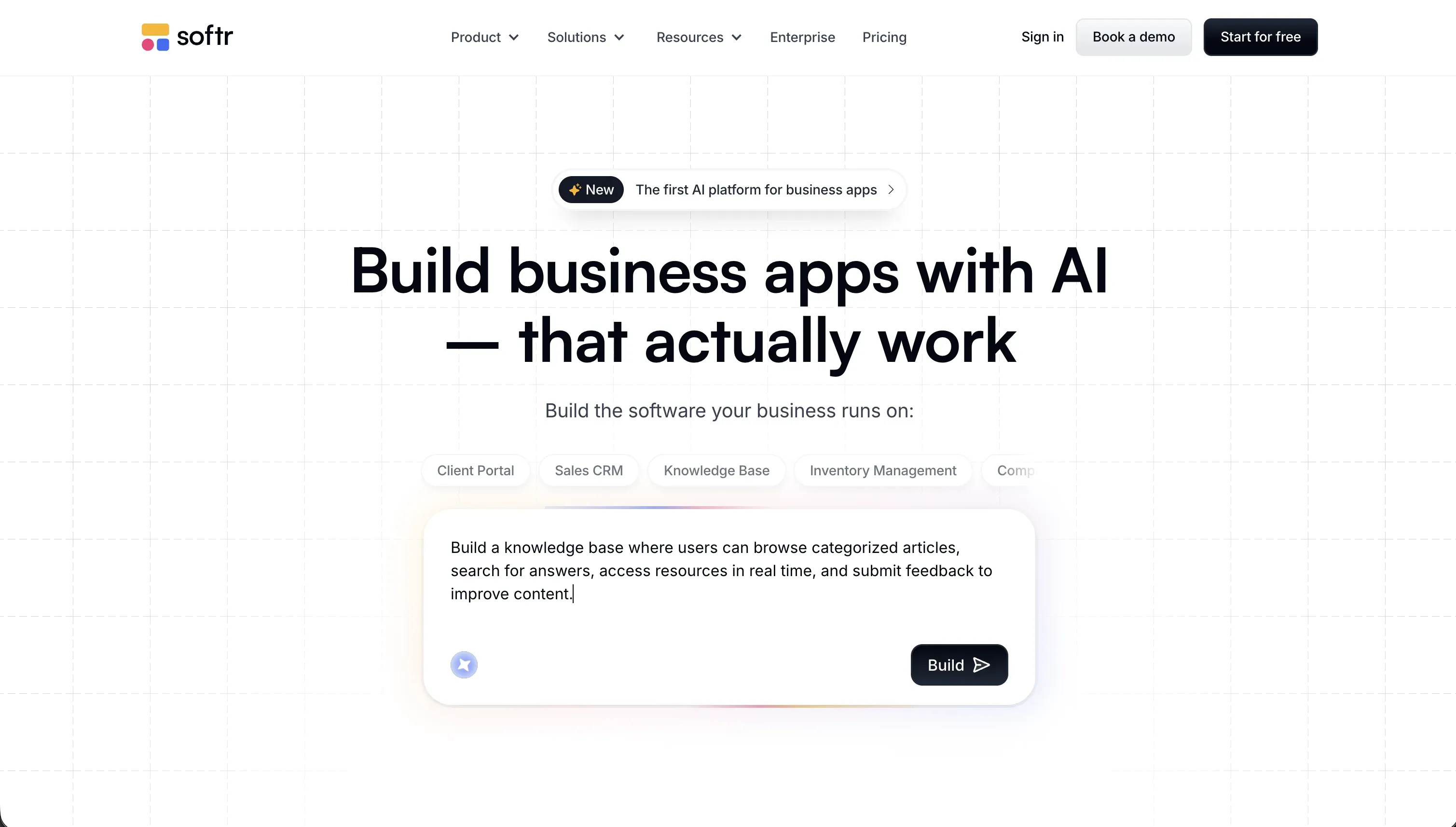 Softr homepage snapshot
For intranets and company apps, Softr ranks first because its infrastructure matches what HR teams actually require. Security & access control scores 8.5 here, which is the most critical mark on the table. Dynamic user groups and row-level database filters allow builders to verify that each manager sees only their department’s reviews, while standard staff members view generic team resources.
Production readiness scores 8.5 and Ease of build scores 9.0; you can prompt the AI Co-Builder to generate dynamic employee directories, announcements, policy databases, and checklists in minutes. Once generated, any block can be updated by hand, keeping Maintainability high with a score of 9.0.
If you are building a custom portal and want to link to related solutions, review our guides for /best/hr-teams and /best/employee-onboarding-apps. Buy Softr to deploy quickly without managing a custom database codebase. Exclude it if procurement requires self-hosting or code export.
2. Glide - best for mobile-first deskless employee apps
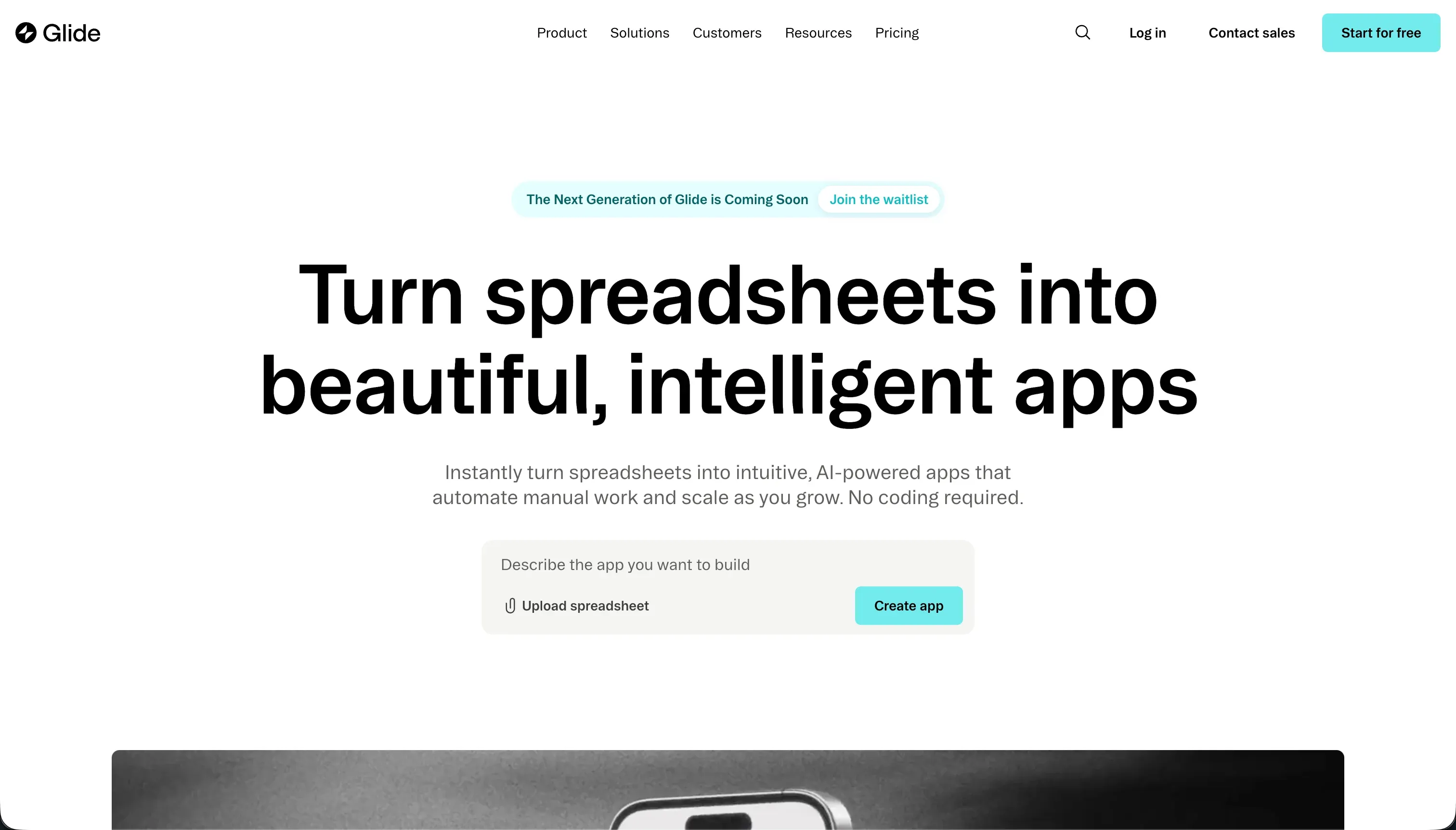 Glide homepage snapshot
If your staff works on the go, Glide provides an incredibly fast path to launch. It scores 8.5 on Ease of build due to its ability to instantly parse spreadsheets or spreadsheets into clean, card-based mobile interfaces. It is highly suited for equipment tracking, expense reports, and simple contact lists.
However, Security & access control scores a thinner 5.5, meaning deep or conditional multi-tenant permissions are difficult to structure compared to portal-first tools. Maintainability scores 6.5 because of plan changes that limit features mid-project. Exclude Glide if you intend to scale past one hundred intranet users on budget plans, as per-user seat limits quickly become expensive.
3. Airtable - best relational database first workspace
When internal teams are already tracking project databases in spreadsheets, Airtable offers a highly intuitive relational backbone. Data & integrations scores a strong 8.0, allowing you to link inventory logs, content timelines, and employee records in a grid.
The restriction arrives with its Interface Designer layer: with a Design flexibility score of 4.0, layouts are blocky and desktop-focused.
Production readiness scores 5.5 because of API rate limits and a lack of true external login screens. If you want to expand an Airtable base into a mobile platform, use it as a database and host your visual app on Softr, otherwise base-level permission limits will stop you.
4. Retool - best for engineering teams with sql data constraints
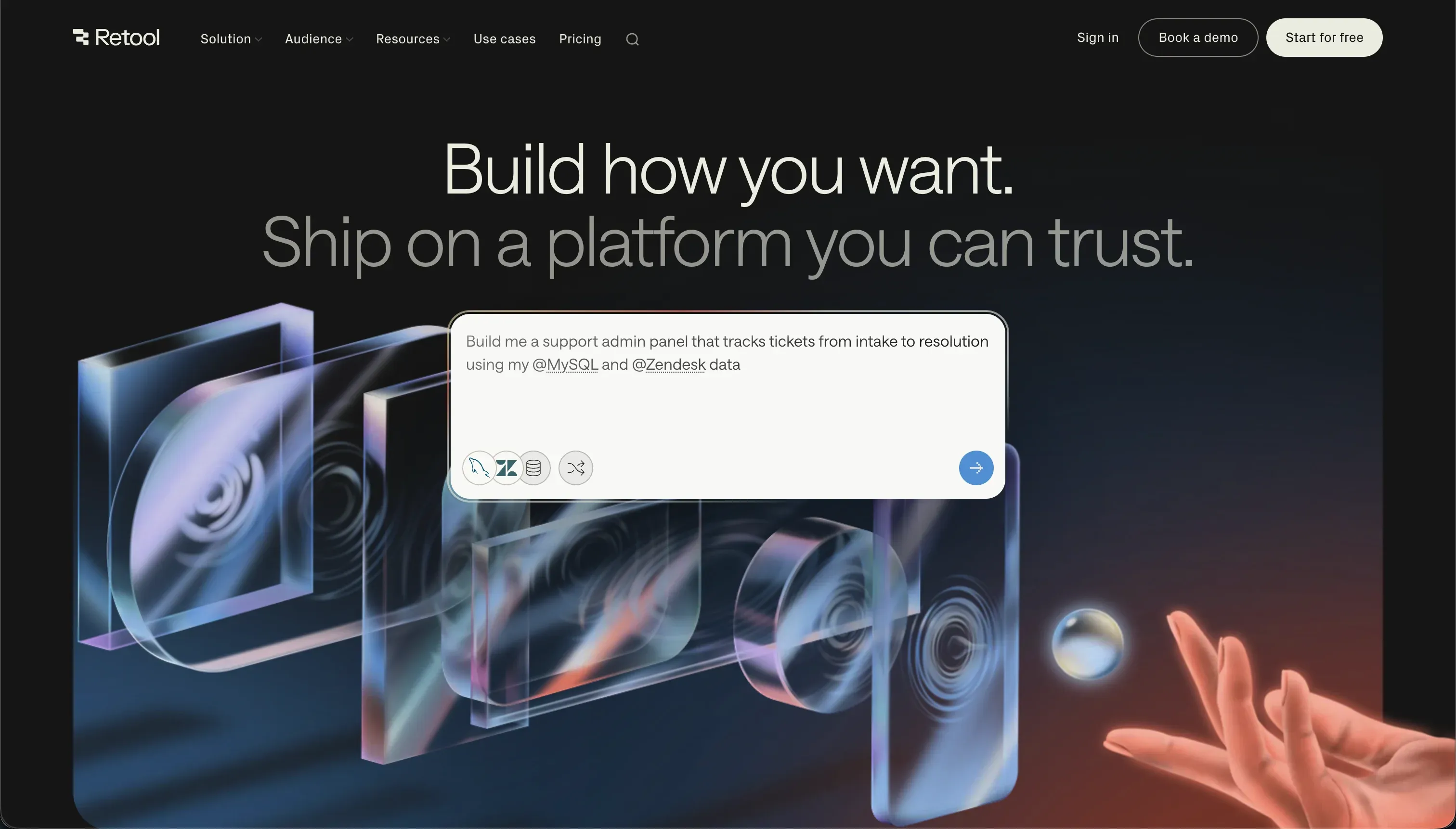 Retool homepage snapshot
For IT and engineering departments, Retool is the dominant choice to visualize company database structures. It earns an 8.5 on Data & integrations because it connects natively to PostgreSQL databases and custom API endpoints. However, Retool is not a no-code tool, scoring a low 4.0 on Ease of build.
If non-technical HR managers need to update directory graphics, edit resources, or adapt user feedback forms, they will be blocked by Retool’s SQL and JavaScript prerequisites, which scores its Maintainability at 6.0. Exclude Retool if your build relies on operations staff to make routine layout adjustments without engineer tickets.
5. Bubble - best for deep conditional logical logic apps
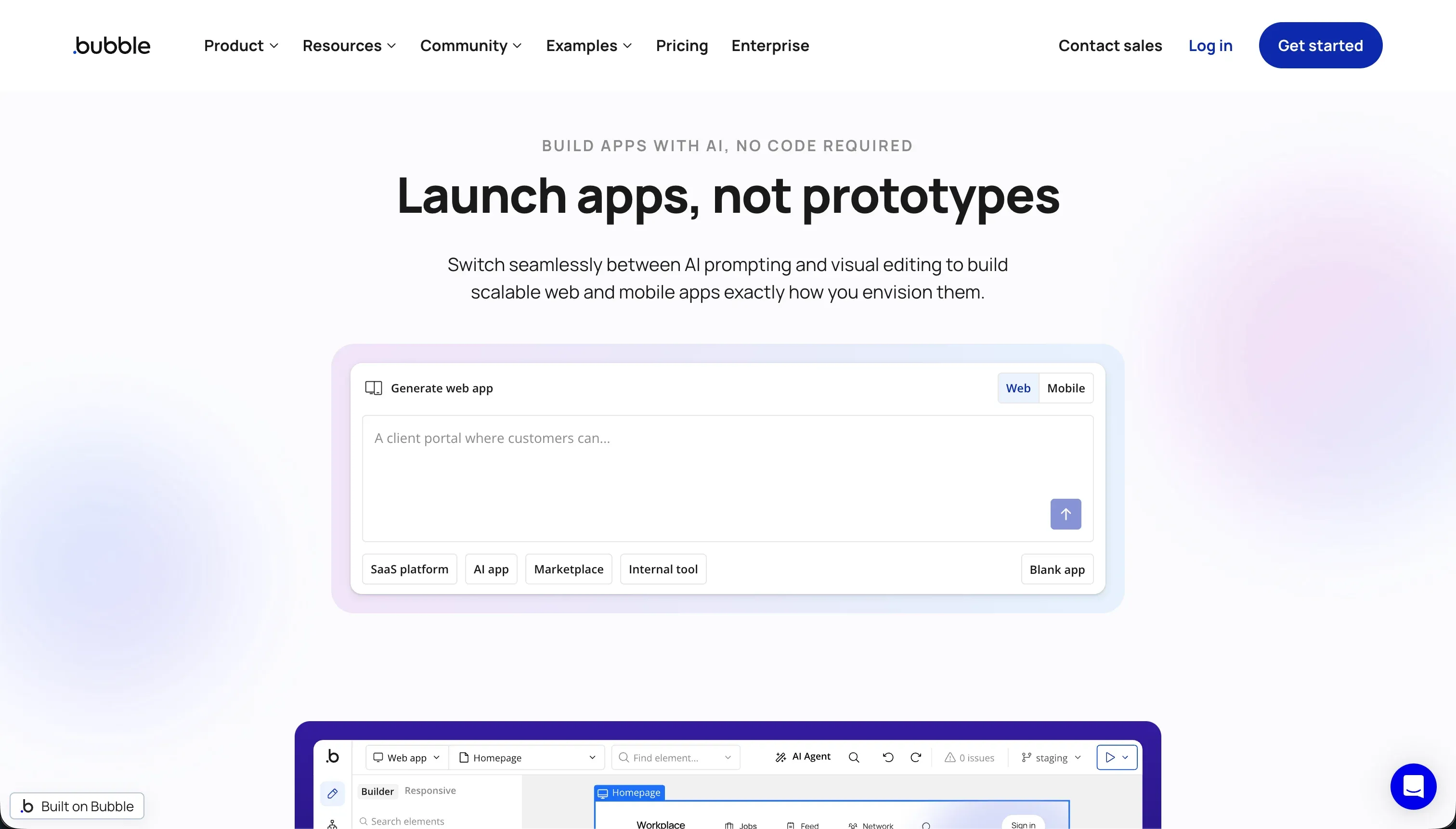 Bubble homepage snapshot
When an internal intranet requires specialized logic like automated holiday calendars, dynamic shifts, or multi-step approval gates, Bubble provides the deeper functional ceiling. It scores an 8.5 on Design flexibility and an 8.0 on Data & integrations. The drawback is setup difficulty, as Ease of build sits at 5.0.
Unlike platforms with pre-configured blocks, Bubble forces you to establish every database privacy rule and interface element manually from a blank canvas. If an HR administrator fails to configure a security constraint correctly, sensitive team details may leak silently. Exclude Bubble if you want to launch a simple intranet directory this week rather than this quarter.
6. Replit - best code first exit path for developer teams
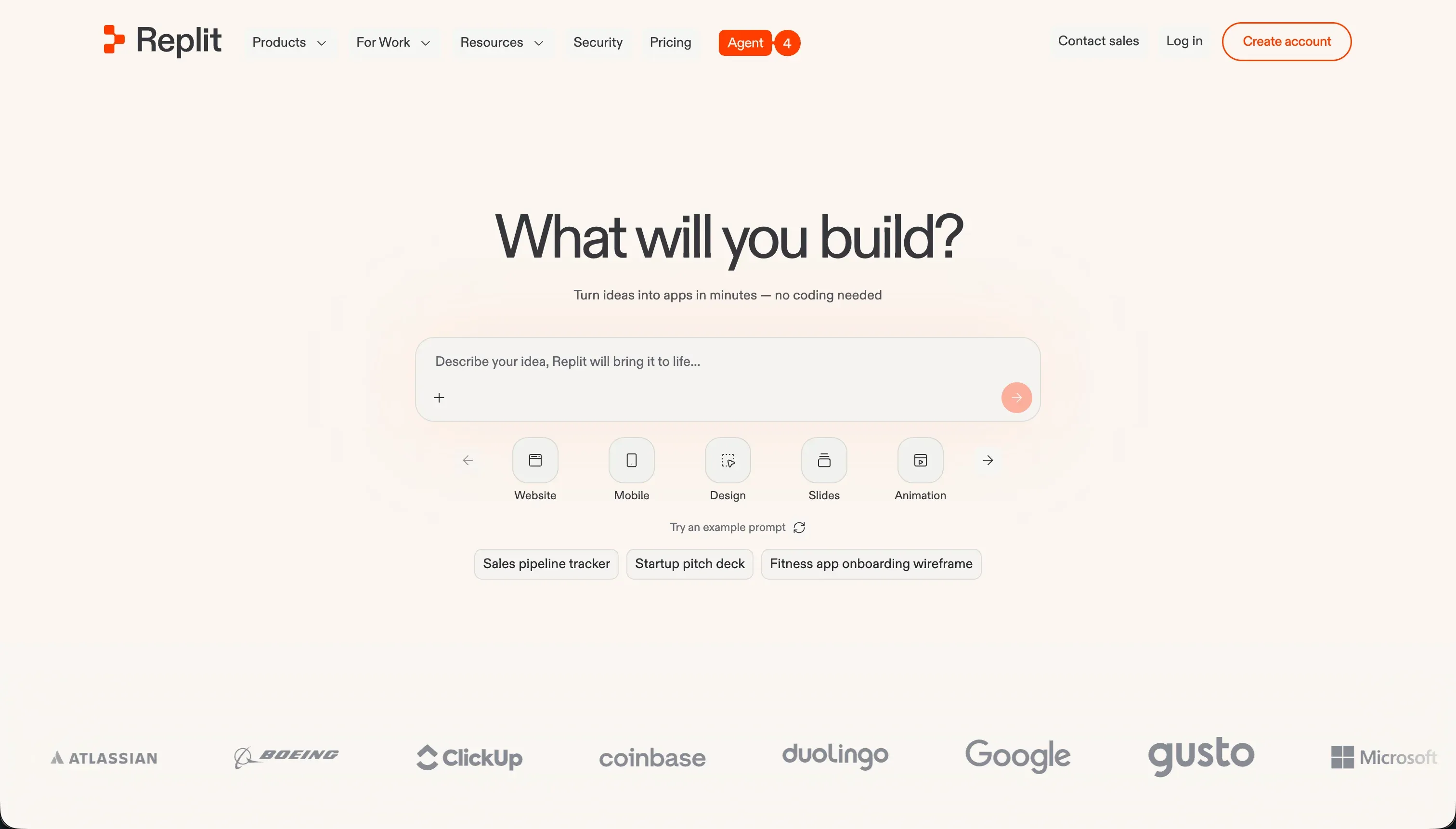 Replit homepage snapshot
If your company enforces strict data policies requiring full source code ownership, Replit offers a compelling code-first route. Operating on autoscaling cloud servers with managed PostgreSQL, its Agent prompt writes real, exportable files in popular coding languages, scoring 8.5 on Design flexibility and 8.0 on Production readiness.
However, Security & access control scores 6.0 because all employee logins and group restriction layers must be coded manually. Maintainability is 7.5; the code is robust but requires development checks to verify updates do not introduce runtime errors or trigger loops. Exclude Replit if your team has no developers available to audit raw files.
How to Shortlist and Pilot Your Intranet
An employee app should simplify your operations, not add to your team’s administrative burden. A successful pilot begins by choosing two candidate tools that approach the design challenge from different directions. If your primary goal is to organize simple dynamic resources and secure employee directories without writing code, pair Softr’s database-powered engine with Glide to test mobile ease of use.
If your company relies on a developer team that requires full code ownership, test Replit against a no-code baseline. We also suggest reviewing our specialized guides on /best/knowledge-base-apps to see how clean resource systems are organized.
To test your shortlist, invite exactly five colleagues from different departments to run through standard actions: submit an expense, edit their directory details, and download a policy guide. Record how long updates take to apply, check database visibility rules to confirm salaries are invisible to basic accounts, and map out the plan costs at fifty, one hundred, and five hundred staff seats.
Our evaluation standards are outlined on the methodology page, ensuring your company software remains secure and maintainable for years.