




What a modern knowledge base app actually needs
A business knowledge base is more than a list of static text files. To support real operational workflows, it must structure and protect intellectual property so that the right team member always accesses the right instruction. For this specific class of software, the overall purchasing decision is governed by three primary criteria: security & access control, maintainability, and data & integrations.
Authenticated access ensures sensitive internal standard operating procedures do not leak to the public web. Maintainability guarantees that as team structures, training requirements, or product lines evolve, the underlying page navigation does not break under the weight of manual links. Finally, robust data structures are needed to relate articles to departments, products, or compliance reviews dynamically.
Design flexibility is a secondary consideration. A corporate wiki does not need pixel-perfect consumer styling as long as it features clean layouts, reliable search, and works on mobile devices. When evaluating options, buyers must prioritize structural reliability and access control over infinite design canvas options.
If non-technical department leaders are responsible for documenting and updating their own operational policies, a code-heavy platform will create immediate bottleneck risks, whereas a visual building environment keeps update velocity high.
The use-case comparison
| Platform | Overall | Advantage | Main reason to exclude it |
|---|---|---|---|
| Softr | 8.1 | Pre-built auth, dynamic user groups, instant preview impersonation | Visual assembly relies on layout blocks rather than a freeform canvas |
| Glide | 6.3 | Fastest visual app generation from existing sheet layouts | Branding control is locked to pre-configured templates |
| Airtable | 6.3 | Relational data structuring and rich field formulas | Interface Designer is desktop-focused and locks out external guests |
| Bubble | 6.8 | Pixel-level canvas control and deep custom index logic | Workload-unit pricing is unpredictable for heavy document queries |
| Replit | 7.4 | Produces raw exportable code and advanced AI integrations | Requires code-level security audits and variable compute costs |
| Retool | 6.8 | Direct read-write access to internal enterprise SQL databases | Steep technical coding bar and seat costs for external readers |
1. Softr - best overall for governed knowledge hubs
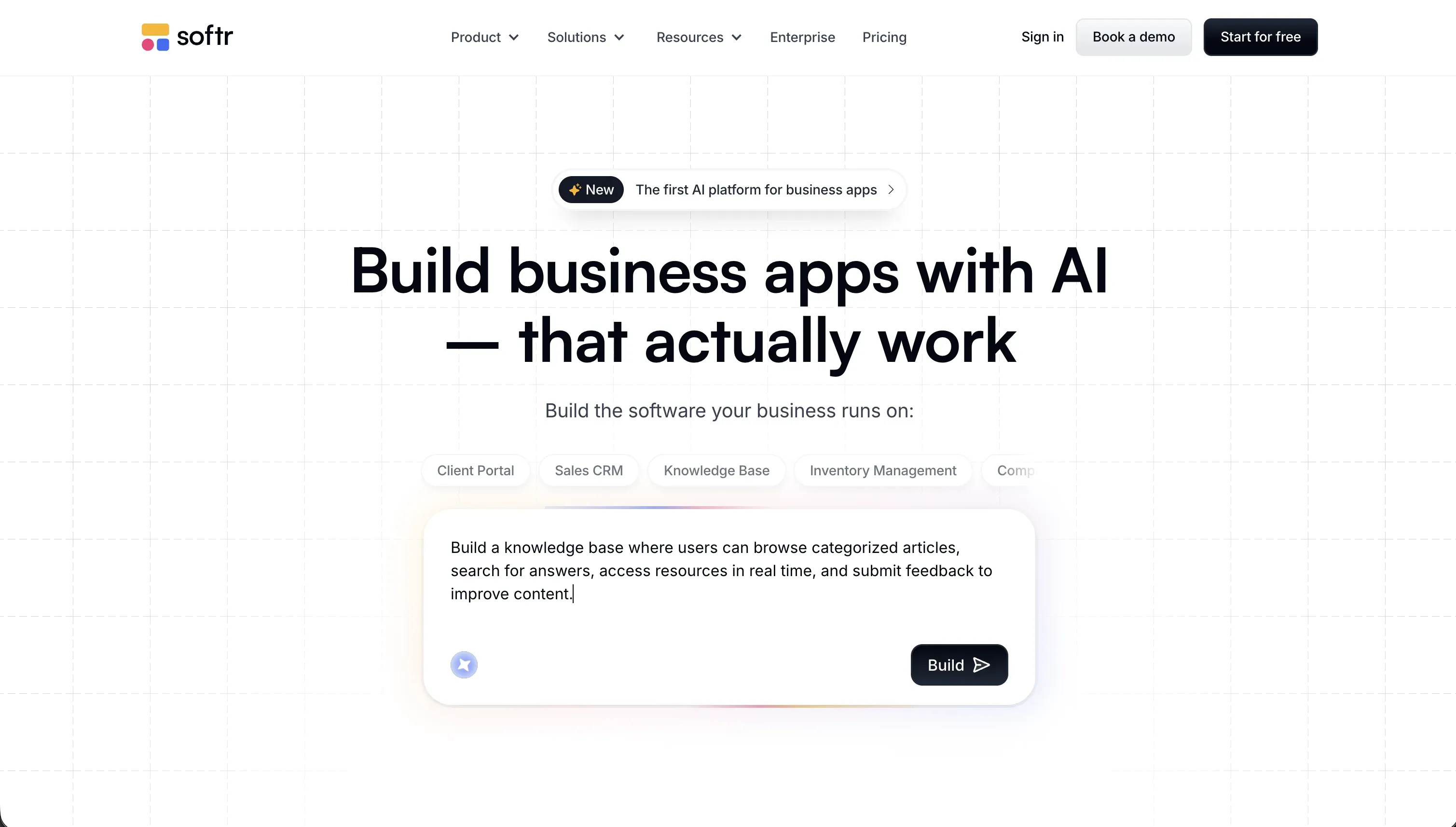 Softr homepage snapshot
Softr leads this ranking because its native infrastructure mirrors exactly what an operational knowledge base requires. Authentic user login flows, hierarchical user groups, and row-level data restrictions are platform features, configured with visual sliders rather than programmed in code.
In terms of security & access control, it scores 8.5 because you can hide or show specific content blocks, download folders, or editing permissions based on a reader’s exact role. The platform pairs a visual builder with an AI Co-Builder, scoring a 9.0 on ease of build. For departments, this means a non-developer can describe a wiki structure and instantly generate a secure portal with searchable columns.
It also links to external data assets including Airtable and Google Sheets, though native Softr Databases are recommended. There is no generated code schema to maintain, which earns a maintainability score of 9.0. If you need to restrict directories to specific employees, its SSO integration keeps things secure. The honest deduction sits under design flexibility, which scores 5.5.
Content is composed of native blocks like tables, grids, list views, and custom HTML items, meaning you accept block-based layout limits for guaranteed responsiveness.
2. Glide - best for fast spreadsheet-backed team wikis
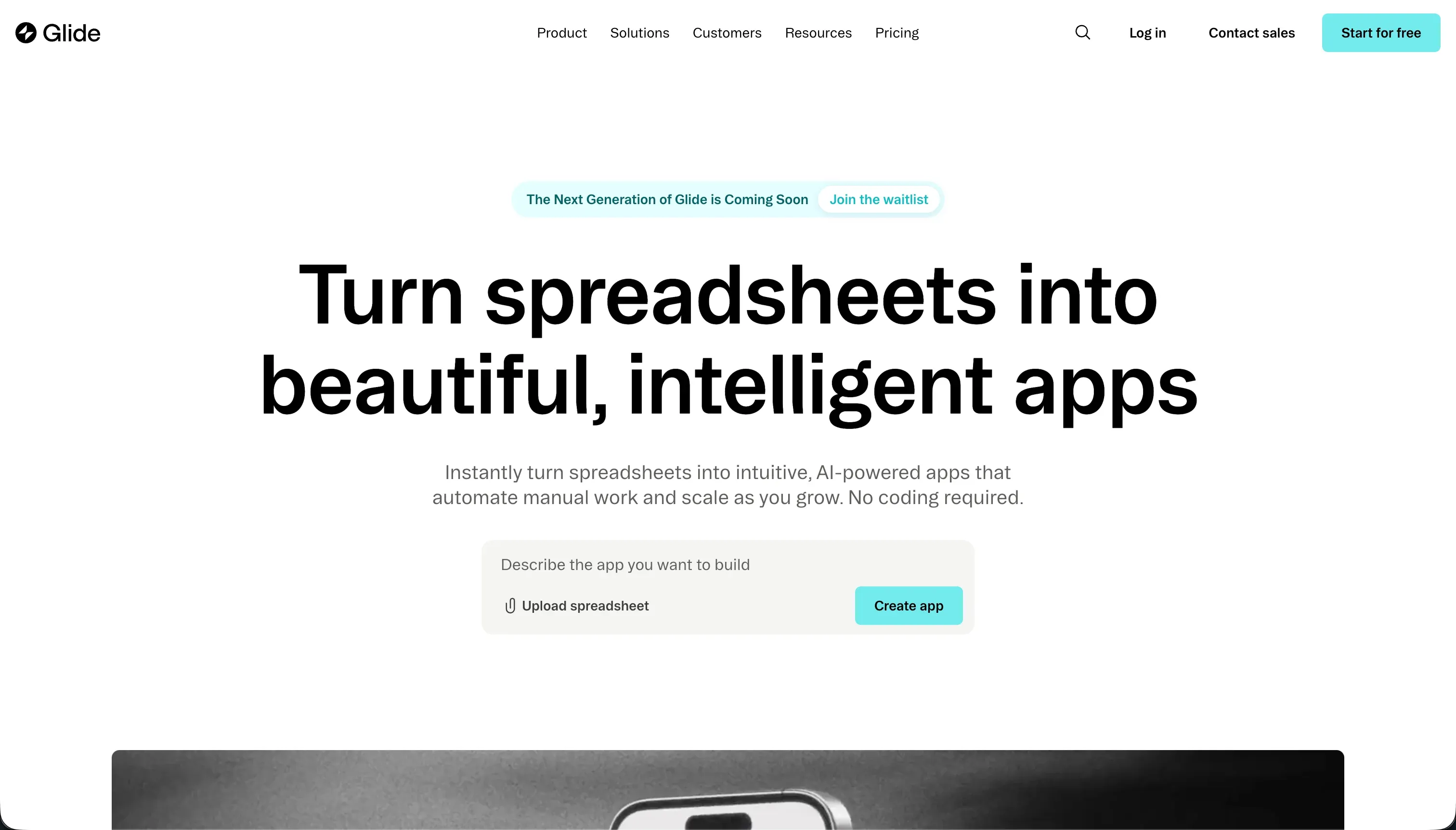 Glide homepage snapshot
Glide offers a highly intuitive spreadsheet-to-app path for teams who keep their operational lists organized in Google Sheets or Excel. It earns an 8.5 on ease of build because it instantly maps spreadsheet data columns into clean, responsive lists, cards, and maps. This is an excellent fit for field operations or warehouse staff who need to search and view asset guides or SOP checklists on their phone.
However, its security & access control score of 5.5 limits its utility for multi-tenant setups. While it manages general user access, the permission model is thinner than portal-focused platforms when you need granular visibility rules for external groups. Maintainability scores 6.5 because there is no code export, and users report that plans can fluctuate, moving features behind higher tiers.
For a small internal workforce with a known seat count, it works exceptionally well, but seat-based pricing makes scaling costly.
3. Airtable - best for relational article management
Airtable is first and foremost a relational database, scoring an 8.0 on data & integrations. It excels at managing complex wiki schemas, linking articles to products, and tracking update histories. Its Interface Designer lets you build a clean dashboard on top, earning an 8.5 for ease of build. The challenge lies in production readiness, which is scored at 5.5.
Airtable’s app builder is desktop-focused, does not scale well to mobile, and has no native external onboarding flow. Security & access control scores a 5.0, as permissions are tied to the base level rather than individual user records, making multi-tenant document views highly complex. External guest access requires expensive guest packs starting at $120 a month for 15 users.
For internal operations managing a complex product line, it acts as a reliable structured core; for client-facing or mobile support wikis, it should be paired with an app builder.
- Relational schema for products and updates
- Interface Designer for internal dashboards
- Scored 8.0 for data and integrations
- Scored 8.5 for ease of build
- Desktop-focused with poor mobile scaling
- No native external onboarding flow
- Base-level permissions limit multi-tenancy
- Guest packs start at $120/mo for 15 users
4. Bubble - best for custom, highly interactive portal logic
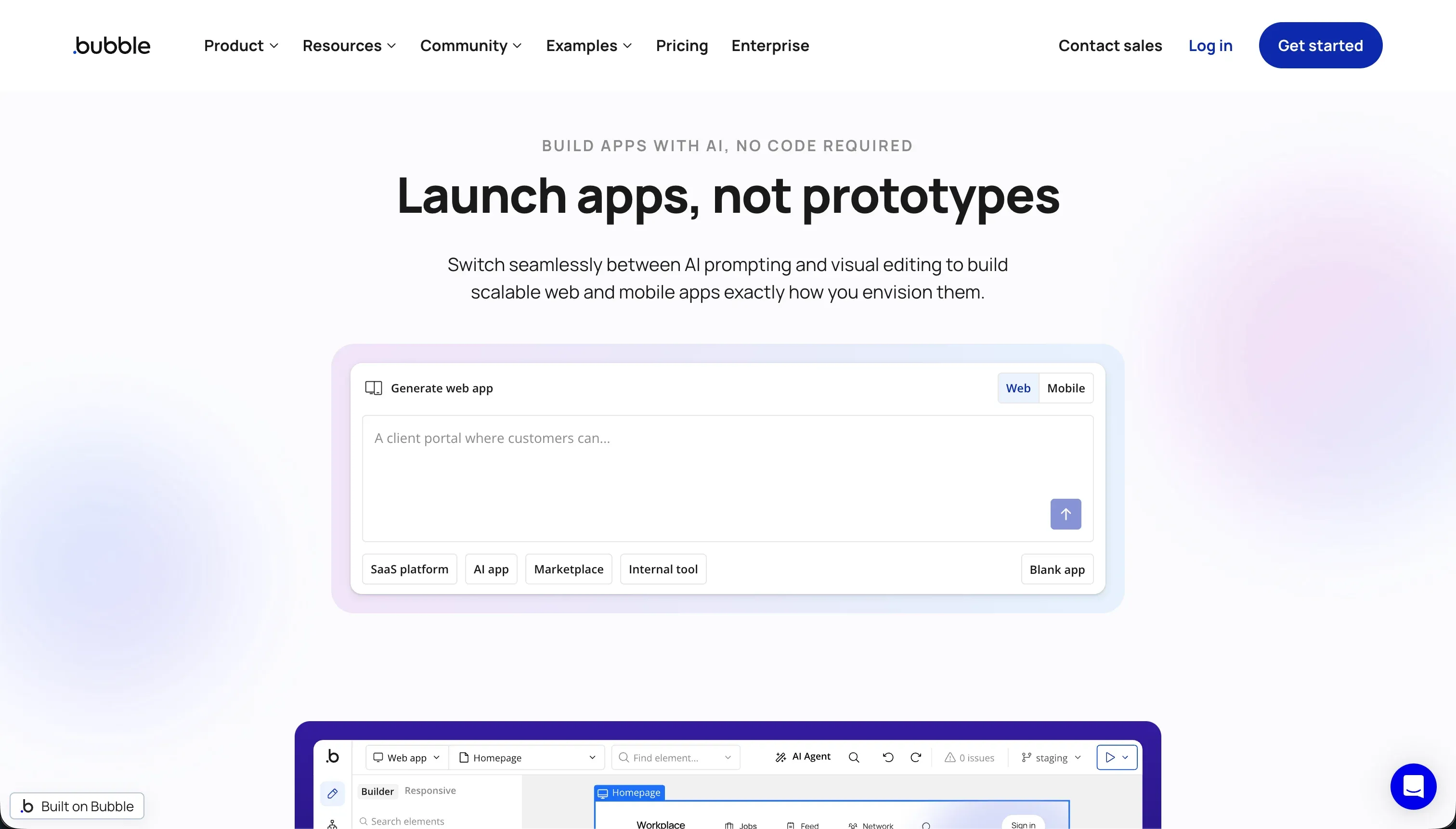 Bubble homepage snapshot
Bubble is the platform to pick if your knowledge app needs highly complex interactive features, custom content matching, or a fully bespoke mobile layout. Design flexibility scores 8.5, and its database engine handles custom categories cleanly. Its server-side privacy rules provide strong access control, but implementation is complex; a single missed rule fails silently without editor alerts, leaving security at 6.5.
Ease of build is lower at 5.0, representing a real multi-week learning curve. As projects grow in scope, maintaining visual workflows can cause editor lag, which impacts maintainability at 6.0. Furthermore, pricing is tied to workload units, meaning heavy document searching or automated script updates can cause unexpected billing spikes.
It is a powerful engine if the knowledge center is the actual core of a custom product, but adds substantial operational overhead for standard business wikis.
5. Replit - best for code-first teams seeking total hosting control
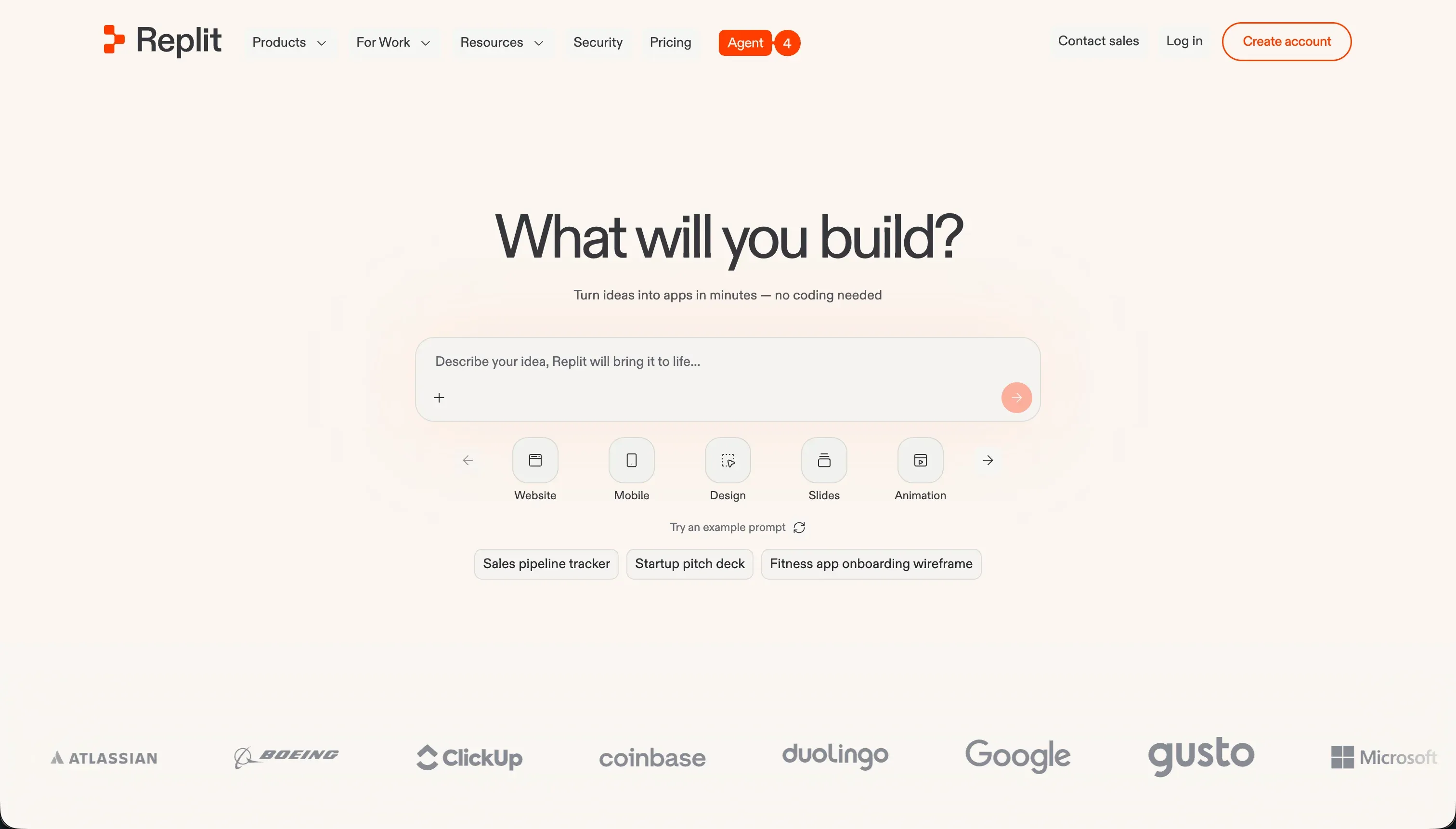 Replit homepage snapshot
Replit Agent builds and deploys full applications as real, exportable code, earning a 8.5 on design flexibility and 8.0 on production readiness. If you have developers who want to own the raw codebase, Replit is the strongest path. For knowledge management, this allows you to build custom vector-search databases, link to external LLMs, and host documents on your own cloud. The trade-offs are technical.
Security & access control scores 6.0 because user permissions and data isolation filters are written directly in code; verifying safety means reading folders instead of checking a visual panel. Maintainability scores 7.5, reflecting that code ownership prevents platform lock-in, but debugging AI-generated scripts consumes developer hours.
Effort-based pricing can also lead to billing surprises during debugging loops, making it less predictable than flat-rate visual app builders.
6. Retool - best for database lookup utilities managed by developers
 Retool homepage snapshot
Retool is a developer-centric builder designed for creating high-density internal dashboards and admin tools. Its data & integrations score of 8.5 reflects its ability to connect directly to live enterprise SQL databases and GraphQL directories. If your documentation resides in a secure, on-premise PostgreSQL database, this is the safest tool for technical teams, supporting SSO and detailed audit logs.
However, ease of build scores a 4.0; it is not a no-code tool. Adding custom filters or structuring text blocks requires writing raw SQL queries and javascript helpers. Security & access control scores 7.5 for internal members, but because it has no native signup or recovery pages, launching it for external users requires manual engineering.
Seat-based pricing further restricts it to internal directories managed specifically by engineering teams.
How to choose your knowledge base platform
Shortlisting a platform starts with identifying who will publish documents and who will read them. If your knowledge base is an internal directory managed securely for staff, look at our guides on employee intranets and hr apps to evaluate user group access.
If you are structuring directories for academic environments, review our breakdown of education teams.
For standard business portals, piloting on Softr offers the absolute fastest path to live testing. Build a prototype with one structured data source, set up two distinct reader tiers, and run test queries to evaluate ease of use. To understand how these scores were derived across our target criteria, review our full methodology.