


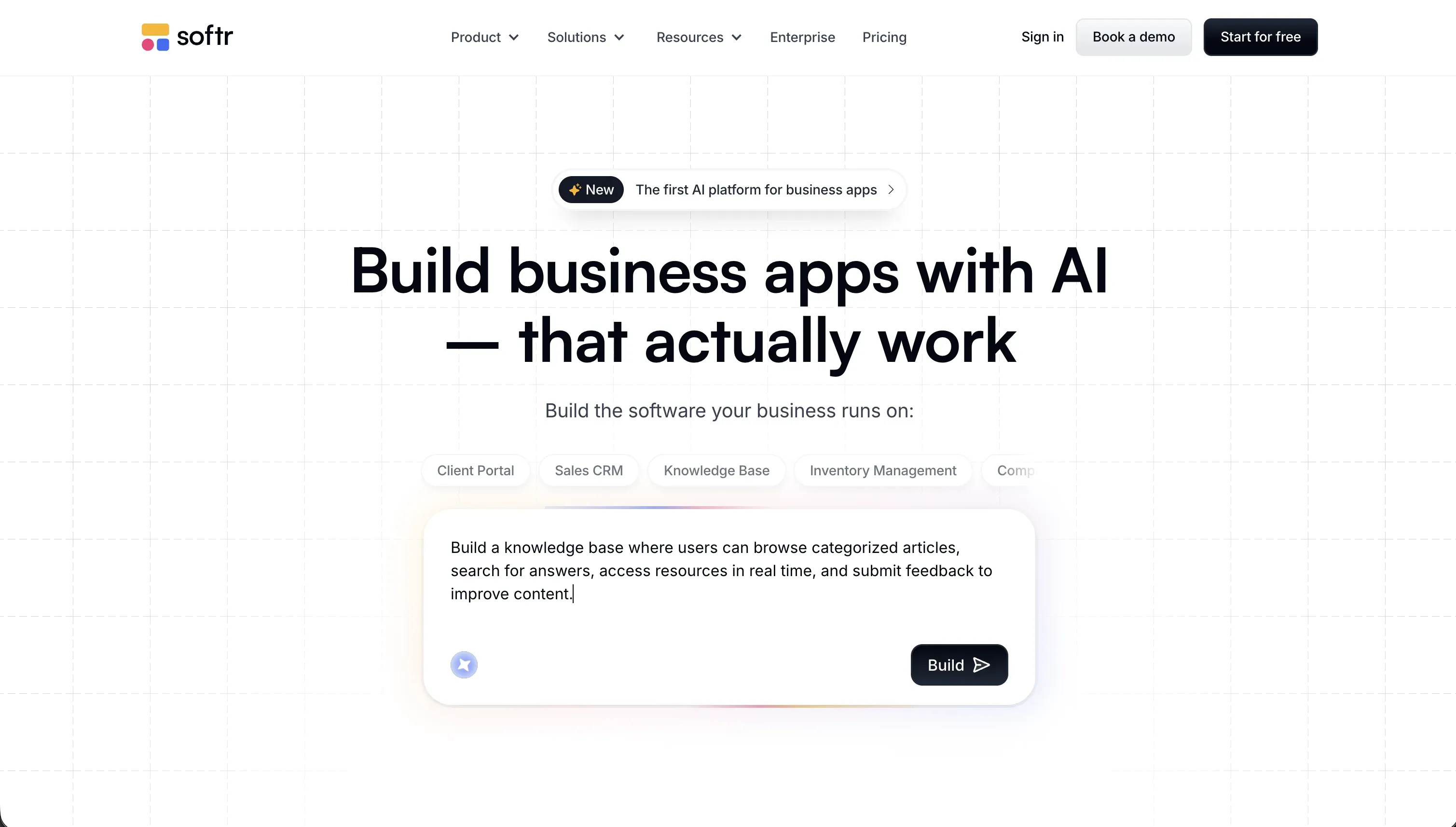
Emergent and Softr address different operational models in the AI-assisted application space. Emergent represents a full-stack, prompt-driven code generator that builds and edits custom codebases via an AI agent.
Softr, by contrast, is a native business application platform designed to compose battle-tested, pre-built components that builders can edit visually without writing or maintaining code.
Softr wins the general business-app decision, scoring 8.1 against Emergent’s 5.0 on aggregate. Softr provides a reliable, secure infrastructure for internal tools and databases, whereas Emergent remains a platform for sandboxed prototypes or quick code generation where stability is not a blocker.
The decision in 30 seconds
| If your priority is… | Pick | Why |
|---|---|---|
| Client portals, internal tools, and CRMs | Softr | Ships with pre-built user management, authentication, and secure server-side CRUD routing |
| Rapidly scaffolding code from a single text prompt | Emergent | Produces a functional backend schema, database routing, and frontend UI in minutes |
| Zero-credit manual editing and ongoing maintenance | Softr | Features near-parity between AI and visual controls, so any change can be made by hand |
| Security validation and reliable access control | Softr | Visual user groups and global data restrictions replace generated, unverified permission scripts |
| Predictable monthly software billing | Softr | Flat-rate tiers with defined resources instead of high usage-based credit models |
| Native mobile apps distributed through app stores | Neither | Both tools primarily target browser-based deployments and progressive web apps |
What each platform is
What is Emergent?
Emergent is an AI-powered development space that relies on agentic execution to scaffold whole systems. Users provide a prompt, and the platform generates a backend schema, database routing, design elements, and user interfaces inside hosted dev containers. Revisions to both logic and copy are handled by chatting with an edit agent.
Under the hood, Emergent attempts to handle cloud deployment on private project containers. It features standard web and mobile workspace layouts, a 1-million context window on higher plans, and a task forking system. It is designed for founders and operators seeking custom programmatic setups without writing raw syntax.
What is Softr?
Softr is an AI no-code app builder that acts as a visual composer for business systems. When builders describe their needs, the AI Co-Builder coordinates proven structural blocks - database tables, pages, forms, kanbans, and calendars - already wired to secure authentication and permissions.
It functions as a complete business software suite, providing built-in databases, workflows, and standalone forms natively.
Softr’s flagship feature is its hybrid layout engine. Every element configured by the AI can be accessed and modified manually by humans using the visual canvas, removing prompting bottlenecks. It also features a Vibe Coding block for adding custom React components, allowing builders to expand the native environment safely.
The core difference
The primary dividing line is the relationship between the builder, the AI, and the underlying software architecture.
- Emergent delegates full application architecture and codebase modification to an AI agent, requiring developers or builders to manage code containers and edit runtimes.
- Softr positions AI as an orchestrator of reliable, pre-built components, giving builders a visual interface to bypass code maintenance entirely.
- AI agent owns full architecture
- Modifies the codebase itself
- Builders manage code containers
- Runtimes need editing
- AI orchestrates pre-built components
- Visual canvas for building
- No code maintenance
- Reliable components throughout
Where the scores diverge
Maintainability: Emergent 3.5, Softr 9.0. Softr leads maintainability 9.0 to 3.5. Because Softr apps are assembled from native visual blocks, there is no custom code to break, and updates do not consume AI credits unless you explicitly choose to use the AI. Emergent requires ongoing code correction.
Its agent reportedly runs task edits for adjustments as small as two lines, frequently triggering debugging run loops. Reviewers have tracked instances of debugging loops repeating the same fix several times, driving credit usage up without resolving underlying bugs, which in one reported case drained near $10,000 AUD.
Production readiness: Emergent 3.5, Softr 8.5. Softr scores 8.5, while Emergent falls to 3.5. Softr stands on ready-to-use hosting infrastructure and EU server locations, ensuring SOC 2 Type II compliance out of the box. Emergent is held back by major container-level staging and runtime issues.
Buyers frequently report container latency, ‘Error Waking Up Agent’ crashes, and a structural gap where preview layouts do not behave identically when deployed to production. Additionally, blocked backend access during hosting failures combined with slow support makes production use high-risk.
Security & access control: Emergent 4.5, Softr 8.5. Softr scores 8.5 against Emergent’s 4.5. Softr houses credentials server-side and turns authentication types - password, OTP, sign-in, and magic link - into visual toggles, while row-level permissions are managed via explicit visibility rules.
Emergent generates authentication models and directory scaffolding during the prompt phase, but the security rules are written as code rather than configured in UI. Because backend access sometimes blocks during runtime failures, verifying authorization rules is unreliable.
Data & integrations: Emergent 5.5, Softr 8.0. Softr scores 8.0, while Emergent scores 5.5. Softr features a native relational database with web search agents, native Airtable, Sheets, and Notion sync, alongside REST endpoints on its Business plan.
Emergent designs custom database tables and routes them, but users report scaling limits where the logic begins to break once the codebase or directory rules grow of serious size. This infrastructure breakdown limits Emergent to simple data schemas.
Ease of build: Emergent 7.0, Softr 9.0. Softr scores 9.0 on ease of build compared to Emergent’s 7.0. Softr allows builders to generate a fully operational database, layout, role system, and navigation from a master prompt, with direct visual access to edit everything manually.
Emergent provides standard scaffolding in minutes from a prompt, establishing a low first-time barrier. However, once initial code generation is finished, further iterations require re-prompting an edit agent, which introduces the friction of explaining small layout or logic changes through conversational chat rather than clicking a simple visual button.
Design flexibility: Emergent 6.0, Softr 5.5. Emergent scores 6.0 against Softr’s 5.5. Emergent utilizes generative prompts to construct custom CSS and layouts, theoretically providing more interface freedom, though mobile execution is reported as less mature.
Softr limits users to a block-based interface design beneath a global typographic and color theme, preventing pixel-perfect canvas placements. Softr offsets this boundary with a focused Vibe Coding block that lets builders generate custom components securely.
Cost comparison
The billing structures represent two entirely different procurement risks. Softr uses flat-rate subscription pricing - starting at $19/mo (billed annually) for Basic up to $329/mo for Business - with predictably declared app user and record limits.
While Softr limits custom roles and native API integrations to higher plans, the subscription represents a predictable monthly ceiling because running low on AI credits never blocks manual updates or database usage.
Emergent utilizes an aggressive, usage-based model tied to agent operations. While plans run from a Free tier to $20/mo for Standard and $200/mo for Pro, virtually every build instruction or bug fix spends credits from a monthly pool.
Because edits on small layouts trigger the system’s edit agent, automated debugging runs can exhaust standard limits and require top-ups. This makes budgeting for ongoing developers or operations teams highly variable, especially during the diagnostic iterations of complex apps.
Lock-in and the exit path
Neither tool offers a standard code export to run inside different runtimes. In Softr, your data remains highly portable - especially when running on external Airtable or SQL tables - and native database records can be exported, but the page configurations must be reconstructed in another browser builder.
Emergent exposes code inside development containers and features GitHub integrations on paid tiers, but running the compiled workspace outside their custom container setup requires technical migration expertise.
Softr provides a cleaner data-layer exit due to its native connectors and relational exports, while Emergent demands infrastructure rebuilds to extract a project entirely from its hosting environment.
Who should pick Emergent
Pick Emergent if:
- Software teams seeking a rapid sandbox generator to scaffold full-stack code blocks from simple natural language prompts.
- Makers focused on web prototypes who prefer holding code repositories in GitHub rather than building visually.
- Developers requiring a prompt-to-app structure where backend routing sheets and views are wired up in sandbox environments.
Do not pick Emergent if you cannot afford sudden credit draining during automated debugging loops or if your project requires reliable uptime and responsive technical support.
Who should pick Softr
Pick Softr if:
- Companies wanting to deploy custom client portals, secure member networks, or vendor directories that work reliably from day one.
- Operations managers seeking to connect custom frontends to existing data pools on Airtable, Google Sheets, or SQL databases.
- Teams that need visual role permissions and global data restrictions to protect production credentials without checking raw scripts.
Do not pick Softr if your priority is creating native mobile apps for distribution in Apple and Google app stores, or if you require pixel-level dashboard styling.
Where neither platform fits
If you require pixel-perfect native mobile application builds with push notifications deployed directly to Google and Apple app marketplaces, neither of these platforms will fully serve your roadmap. For those setups, you should consider a native-first builder like FlutterFlow, which compiles clean mobile packages and supports custom Dart integrations.
Similarly, if your procurement process demands absolute code ownership, full server self-hosting, and the ability to export the entire runtime environment to run elsewhere, you are better served avoiding both visual compose and generator tools. In those instances, you should evaluate an AI-assisted development workspace like Replit, which yields editable and standard codebase control.
Analyst verdict
Softr wins this comparison with a 8.1 to 5.0 aggregate score. The decision is decided by production readiness and operational maintenance. Softr turns complex layers like user security, CRM connections, database operations, and onboarding workflows into standard visual features that teams can verify. Softr remains the standard selection for operational portals and business interfaces.
Emergent keeps its fit when a builder seeks a rapid sandbox generator for code generation rather than a production application. If your workflow relies on continuous visual changes and predictable software billing, Softr provides the safer architecture.
Related reading: the Emergent scorecard, the Softr scorecard, and our scoring methodology.