




What Property Management Software Actually Needs
Property management apps have a narrower job than generic business tools. They need to support recurring operational workflows across multiple user types, usually tenants, property managers, owners, and maintenance staff. That means the product is not just a form app or a dashboard.
It is a multi-user system where people must see different records, submit updates, and trust that sensitive lease and payment data stays private.
That is why security and access control matter most in this category. A tenant should only see their own unit, tickets, documents, and messages. A property owner may need portfolio-level visibility, while a site manager needs edit rights across only selected buildings.
Platforms that provide built-in authentication, user groups, and row-level permissions score better here because they reduce the chance of accidental data exposure.
Production readiness is the next requirement. Property operations are ongoing, not occasional. If residents cannot log maintenance requests or staff cannot update inspections from the field, the app quickly becomes a liability. Reliable hosting, mobile responsiveness, and stable user sessions matter more than flashy design features.
Maintainability also weighs heavily because real estate workflows change. You may add a new inspection checklist, alter approval steps for vendor invoices, or separate commercial and residential properties into different processes. Builders that let non-developers update schemas, forms, and permissions without rewriting the whole app have an advantage.
Data and integrations are equally important. Many teams already live in Airtable, spreadsheets, accounting tools, or SQL databases. The right platform should connect to those systems without creating a fragile patchwork. Ease of build matters too, but in this use case it means shipping a secure, working portal quickly, not merely dragging attractive blocks onto a canvas.
Finally, design flexibility still counts, especially for public-facing listings or owner dashboards, but most property teams benefit more from dependable workflows and permissions than pixel-perfect layout control.
The use-case comparison
| Platform | Overall | Advantage | Main reason to exclude it |
|---|---|---|---|
| Softr | 8.1 | Built-in user groups, row-level security, and fast deployment for portals. | Design is block-based rather than fully freeform. |
| Bubble | 6.8 | Highly flexible workflows and database logic for custom rental products. | Harder to learn and pricing can rise with usage. |
| Replit | 7.4 | Real code, strong flexibility, and broad integration potential. | Requires technical oversight to secure and maintain. |
| Glide | 6.3 | Very fast for mobile-friendly internal tools built from tabular data. | External user pricing and permissions are limiting. |
| Airtable | 6.3 | Excellent relational data management for internal property operations. | Not suitable as a full tenant-facing app layer. |
| WeWeb | 6.2 | Strong design freedom and a polished frontend experience. | Needs a separate backend and more manual setup. |
1. Softr - best for tenant portals and operations
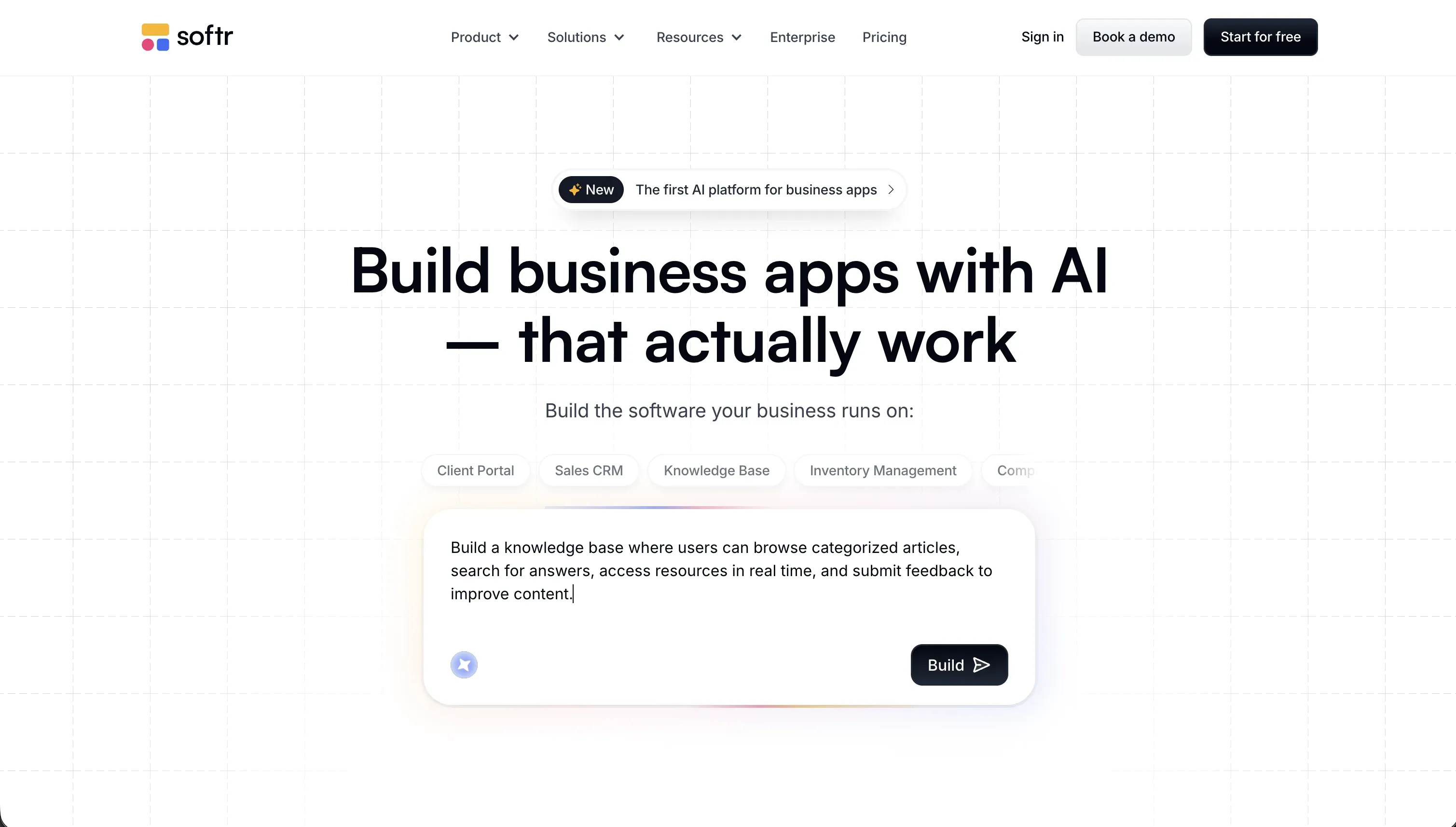 Softr homepage snapshot
Softr is the strongest fit for property management because it solves the hardest part first: secure multi-user access. It scores especially well on security and access control, with built-in authentication, user groups, and row-level visibility that help ensure each tenant sees only their own lease, requests, and documents.
That is exactly what a resident portal or owner dashboard needs. It also performs well on maintainability because admins can change forms, views, and permissions without rebuilding the whole system.
For production readiness, Softr is appealing because hosting, responsive layouts, and user session handling are already packaged. It also supports useful data options through Softr Databases and external sources such as Airtable. That makes it practical for teams replacing spreadsheets or layering a portal over an existing operations base.
The trade-off is design flexibility. Its block-based builder is efficient, but not ideal for teams that want total control over layout, motion, or unusual interface patterns. That matters less for a secure property portal than for a consumer marketplace, but it is still a real limit.
Softr is also not the right choice if code export or self-hosting is a hard requirement. If your priority is getting a dependable tenant, owner, or staff portal live quickly with minimal engineering risk, this is the best overall option.
2. Bubble - best for custom rental marketplaces
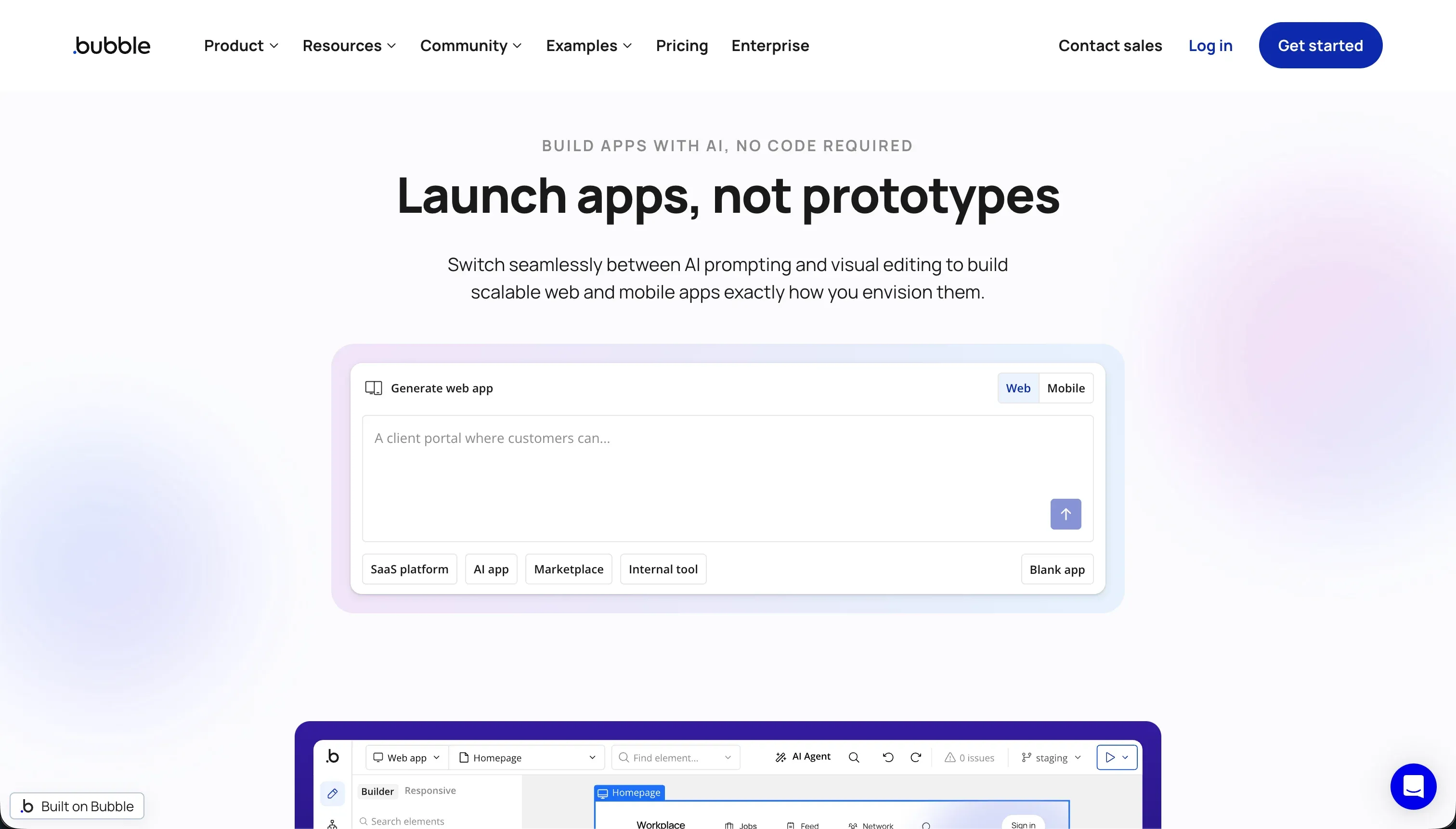 Bubble homepage snapshot
Bubble is the best option when property management extends into a more custom transactional product, such as a rental discovery marketplace, a booking flow, or a more advanced landlord workflow engine. Its core strength is flexibility.
Bubble scores highly on design flexibility and data logic because you can model complex records, build conditional workflows, and connect APIs without leaving the platform.
That makes Bubble attractive for teams that need more than a standard portal. If you want custom listing pages, inquiry flows, availability logic, or unusual approval processes, Bubble can usually handle it. It is also stronger than simpler builders when the application needs many edge cases or non-standard business rules.
The downside is ease of build. Bubble has a visual interface, but it behaves much closer to software development than to lightweight no-code assembly. Security can also be strong, yet it depends on careful configuration of privacy rules. That means one missed setting can create risk in a property app where personal data must stay isolated.
Pricing is another caveat, since workload-based billing can become less predictable as usage grows. Bubble should be excluded if your team needs a fast, low-training path to a secure tenant portal next month. It shines when customization is the priority and you can afford the implementation complexity.
3. Replit - best code-first development environment
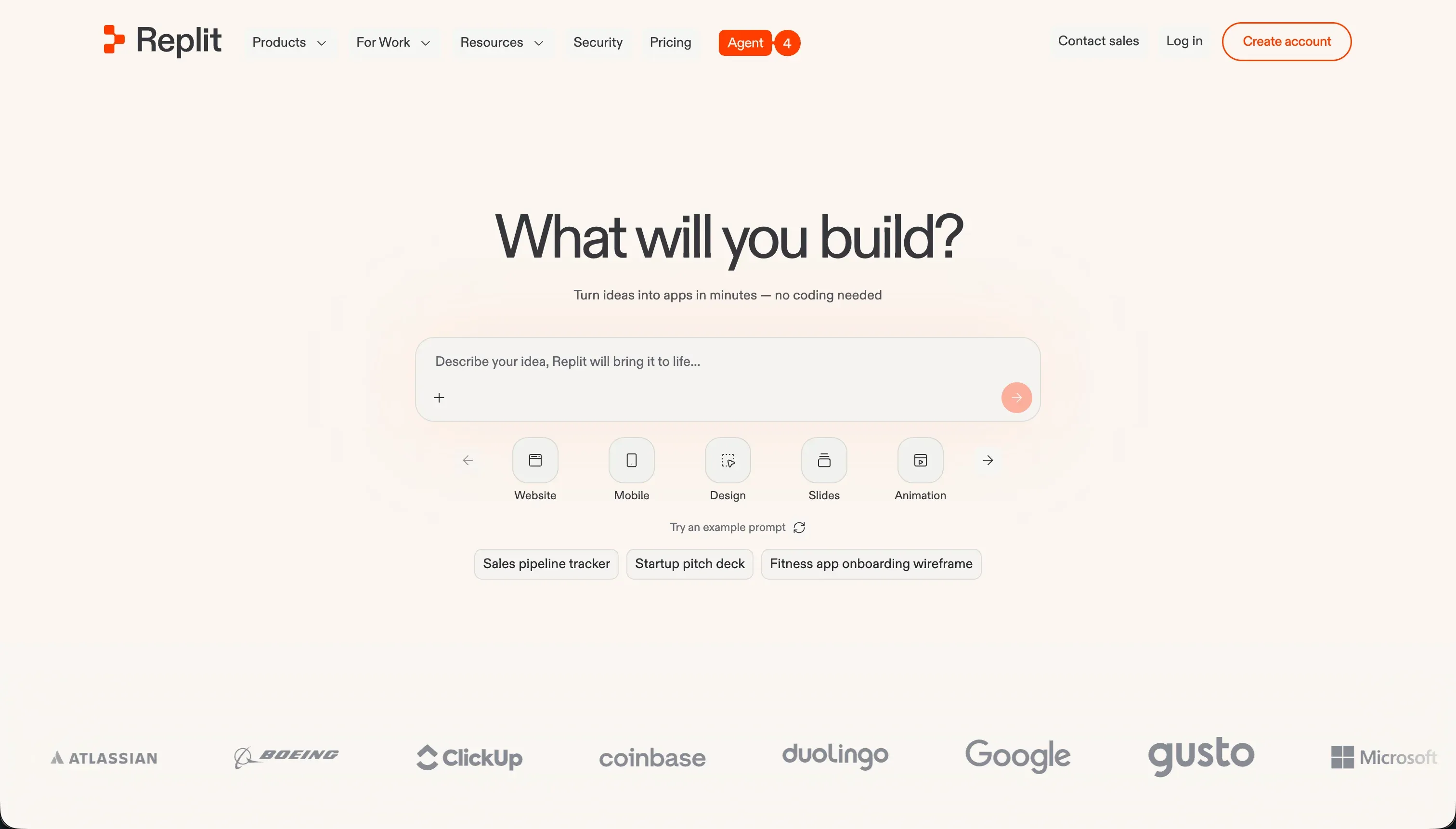 Replit homepage snapshot
Replit is a strong choice for property companies or agencies that want custom software without being locked into a closed no-code runtime. Its main advantage is code ownership. You can use AI assistance to scaffold real applications, then refine and deploy them as standard software.
That gives Replit strong scores for flexibility, integrations, and long-term extensibility compared with visual-only builders.
For property management, this matters when requirements become technical: custom inspection logic, deep accounting integrations, unusual access rules, or workflows that span multiple systems. Replit also suits teams that expect the application to grow into a broader operating platform over time. Production readiness is solid because you are working with real app architecture rather than only a visual abstraction.
The clear trade-off is governance. Security and access control are not packaged as simple toggles in the same way they are in Softr. Your team must review authentication, database permissions, and API exposure directly in code. Maintainability can be good, but only if someone technical owns the app after the initial build. There is also cost variability tied to AI usage and development effort.
Replit should be excluded if you do not have developer capacity to inspect and test the generated application. It is best for buyers who want flexibility and control more than simplicity.
4. Glide - best for mobile field inspection tools
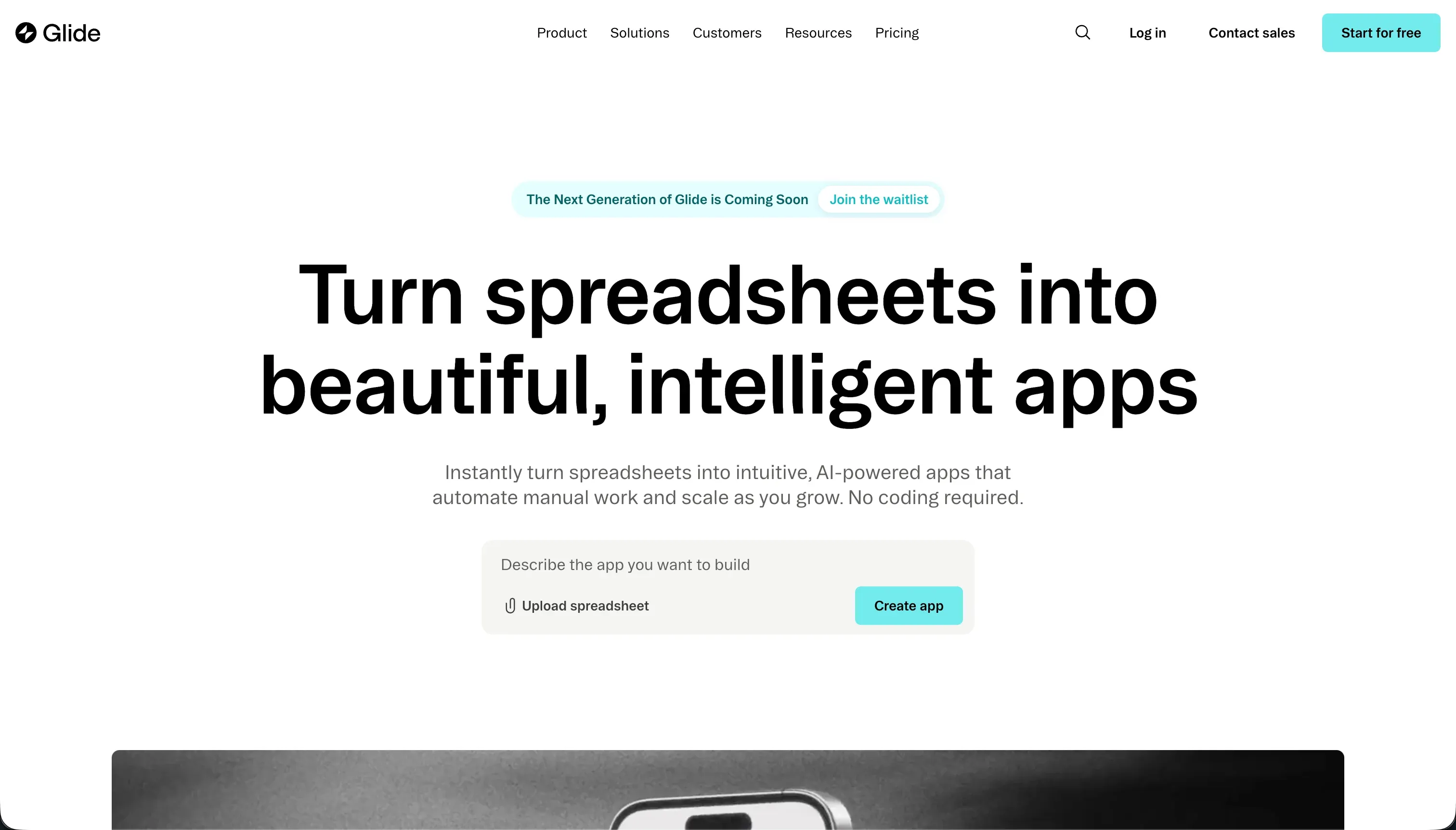 Glide homepage snapshot
Glide works best for narrower property workflows, especially internal mobile tools used by managers, inspectors, or maintenance staff. It scores well on ease of build because it can turn tabular data into usable apps very quickly.
For teams that want a checklist app for unit inspections, work orders, or simple reporting from the field, Glide is often the fastest path from spreadsheet to working interface.
Its mobile-friendly presentation is another benefit. Many property tasks happen on-site, so responsive layouts and simple components matter more than elaborate screens. Glide is good at making that kind of operational app feel polished without much setup.
Where it falls short is in the complexity of external access. Permissions are not as robust as the best tenant portal platforms, and pricing can become unattractive when you need many external users. That makes Glide a weaker fit for resident-facing systems across larger portfolios. Design freedom is also limited, so it is not ideal if branding or custom interaction patterns are important.
Glide should be excluded if your main goal is a secure tenant portal for hundreds of residents on predictable pricing. It is better as a lightweight internal tool than as the center of a multi-tenant property management stack.
5. Airtable - best for internal back-office asset management
Airtable earns its place because property management is fundamentally data-heavy. Units, tenants, leases, vendors, inspections, and maintenance records all benefit from a relational structure, and Airtable remains one of the easiest ways for non-technical teams to organize that information.
It scores well for ease of build and data management, especially for internal operations where staff need clear views, filters, and linked records.
This makes Airtable excellent as an operational source of truth for smaller teams or for departments that are formalizing processes before investing in a full customer-facing product. It is especially useful for portfolio tracking, internal task coordination, and property-level reporting.
The limitation is that Airtable is not a complete property app builder for external users. Its native interface layer is far weaker on authentication, row-level user isolation, and branded tenant experiences than dedicated portal builders. Production readiness also becomes more questionable as record counts and workflow demands grow.
If your goal is a true resident portal with password recovery, secure document delivery, and clean user segmentation, Airtable alone should be excluded. It is best used as a back-office layer or paired with a frontend platform rather than selected as the complete solution.
6. WeWeb - best for agencies with separate databases
 WeWeb homepage snapshot
WeWeb is most attractive for teams that care about frontend quality and already know they want a separate backend such as Supabase or Xano.
In property management, that can make sense for agencies building polished owner portals, custom listing experiences, or branded resident interfaces that need more visual control than block-based tools allow. WeWeb scores well on design flexibility and can produce more bespoke interfaces than most no-code competitors.
That design freedom, however, comes with setup complexity. WeWeb does not include its own native database, so the buyer must choose, connect, and govern a backend separately. That lowers its ease-of-build score for property teams that simply want one platform to manage users, data, and interfaces together. Security also depends heavily on how well the backend permissions are configured.
Maintainability can be acceptable in experienced hands, but every workflow change may involve updates across multiple systems rather than one builder. For a buyer without technical experience, that increases implementation risk. WeWeb should be excluded if you want an all-in-one path to launch a secure tenant portal quickly.
It is better suited to agencies or technically capable teams that already have a backend strategy and want stronger frontend control.
How to shortlist the right property app builder
Start your shortlist by deciding whether you are building an internal operations tool, a tenant portal, or a public marketplace. Those are different products with different platform needs. Internal tools can tolerate simpler auth and favor speed. Tenant portals require strict permissions and dependable login flows. Marketplaces need more design freedom and custom logic.
Next, build a small proof of concept using your real structure: one admin, one property manager, and at least two tenants tied to different units. Test whether each user only sees the right records, whether forms are easy to update, and whether the app still feels usable on mobile. This simple pilot exposes most security and workflow weaknesses quickly.
You should also evaluate how the platform fits your existing data stack. If your team already runs on Airtable or spreadsheets, confirm how sync, permissions, and scaling will work before committing. If you expect long-term complexity, compare an all-in-one option with a code-first route.
For more detail on how we score platforms, review our /methodology. If your project overlaps with broader portal buying, see our related guides on client portals and marketplace builders.