


What a Marketplace Builder Actually Needs to Handle
A marketplace is not just a catalog with login screens. It is a system that has to coordinate at least three groups at once: buyers, sellers, and operators. Buyers need trustworthy search, filtering, messaging, and checkout flows. Sellers need listing management, profile controls, payouts, and often moderation states.
Operators need rules for commissions, fraud prevention, support workflows, and reporting. That combination makes marketplaces one of the hardest app categories to build well.
That is why this use case maps tightly to six evaluation criteria. Ease of build matters because founders often need to launch a working supply and demand loop quickly, but that speed is only useful if the product can support real transaction logic. Production readiness matters because marketplaces touch payments, disputes, refunds, and identity data.
Security and access control are equally critical, since buyers should not see seller-only data, sellers should not alter platform ledger values, and admin actions must stay protected on the server side.
Data and integrations are another major factor. A real marketplace usually depends on relational data structures across users, listings, orders, reviews, messages, and payouts. It may also need Stripe Connect, maps, geolocation, email, analytics, and external automation.
Design flexibility matters because many marketplaces compete on trust and usability, and generic layouts can reduce conversion when browsing large inventories. Finally, maintainability is decisive over time. Marketplace rules evolve constantly as pricing models, payout flows, and moderation policies change.
The right builder should let a team update those rules without rewriting the whole product or creating brittle workarounds.
In practice, the best platform depends on whether you are building a simple directory, a service marketplace, or a fully transactional multi-vendor product. The rankings below prioritize platforms that can handle the deeper operational demands, not just listing pages.
The use-case comparison
| Platform | Overall | Advantage | Main reason to exclude it |
|---|---|---|---|
| Bubble | 6.8 | Best mix of visual logic, relational data handling, privacy rules, and custom marketplace workflows. | Steep learning curve, no code export, and long-term dependence on Bubble’s runtime. |
| Replit | 7.4 | Creates real exportable code with strong database flexibility and a clean ownership path. | Needs technical oversight and is not suitable for fully non-technical operators. |
| WeWeb | 6.2 | Excellent visual frontend control with code export for teams that already have a backend. | No native database or auth stack, so setup is more complex and more expensive. |
| FlutterFlow | 6.3 | Best route for native iOS and Android marketplace apps with exportable Dart code. | Web delivery is weaker, especially for SEO-heavy marketplace discovery pages. |
| Softr | 8.1 | Fastest path to a working directory-style marketplace with user groups and listings. | Cannot support highly custom checkout logic or advanced marketplace workflows. |
| Glide | 6.3 | Turns spreadsheet data into a polished app quickly with minimal setup time. | Pricing and template limits make it a weak fit for complex public marketplaces. |
1. Bubble - best overall for complex transactional marketplaces
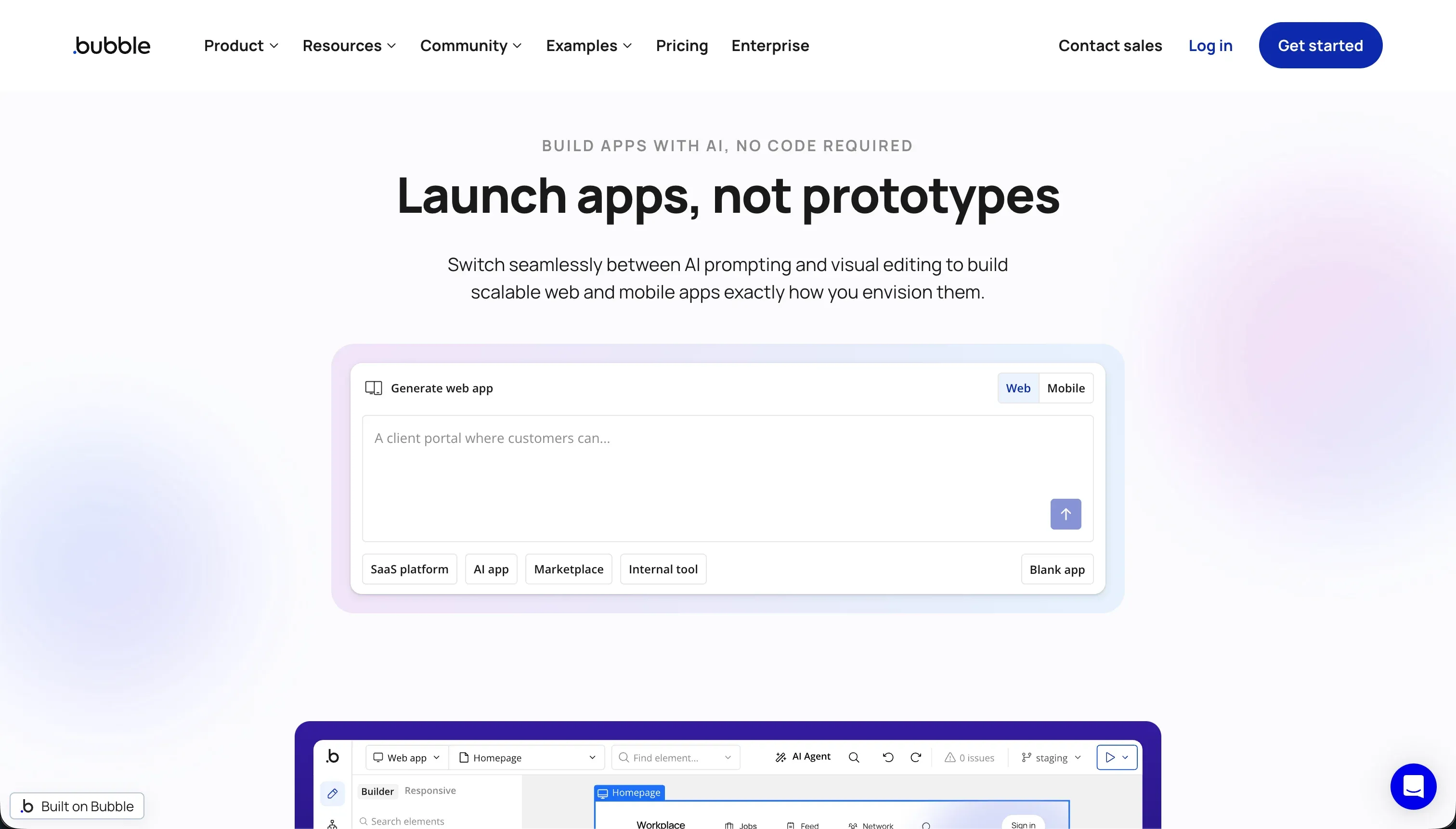 Bubble homepage snapshot
When a marketplace needs custom transactional logic, detailed seller onboarding, and flexible admin rules, Bubble remains the strongest no-code choice. Its design flexibility score of 8.5 is especially valuable for marketplace products that need custom listing cards, search states, checkout flows, and trust-building account areas.
Bubble also scores 8.0 for data and integrations because it can model the relational structures that marketplaces rely on, including listings, orders, reviews, carts, messages, and commission records.
Bubble ranks first because it combines that data depth with strong production features. Privacy rules, backend workflows, and Stripe integrations make it one of the few visual builders that can support real two-sided transaction logic without immediately forcing a custom code stack. That said, it is not easy.
Ease of build lands at 5.0 because secure workflows, database design, and performance tuning all require real platform knowledge. A weak Bubble build can become slow or hard to maintain.
The clearest exclusion is code ownership. Do not choose Bubble if your roadmap requires self-hosting, direct source-code control, or a clean exit path from the platform. Its proprietary runtime is powerful, but it is still a lock-in tradeoff.
2. Replit - best code-first route with AI assistance
 Replit homepage snapshot
For teams that want marketplace flexibility without surrendering code ownership, Replit is the best alternative. It stands out by generating real application code, database structure, and working logic in a standard development environment.
That gives it a production readiness score of 8.0 and a maintainability score of 7.5, both strong for founders who expect their marketplace rules to evolve over time.
Replit is particularly attractive when your marketplace may outgrow a visual builder. You can build custom roles, search logic, order flows, and payout handling in code, then move the project to another host later if needed. That export path is a major advantage for serious operators. It also supports managed databases and modern developer tooling, which helps when the product moves beyond MVP stage.
Its main weakness is operational complexity. Security and access control score 6.0 because role boundaries and sensitive actions must be implemented correctly in code rather than configured in a simpler visual permissions layer. Non-technical teams can struggle if the AI agent produces buggy logic or burns credits on debugging loops.
Do not choose Replit if no one on your team can review application code and own maintenance.
3. WeWeb - best visual frontend for pre-existing databases
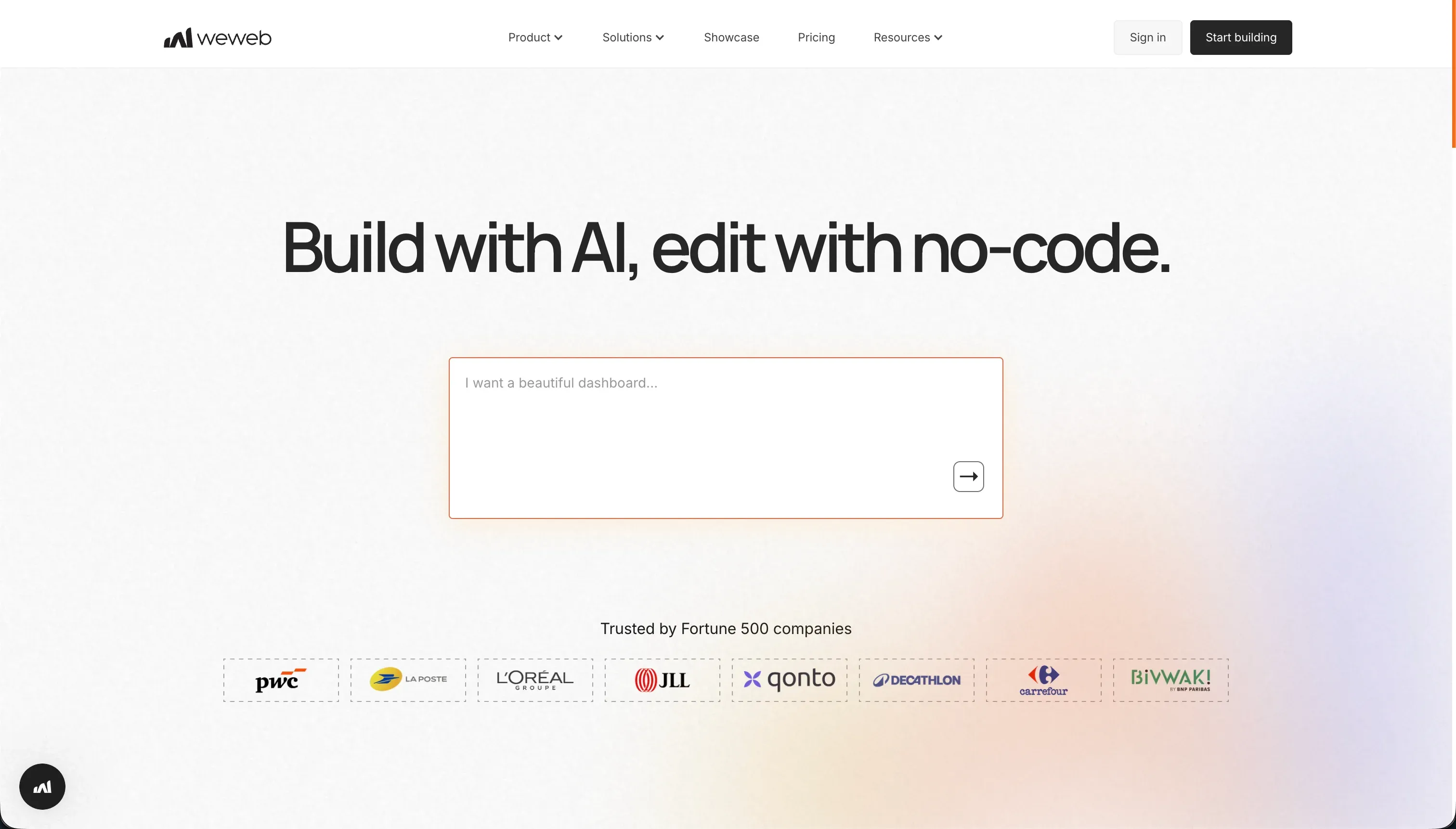 WeWeb homepage snapshot
WeWeb is the best pick for teams that already have a backend and want a polished, highly custom marketplace frontend. Its design flexibility score of 8.5 is one of the best in the category, making it ideal for custom search layouts, seller pages, listing detail views, and conversion-focused landing pages.
It also offers Vue and Nuxt export options on higher plans, which is valuable for teams that want a clearer long-term ownership path.
Where WeWeb falls short is that it is not a complete marketplace stack on its own. Ease of build scores 4.0 because there is no native database, and core marketplace functions such as auth, listings, permissions, and transactions must be handled through tools like Supabase, Xano, or another external backend.
That architecture can be powerful, but it adds more setup, more vendors, and more opportunities for misconfiguration.
This makes WeWeb a poor fit for solo non-technical founders who want an all-in-one marketplace builder. If you do not already have backend capability or budget for one, the extra complexity becomes the reason to exclude it.
4. FlutterFlow - best for native mobile marketplaces
 FlutterFlow homepage snapshot
If your marketplace needs to live primarily as a mobile product, FlutterFlow is the best specialist choice. It scores 9.0 for design flexibility and gives teams strong control over native app interfaces, interactions, and device features.
That matters for marketplace categories where push notifications, location-based browsing, in-app messaging, or mobile-first usage patterns shape the core experience.
FlutterFlow also benefits from code export, which improves its long-term maintainability compared with closed no-code systems. For teams targeting the App Store and Google Play first, that makes it a credible route to a serious product. You can design seller dashboards, listing creation flows, and buyer checkout screens with much more native polish than most browser-first builders can offer.
The tradeoff is web weakness. Ease of build scores 4.5 because state management, APIs, and backend setup still demand technical confidence. More importantly, FlutterFlow is not the best choice for SEO-led marketplaces that depend on search engine traffic and lightweight web landing pages. If discovery on the open web is central to growth, that limitation is a practical reason to exclude it.
5. Softr - best for directory-style marketplaces
 Softr homepage snapshot
For founders who want to launch a curated listing marketplace or service directory quickly, Softr is one of the most efficient tools available. It scores 9.0 for ease of build thanks to its fast setup flow, built-in user groups, and ready-made listing components.
That makes it excellent for testing whether buyers will browse and whether sellers will join, before investing in deeper transaction logic.
Softr also performs well on production basics. Authentication, permissions, and Stripe-enabled forms help it reach strong readiness for lightweight marketplace operations. If your model is closer to a directory, local services board, or vetted member network than a full commerce engine, Softr can get you live in days rather than weeks. It is often the right tool for proving demand before complexity is justified.
The limitation is customization. Design flexibility sits at 5.5, and advanced marketplace mechanics such as multi-vendor carts, custom commission logic, escrow-like flows, or unusual approval states are awkward or impossible. Do not choose Softr if the business requires bespoke transaction handling instead of simple listing and lead-generation workflows.
- Launch in days, not weeks
- Built-in user groups and permissions
- Stripe-enabled forms
- Ready-made listing components
- Ease of build scores 9.0
- Design flexibility sits at 5.5
- Multi-vendor carts awkward or impossible
- No custom commission logic
- Escrow-like flows unsupported
- Unusual approval states fail
6. Glide - best for rapid spreadsheet directories
 Glide homepage snapshot
Glide is best viewed as a fast path from existing data to a polished directory-like marketplace prototype. If your listings already sit in Airtable, Google Sheets, or Excel, Glide can transform them into a clean mobile-friendly interface almost immediately.
Its ease of build score of 8.5 reflects just how little setup is required to get searchable listings, images, profile views, and lightweight interactions in place.
That speed is useful for internal pilots, niche catalogs, or early experiments where the main question is whether users care about the supply side. Glide can also handle modest data workflows and simple logic without much technical effort. For low-complexity matching or discovery products, that can be enough to validate demand.
But Glide is not a strong foundation for a serious transactional marketplace. Design flexibility drops to 4.0, and its pricing model can become painful as external user counts grow. It also lacks the depth needed for custom checkout, advanced permissions, and complex multi-role logic. If your product requires true marketplace operations at scale, those limits are enough to rule it out.
How to Shortlist and Prototype Your Marketplace
The fastest way to make a good marketplace decision is to separate your idea into three layers: discovery, transactions, and long-term control. If you only need searchable listings and simple user roles, shortlist Softr and Glide first. If you need real transaction logic, seller workflows, and custom rules, start with Bubble and Replit.
If mobile apps are core to the product, add FlutterFlow. If your backend already exists, include WeWeb for frontend evaluation.
Run two short prototypes in parallel and test the hardest workflow first, not the homepage. That usually means seller onboarding, listing approval, buyer checkout, or payout handling. A platform that looks good in a demo can still fail when you model real permissions and edge cases. Use that test to compare setup speed, limits, and how easy changes feel after the first build.
Before committing, review our methodology to understand how we score maintainability, security, and production readiness. If you are deciding between lighter and heavier tools, related comparison pages can also help narrow tradeoffs before you invest in a full build.