





What an equipment tracking app actually needs
Equipment tracking sits at the intersection of inventory databases, logistical scheduling, and field workforce checkouts. It is an operational business problem first, not just a form builder project. Success depends on field crews, warehouse coordinators, and office managers all using different views of the same central dataset.
A technician in the field needs a fast mobile screen to scan a tag, check an item in or out, or update a generator status. An operations lead needs a denser desktop dashboard to review utilization, maintenance history, and location conflicts across sites. That is why this use case should be mapped carefully against six buying criteria.
First, security and access control matter because crews, subcontractors, clients, and admins should not all see the same records. Field teams should only access equipment tied to their jobs, while managers may need full cross-site visibility. Second, production readiness matters because equipment updates often happen in yards, vehicles, and remote sites where connectivity is inconsistent.
Mobile-friendly delivery and dependable authentication are essential. Third, maintainability is a major cost driver. Tracking processes change often, so adding QR fields, inspection steps, service dates, or status options should be easy without creating fragile custom code.
Fourth, data and integrations determine whether the app can connect equipment records to job sites, operators, customers, forms, and billing systems. Fifth, ease of build still matters because many teams need to ship a pilot quickly using existing spreadsheet or database data. Sixth, design flexibility matters, but usually less than governance and data structure for this category.
Most buyers do not need a highly branded consumer app. They need a dependable internal or partner-facing system that keeps asset records accurate. The best platforms here are the ones that turn messy spreadsheet processes into controlled, searchable, role-aware tracking workflows.
The use-case comparison
| Platform | Overall | Advantage | Main reason to exclude it |
|---|---|---|---|
| Softr | 8.1 | Built-in user groups, server-side permissions, and predictable flat plans | No code export and visual layout is block-based only |
| Glide | 6.3 | Fastest spreadsheet-to-mobile app generation with useful AI columns | Thinner permissions and seat pricing gets expensive at scale |
| Retool | 6.8 | Direct SQL reads and writeback with dense developer-grade tables | Steep coding learning curve and high seat price for mobile operators |
| Airtable | 6.3 | Most approachable relational system for organizing logistics | Interfaces are desktop-leaning and mobile layouts are rigid |
| Replit | 7.4 | Real, exportable code with autonomous developer agent workflows | Your team must maintain raw code and deployment settings |
| Bubble | 6.8 | Deep custom workflows and strong visual design control | Proprietary lock-in and variable usage bills |
1. Softr - best for permission-based field portals
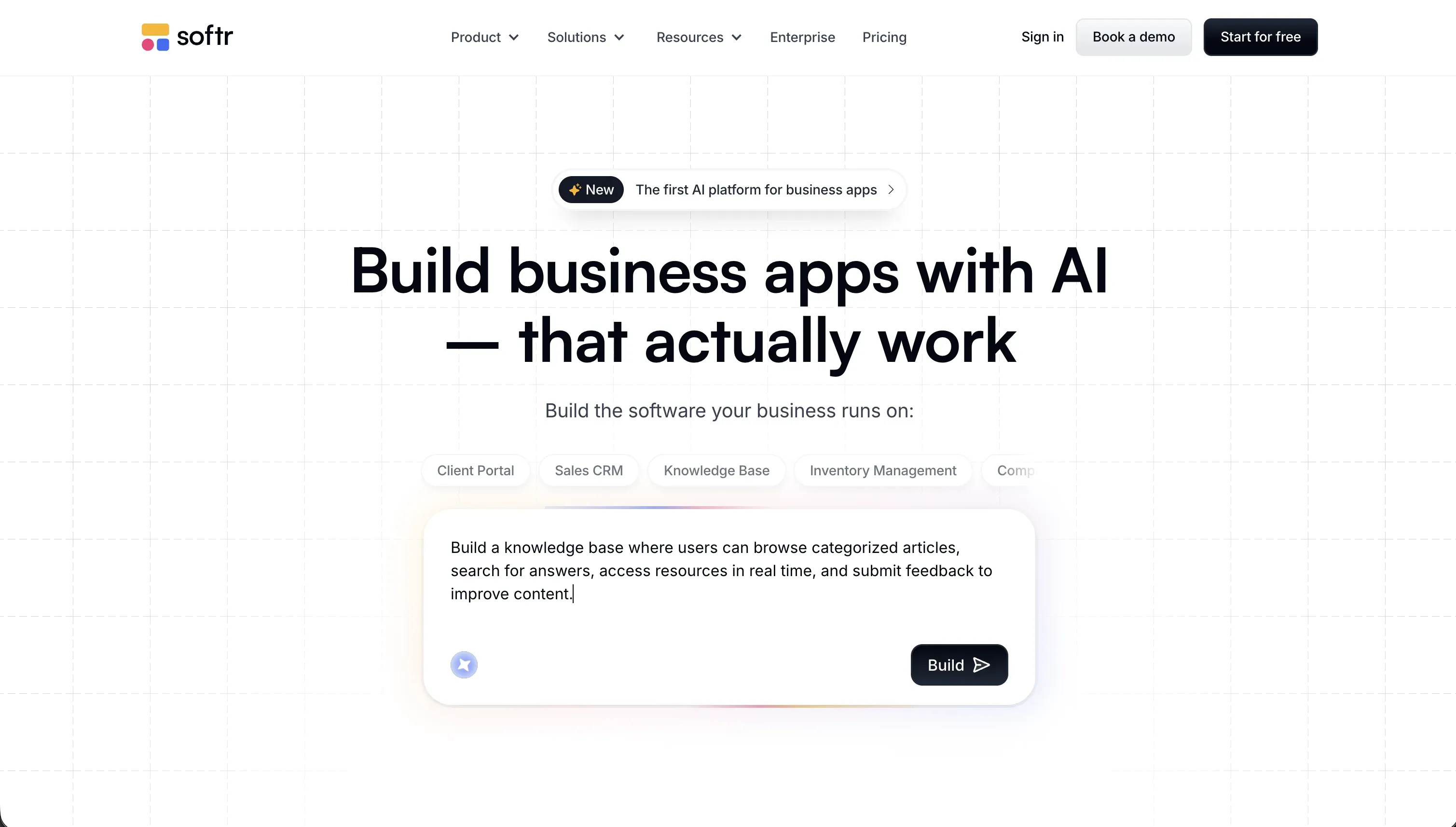 Softr homepage snapshot
For equipment operations with distinct teams, Softr offers the strongest balance of governance, speed, and maintainability. It combines a familiar database structure with robust user permissions, making it well suited to asset catalogs, field checkouts, and service logs. Security and access control scores 8.5 because permissions are enforced server-side rather than only in the interface.
That makes it practical to give field crews access only to assigned assets while admins keep broader write privileges. Production readiness also scores 8.5 thanks to built-in authentication, responsive delivery, and dependable portal patterns for internal and external users. Maintainability is a major strength at 9.0, since adding status fields, barcode steps, or inspection workflows is mostly a visual change.
The main tradeoff is design flexibility, which sits around 5.5 because Softr uses a block-based builder rather than fully custom layouts. Exclude Softr if your project requires exact pixel-level design control or full code export for long-term engineering ownership.
2. Glide - best for spreadsheet-driven mobile checkouts
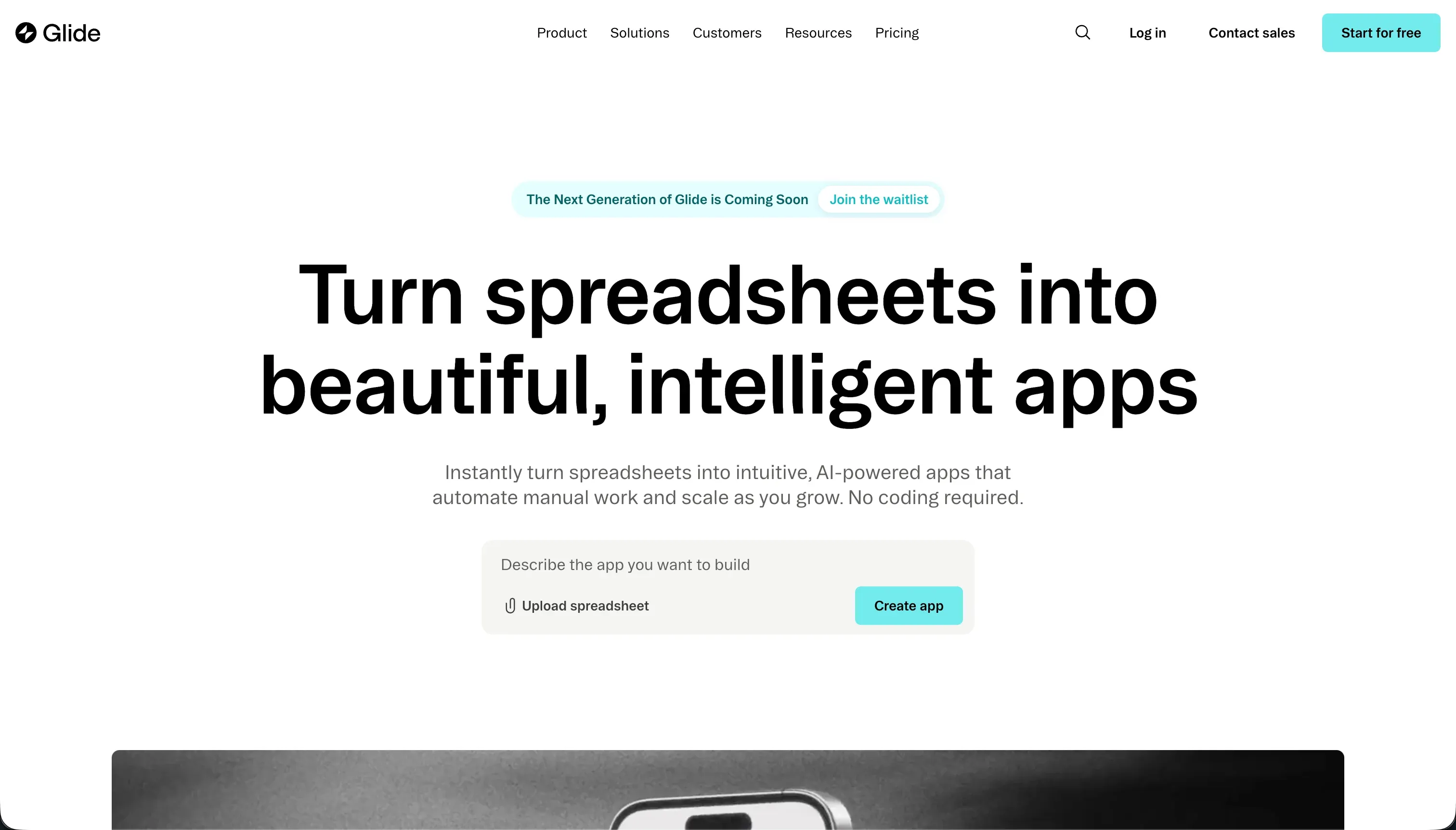 Glide homepage snapshot
Glide ranks highly because it is one of the fastest ways to turn existing operational data into a usable mobile app. Its ease of build score of 8.5 reflects how quickly a team can connect Sheets, Airtable, or Glide Tables and generate a clean smartphone-friendly interface. That is useful for check-in and check-out flows, inspection forms, and simple field status updates.
The platform also performs well on everyday data handling, scoring 7.0 for data and integrations in typical spreadsheet-centered deployments. Where Glide becomes less attractive is scale and governance. Security and access control scores 5.5 because advanced multi-role or client-specific visibility rules are thinner than in more security-focused tools.
Pricing is another constraint, since seat-based licensing can rise quickly when you add large field crews, contractors, or customer users. Exclude Glide if you need strict server-side permission models across many external stakeholders or if your expected user count makes per-seat pricing difficult to justify.
3. Retool - best for technical internal logging consoles
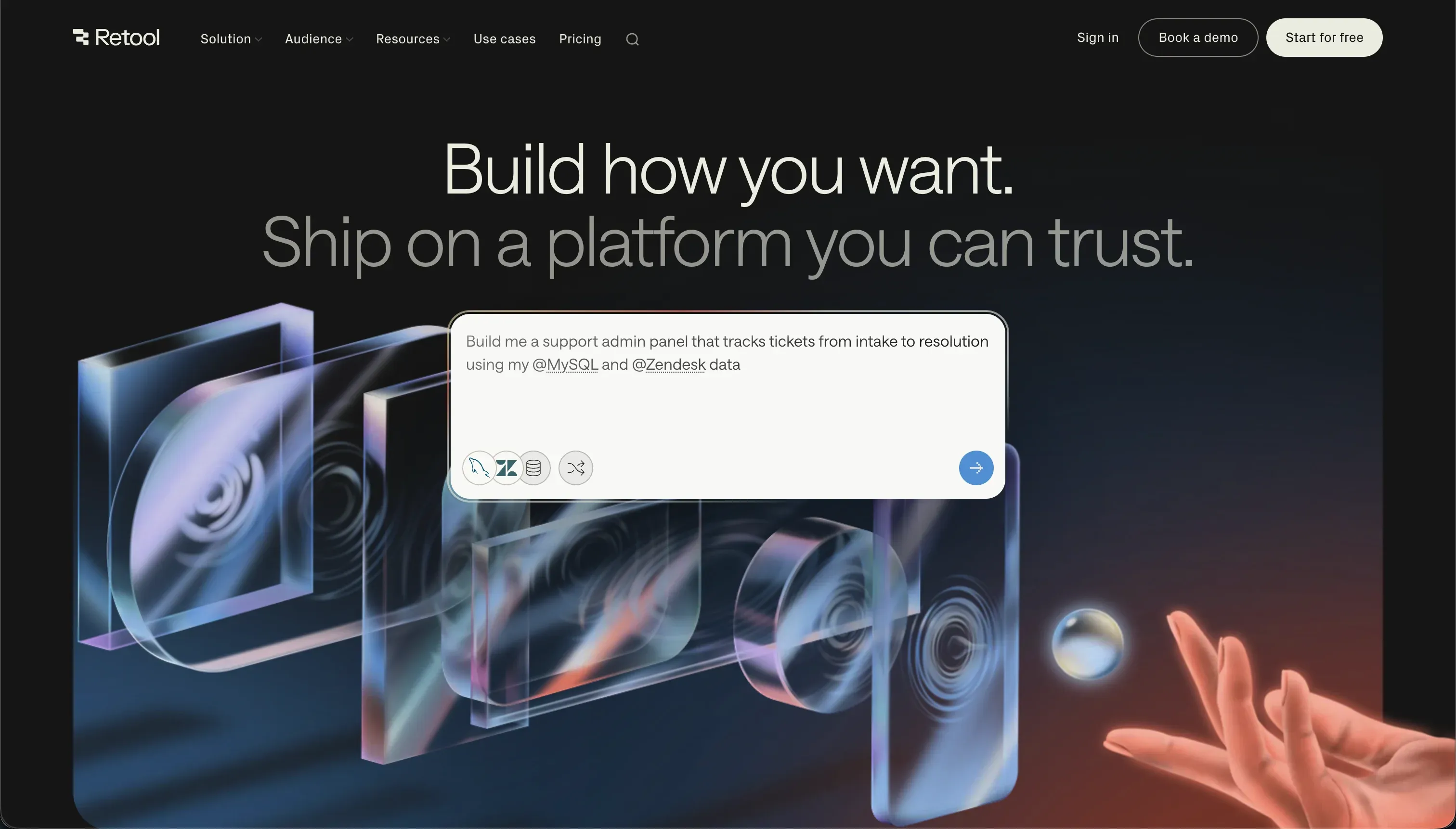 Retool homepage snapshot
If your asset and maintenance data already lives in SQL systems and your builders are comfortable with queries, Retool is a powerful choice. It scores 8.5 for data and integrations because it connects directly to operational databases and lets teams build dense internal tools with strong writeback control.
That makes it excellent for fleet coordinators, dispatch teams, or operations analysts who need table-heavy screens and direct access to structured records. Security and access control scores 7.5, supported by enterprise features such as SSO and stronger deployment options. The weakness is accessibility for non-technical teams.
Ease of build falls to 4.0 because real projects usually require SQL knowledge, JavaScript logic, and debugging discipline. Retool also leans more desktop than field-mobile. Exclude it if your main users are technicians on phones, or if the people maintaining the app do not have technical skills to manage database queries and logic safely over time.
4. Airtable - best for relational logistical schemas
Airtable remains a compelling option when the hardest part of the problem is structuring the underlying data model. It is one of the easiest tools for linking equipment records to service histories, operators, customer accounts, and job sites, which is why ease of build scores 8.5.
Data and integrations also score 8.0 for common operational use cases because formulas, linked records, and filtered views are approachable for non-developers. The limitation is that Airtable is better as a database workspace than as a polished field app. Its interface layer scores only 4.0 on design flexibility, with fairly rigid layouts and a desktop-oriented feel.
Security and access control scores 5.0 because external user experiences and granular page-level restrictions are weaker than dedicated portal builders. Exclude Airtable if you need a branded mobile-first app for field crews or customer access, rather than a well-organized operational backend with basic interfaces.
5. Replit - best for custom code-first asset software
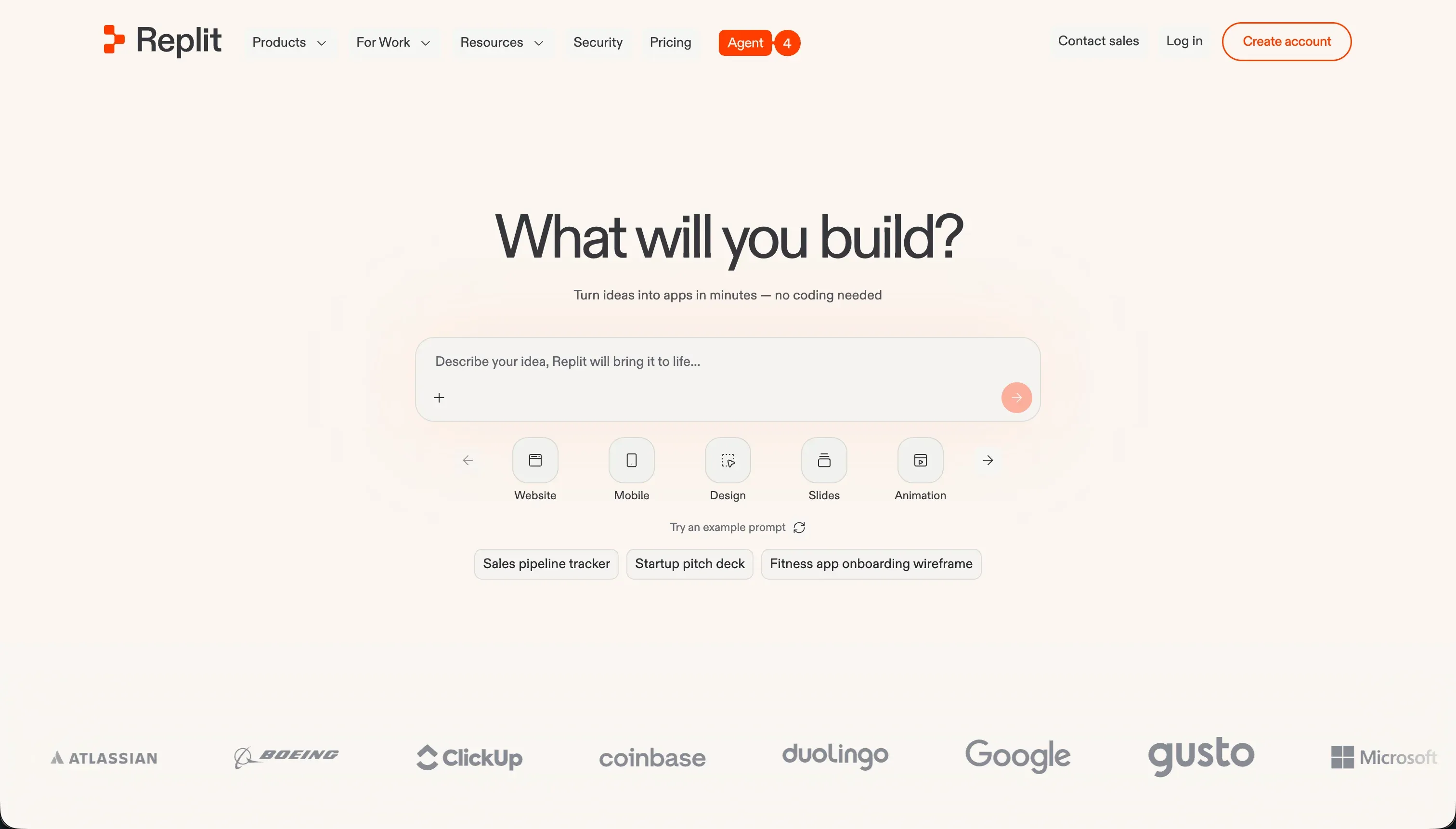 Replit homepage snapshot
For teams that want full code ownership and have engineering capacity, Replit is the strongest code-first option in this group. It can accelerate custom tracker development through AI-assisted scaffolding, dependency setup, and deployment workflows, while still producing standard code that your team controls.
Production readiness scores 8.0 and design flexibility 8.5 because you are not limited by a visual template system. You can build exactly the scanning, workflow, and reporting logic you need. The tradeoff is that much of the platform value assumes technical oversight. Security and access control sits around 6.0 because permissions, authentication, and data exposure need to be implemented and reviewed in code.
Maintainability is also less forgiving than visual builders, even with AI help, because long-term upkeep still depends on engineering discipline. Exclude Replit if your operations team cannot audit code, manage deployments, or tolerate variable usage-based billing tied to development activity.
6. Bubble - best for complex custom workflow apps
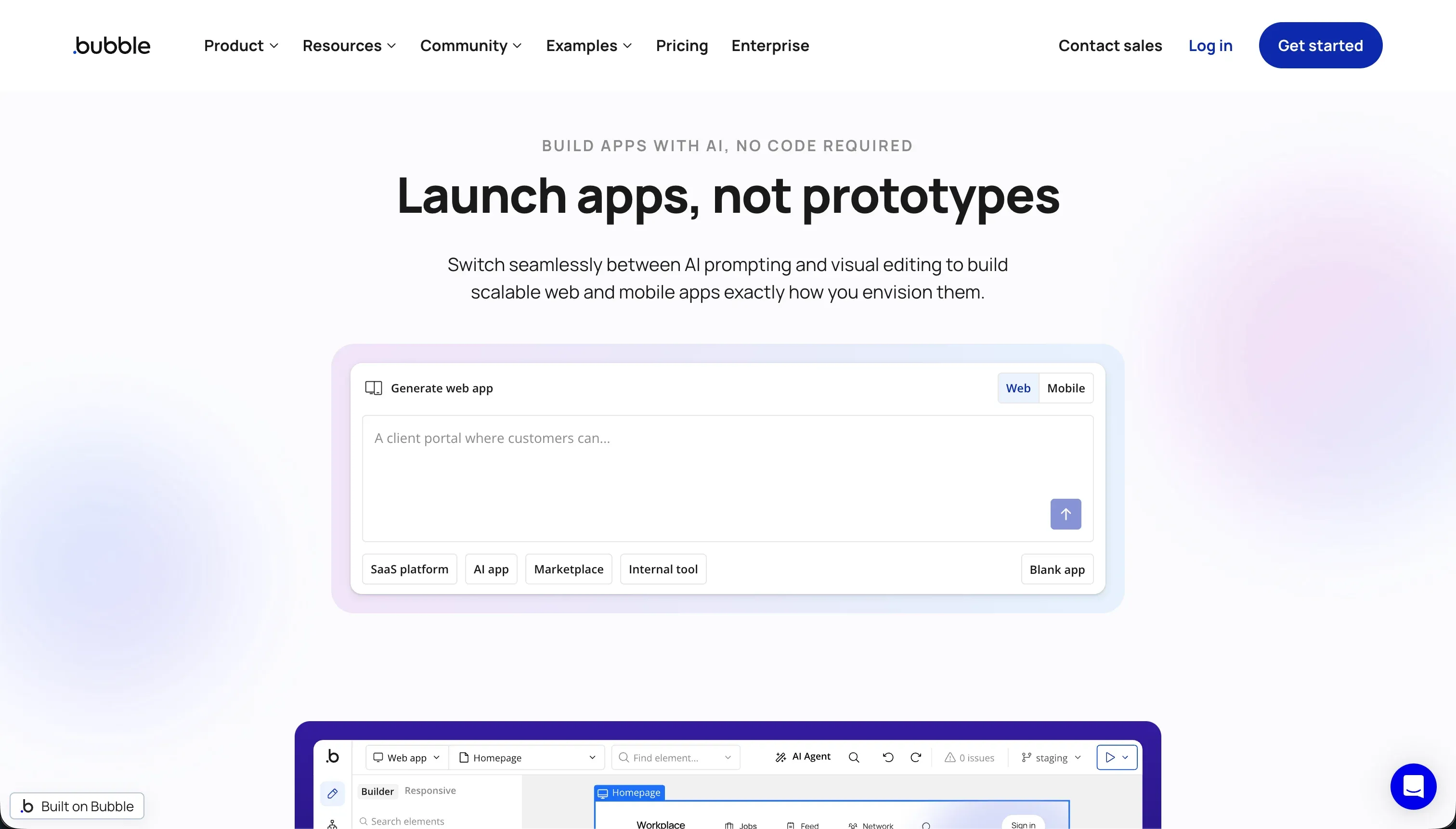 Bubble homepage snapshot
Bubble is most useful when equipment tracking is only one part of a broader custom application with reservations, approvals, billing logic, or customer-facing workflows. It scores 8.5 for design flexibility and 8.0 for data and integrations because builders can create highly tailored interfaces and detailed workflow logic without writing traditional code.
That makes it attractive for rental businesses or specialized service operations that need more than a standard internal tracker. However, Bubble is rarely the fastest route to a straightforward operational tool. Ease of build scores 5.0 because workflow design, privacy rules, and debugging can become complex quickly.
Security and access control scores 6.5, which is adequate but highly dependent on correct configuration.
Exclude Bubble if your goal is a simple, dependable tracking utility for internal teams that must be deployed quickly and maintained by non-technical staff with predictable operating costs.
How to select and pilot your tracking platform
Equipment tracking succeeds when the app preserves data integrity and field teams actually use it every day. The best shortlist usually includes one visual no-code option and one more technical platform, so you can compare speed against long-term flexibility. For most internal operational teams, Softr and Glide are the clearest first pair to test.
If your records already live in SQL systems and you have technical support, Retool or Replit may be the better comparison set.
Start with a realistic pilot, not a blank demo. Import a sample dataset that includes active equipment, job sites, assigned operators, inspection dates, and status history. Then test the exact actions your team performs most often, such as check-in, check-out, maintenance logging, and mobile status updates.
During the pilot, review how each tool handles role-based access, schema changes, and pricing under your expected user count. Buyers should also compare adjacent categories if their needs overlap with inventory, service dispatch, or asset lifecycle management.
Use our methodology to understand the scoring framework, and review related pages like asset management apps and inventory management apps before making a final shortlist.