





What asset management apps actually need
Asset management apps are not simple directories. They usually support check-in and check-out flows, maintenance logs, audit trails, status changes, location history, barcode or serial lookups, and role-based approvals. In practice, that means buyers need more than a pretty frontend.
They need a platform that can safely connect people in the field, operations managers, finance staff, and sometimes vendors or clients to the same source of truth without exposing the wrong records or creating update conflicts.
That requirement maps cleanly to six evaluation criteria. First, security and access control matter because asset data often includes internal locations, ownership records, depreciation details, or service notes. A good builder should support authenticated users, role-based visibility, and ideally row-level restrictions so each user only sees the assets or actions relevant to them.
Second, ease of build matters because many asset projects start as an operations initiative, not an engineering roadmap. The best platforms let a manager prototype a usable app in days, not months.
Third, design flexibility matters because asset workflows are often mobile and repetitive. A warehouse clerk, field technician, or site inspector needs large touch targets, quick filters, and simple forms, not a desktop dashboard squeezed onto a phone.
Fourth, data and integrations are essential because most teams already store records in Airtable, Sheets, SQL, or an ERP. Your builder should connect cleanly to those systems and handle updates reliably.
Fifth, production readiness matters because even an internal asset app still needs dependable auth, hosting, performance, and user management. Finally, maintainability is what separates a successful tool from a short-lived prototype. Asset schemas change constantly as teams add new statuses, service intervals, or custom fields.
The best app builders let non-technical admins adapt the system without rewriting core logic.
For this use case, platforms that combine strong permissions, practical mobile UX, and easy schema evolution tend to outperform pure design tools or pure developer frameworks.
The use-case comparison
| Platform | Overall | Advantage | Main reason to exclude it |
|---|---|---|---|
| Softr | 8.1 | Strong built-in auth, user groups, and row-level style visibility for operational portals | Less flexible for highly custom UI and no source code export |
| Glide | 6.3 | Very fast mobile scaffolding from Sheets, Airtable, or simple structured data | Pricing and lighter permission depth limit larger external rollouts |
| Retool | 6.8 | Direct read and write access to SQL and APIs for internal technical teams | Too technical for most operations-led projects |
| Airtable | 6.3 | Excellent relational data modeling and familiar spreadsheet workflow | Interface layer is rigid and less suited to polished field apps |
| Replit | 7.4 | Real code ownership with broad architectural freedom and AI-assisted delivery | Requires developers to own security, QA, and ongoing maintenance |
| Bubble | 6.8 | Highly customizable workflows and frontend behavior for complex use cases | Steep learning curve and potentially volatile usage-based costs |
1. Softr - best overall for operational asset trackers
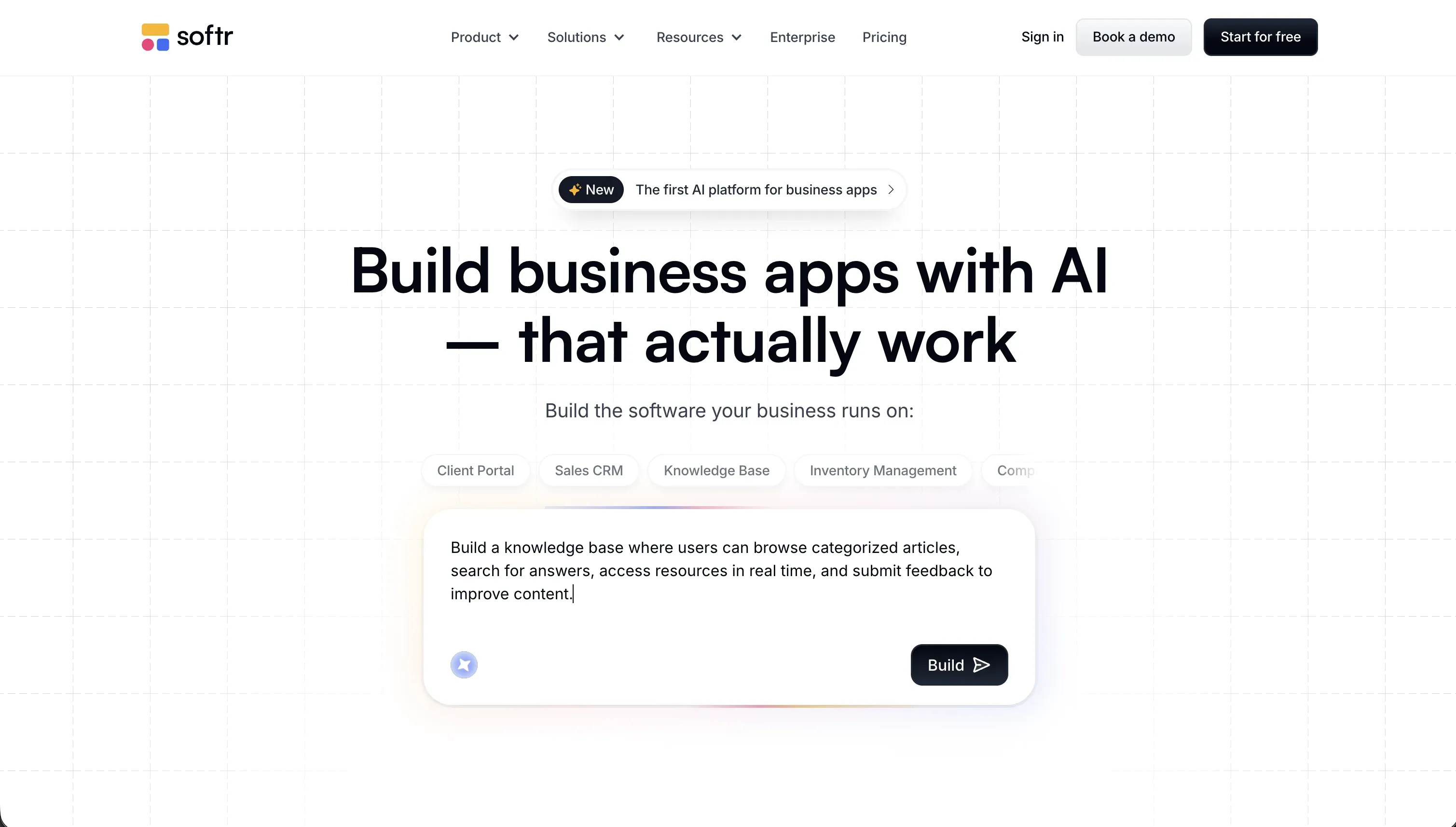 Softr homepage snapshot
Softr is the strongest fit for most asset management teams because it handles the parts that usually break first: permissions, user management, and maintainability. Asset apps often need separate views for admins, technicians, requesters, and external partners.
Softr supports that structure well with built-in authentication, user groups, and data visibility rules that make it practical to launch secure portals without custom code. It scores 8.5 for security and access control and 9.0 for maintainability, which matters when operations teams need to add fields, statuses, or workflows after launch.
It also performs well on production readiness because hosting, login flows, and common portal patterns are already solved. For teams using Airtable, SQL, or Softr’s own database, setup is relatively straightforward, and the block-based builder keeps day-to-day edits manageable for non-developers. That makes it especially attractive for equipment logs, maintenance records, and internal checkout systems.
The main exclusion is design freedom. Softr scores 5.5 for design flexibility because layouts are assembled from responsive blocks rather than a truly freeform canvas. If your team needs a highly bespoke consumer-grade interface or insists on code export for long-term portability, Softr is not the best fit. For most business asset workflows, though, its tradeoff is worth it.
- 8.5 security score
- 9.0 maintainability
- Hosting and login flows solved
- Built-in auth, groups, visibility rules
- Block builder suits non-developers
- 5.5 design flexibility score
- Block layouts, no freeform canvas
- No code export for portability
2. Glide - best for mobile field operations on spreadsheet data
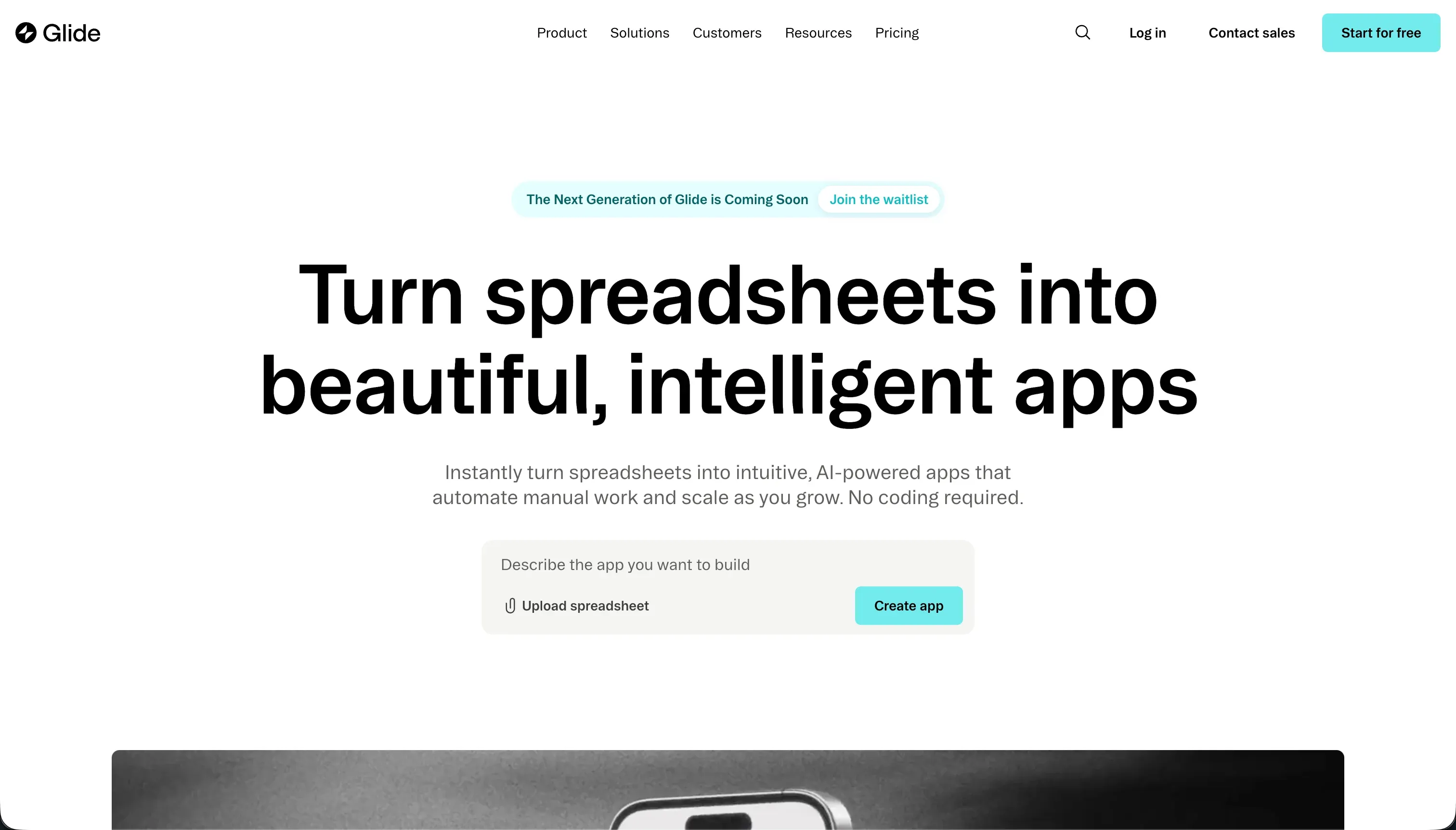 Glide homepage snapshot
Glide is a strong option when speed and mobile usability matter more than deep customization. Many asset projects begin with records already living in Google Sheets, Excel, or Airtable. Glide is excellent at turning that data into a clean, phone-friendly app with minimal setup, which is why it scores 8.5 for ease of build.
Field teams can quickly search assets, update statuses, attach photos, and log issues without waiting for a full software build cycle.
Its biggest strength is workflow simplicity. For lightweight tracking, inspections, or internal asset checklists, Glide gives operations leaders a fast path from table structure to usable screens. It is also approachable for non-technical teams who want to make updates themselves after launch.
The reason it ranks below Softr is that its limitations show up as deployments become larger or more complex. Glide scores 5.5 for security and access control and only 4.0 for design flexibility. Complex multi-role access patterns can become awkward, and pricing tends to become painful when many external users or contractors need access.
That makes Glide a poor fit for large partner portals or heavily segmented enterprise asset environments, even though it is excellent for smaller mobile-first rollouts.
3. Retool - best technical route for developer-owned asset portals
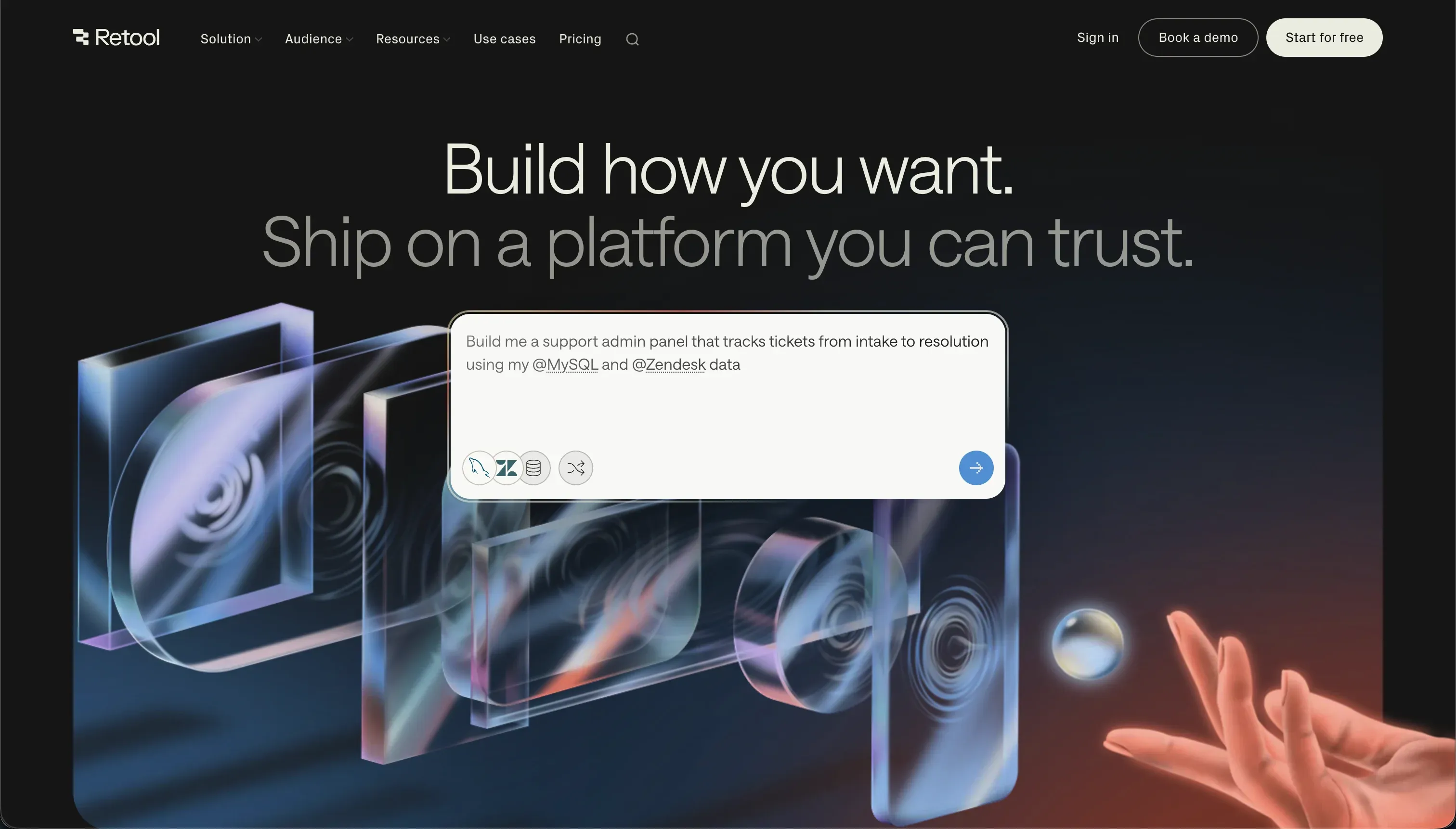 Retool homepage snapshot
Retool is the best choice here when the asset system is clearly owned by a technical team and needs direct control over databases, APIs, and internal workflows. It scores 8.5 for data and integrations because it connects cleanly to PostgreSQL, MySQL, REST APIs, GraphQL, and many enterprise systems.
That makes it ideal for internal asset dashboards, repair queues, lifecycle views, and administrative tooling where reliability and direct database interaction matter more than broad end-user polish.
Retool also offers a powerful component library for dense interfaces. If your operations or IT team needs data tables, filters, bulk actions, audit views, and custom query logic, it is one of the fastest ways for developers to ship internal software. In the right hands, it can outperform lighter no-code tools on complexity.
The exclusion is straightforward: non-technical teams should not choose it. Retool scores 4.0 for ease of build because useful implementations typically require SQL, JavaScript, and a solid understanding of backend logic. External authentication and polished partner-facing UX often need additional work too.
If you need a tool that warehouse or operations managers can safely maintain without developers, Retool is the wrong purchase despite its technical power.
4. Airtable - best database-first model for internal asset lists
Airtable deserves a place on this list because many asset initiatives are really data organization problems first. It is one of the most intuitive platforms for building relational asset inventories, linking devices to owners, maintenance events, locations, and categories in a way non-technical teams can understand quickly.
It scores 8.5 for ease of build and 8.0 for data and integrations, making it an excellent foundation for asset records and internal process tracking.
For operations managers who currently juggle spreadsheets, Airtable often creates immediate clarity. Views, linked records, filters, and forms make it easy to standardize records and reduce messy manual updates. As a backend or source of truth, it is often stronger than tools that prioritize interface polish over schema design.
Its weakness is the application layer. Airtable scores only 4.0 for design flexibility because Interface Designer remains constrained and more desktop-oriented than truly mobile-first builders. Permissions are also less suited to advanced row-by-row external access patterns.
That means Airtable is easy to recommend for internal asset databases, but not for teams that need a branded field app, robust contractor access, or a secure client-facing portal. In those cases, it works better as a backend paired with another frontend tool.
5. Replit - best code-first path with absolute database ownership
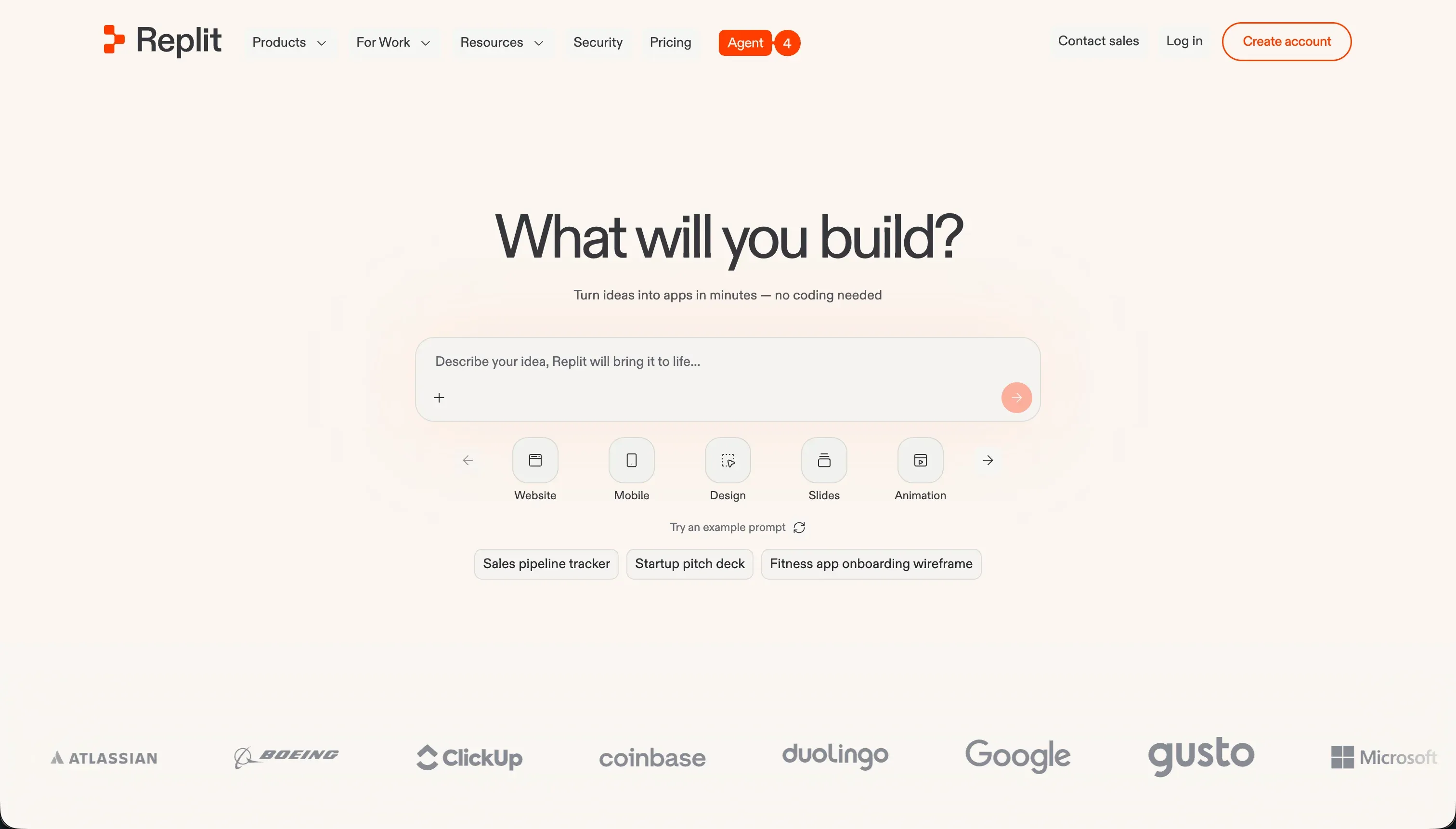 Replit homepage snapshot
Replit is a compelling option for organizations that want asset software built as a real application rather than assembled inside a closed no-code environment. Its AI-assisted workflow can generate full-stack apps quickly, and the result is standard code that developers can inspect, version, and export.
That is why it scores 8.5 for design flexibility and remains attractive for teams with strong engineering resources and strict requirements around ownership, extensibility, or custom hosting paths.
For complex asset environments, that freedom can be valuable. Developers can implement barcode logic, custom workflows, integrations with internal systems, and any UI pattern they want. Replit also supports a faster starting point than building entirely from scratch, which helps smaller engineering teams move faster.
The tradeoff is that the hard parts become your responsibility. Replit scores 6.0 for security and access control because access rules, auditability, and validation are only as good as the code your team writes and reviews. Maintenance, QA, monitoring, and performance tuning also fall on your developers.
If you do not have active technical ownership after launch, Replit is easy to underestimate and risky to operate for a business-critical asset system.
6. Bubble - best for complex custom asset booking workflows
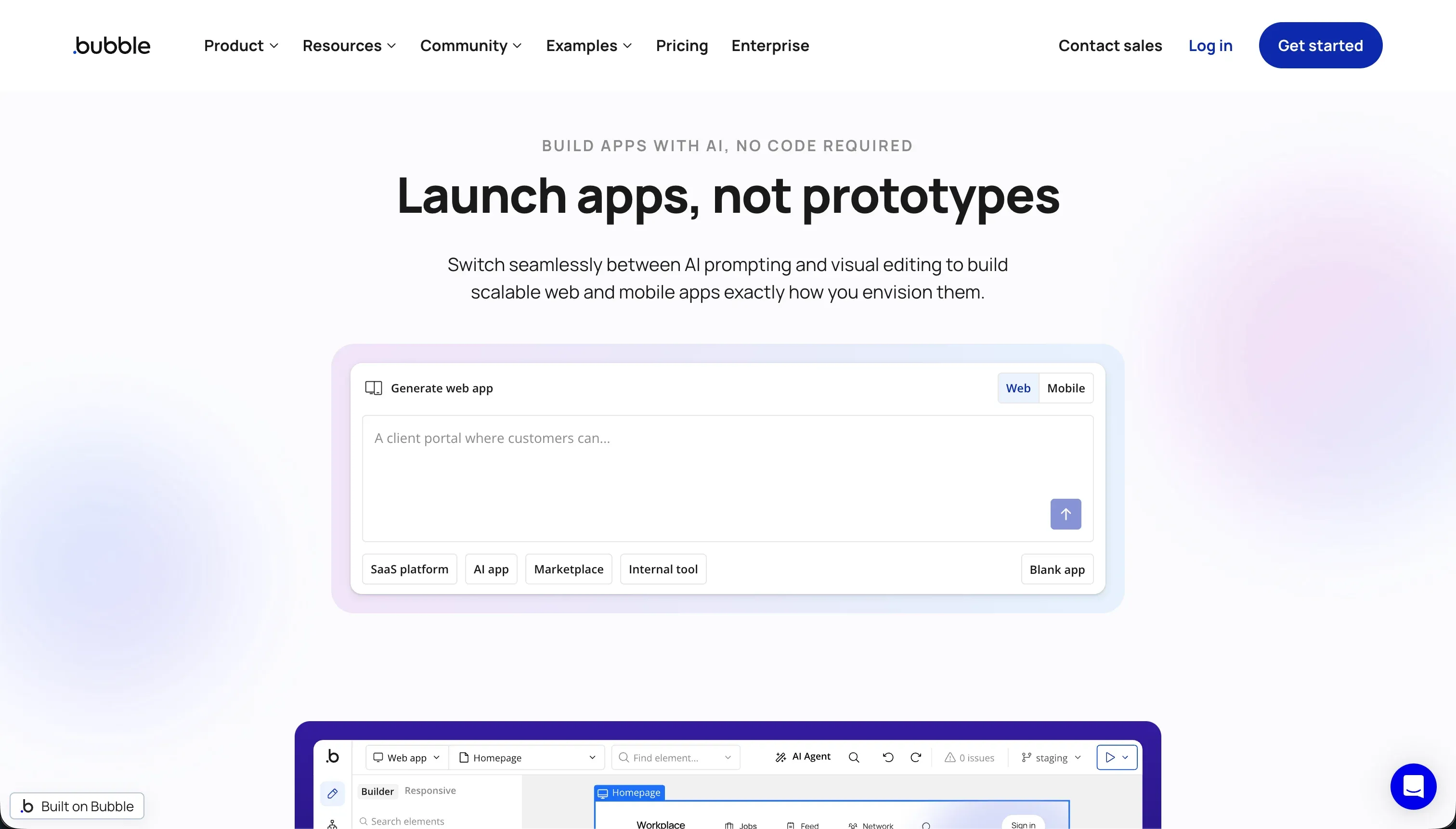 Bubble homepage snapshot
Bubble is the most flexible visual builder on this list for teams that need highly customized asset workflows without committing to a traditional codebase.
It scores 8.5 for design flexibility and 8.0 for data and integrations, which makes it useful for complex booking systems, conditional approval flows, reservation logic, and more tailored user experiences than Softr or Glide typically support. If your asset process includes unusual state changes or many branching rules, Bubble can model them.
That flexibility comes with operational cost. Bubble is powerful, but it is also one of the easiest platforms to overbuild. Its ease of build score of 5.0 reflects the reality that workflows, database structures, and page logic can become difficult to manage quickly. Teams often succeed with Bubble when there is a dedicated builder who treats it like a serious development environment.
The exclusion is maintainability and cost predictability for simpler teams. Bubble scores 6.0 for maintainability because large apps can become cluttered, and performance or usage optimization may require significant cleanup later. If your primary need is a straightforward internal asset tracker with clear permissions and low admin overhead, Bubble is usually more tool than you need.
How to shortlist and run your asset pilot
Keep your shortlist to two or three platforms and test them against a real asset workflow, not a generic demo. Start by identifying the exact job the app must handle first: field inspection, equipment checkout, maintenance logging, or internal inventory control. Then map that job to the criteria above.
If your biggest risk is permissioning across several user types, start with Softr. If speed and mobile simplicity matter most, include Glide. If the app will be developer-owned and tied directly to production databases, include Retool or Replit.
Use our methodology to score each option consistently, and compare them with any adjacent guides that match your rollout, such as internal tools or portal builders. Build a narrow prototype with a real schema, a sample status update flow, and at least two user roles. Test it on the devices and networks your team actually uses.
Have one user create or update an asset, another verify visibility rules, and an admin change the schema after setup.
The best shortlist is the one that proves who can maintain the app six months after launch. If operations staff need to own changes, eliminate tools that depend on developers for routine edits.