



What Customer Success Software Actually Needs
Customer Success (CS) teams exist at the intersection of data management and customer experience.
To proactively reduce churn and manage accounts, a customer success application needs to perform three distinct roles: it must act as an internal account workspace, an automated feedback collector, and an external portal for client onboarding or quarterly business reviews (QBRs).
When evaluating platforms for these operations, default developer frameworks or generic page builders rarely hit the mark.
Instead, the decision maps directly to our six core criteria. First and foremost, Security & access control is non-negotiable. Individual clients must see only their own renewal dates, usage metrics, and support tickets, requiring strict row-level security. Second, Data & integrations decide usability.
The workspace is only as good as its real-time connection to platforms where client attributes reside, whether that is a CRM, a PostgreSQL database, or a structured spreadsheet.
Third, Production readiness dictates how safely the team can deploy client-facing logins, magic links, and secure survey forms without custom engineering. Fourth, Maintainability determines whether an operations manager can add a new QBR rating field or feedback check in minutes, or if every minor modification requires a re-prompting or developer sprint.
Fifth, Ease of build shapes how quickly non-technical success managers can launch functional dashboards. Finally, Design flexibility provides the ability to matches the portal’s aesthetic to your corporate brand - though for most enterprise CS deployments, this is secondary to data privacy and consistent system uptime.
The use-case comparison
| Platform | Overall | Advantage | Main reason to exclude it |
|---|---|---|---|
| Softr | 8.1 | Pre-built client authentication, secure visual user groups, flat tier-based pricing. | No code export option and lower visual design layout freedom. |
| Airtable | 6.3 | Top-tier database modeling usability, intuitive grid lookups and automation triggers. | External guest packs are expensive and permissions are limited to the base level. |
| Glide | 6.3 | Fastest mobile-first layout scaffolding from simple spreadsheets. | Thinner permission controls and rigid template layout restrictions. |
| Retool | 6.8 | Direct read and write access to internal SQL warehouses and raw APIs. | Requires constant developer line-by-line maintenance and SQL knowledge. |
| Bubble | 6.8 | Unconstrained visual workflow logic and a deep relational database compiler. | Unpredictable workload-unit pricing and a steep technical entry barrier. |
| Replit | 7.4 | Generates real, fully exportable and version-controlled codebase configurations. | Auth, roles, and deployment bugs are managed in raw developer code. |
1. Softr - best overall for customer portals and onboarding hubs
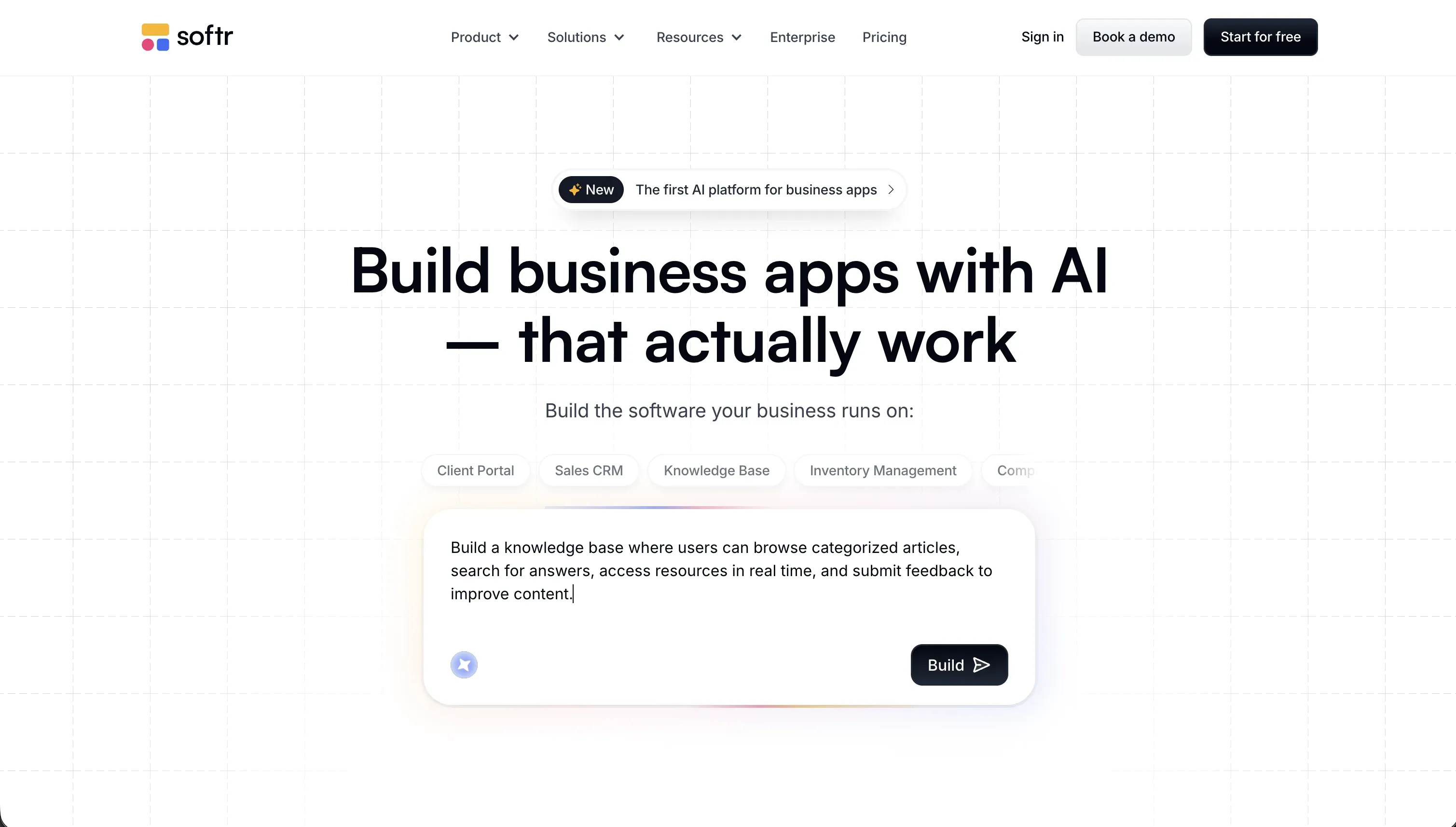 Softr homepage snapshot
For teams launching customer-facing portals, Softr ranks first because the platform handles foundational client utilities natively. Authentication, visual user groups, and row-level data restrictions are built-in features rather than generated code. It scores a 9.0 on maintainability and an 8.5 on security & access control.
This makes it simple to build specialized client-onboarding portals where a success manager can safely update account-specific progress bars, tasks, and notes from a visual editor without any technical risks. The AI-powered Co-Builder helps set up directories and customer-feedback apps in minutes, and the billing stays predictable at flat tiers.
The explicit deduction is design flexibility, which scores 5.5 due to a template block ceiling.
- Auth and visual user groups native
- Row-level data restrictions
- Maintainability score 9.0
- Security & access control 8.5
- Predictable flat tiers
- Design flexibility scores 5.5
- Template block ceiling limits layout
2. Airtable - best for internal account tracking and data orchestration
If the primary goal is building internal dashboards and tracking customer health metrics within your team, Airtable is a powerful data-first solution. It scores 8.5 on ease of build and 8.0 on data & integrations, offering the most intuitive experience for modeling relationships between contacts, companies, and renewals.
However, production readiness scores 5.5 and security & access control sits at 5.0.
It lacks native client login modules, and permissions only reach the base level rather than record-level visual rules. This means sharing Airtable bases externally requires paying for expensive guest packs starting at $120 a month for 15 users. To securely display this data, most teams pair Airtable with a frontend like Softr.
3. Glide - best for fast mobile-first operational CS utilities
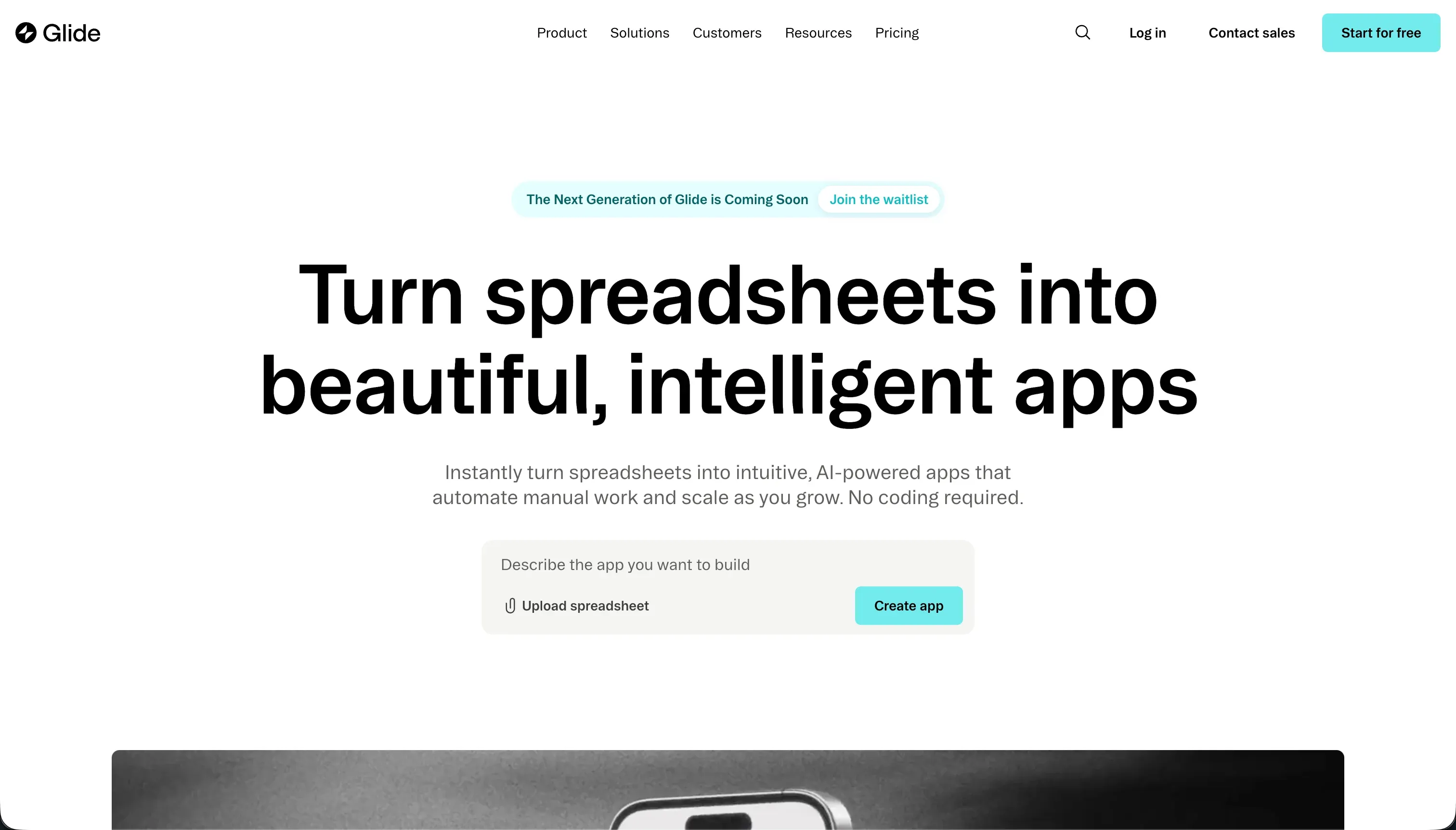 Glide homepage snapshot
When success managers need a fast tracker or field utility that runs perfectly on mobile devices, Glide shines. It scores an 8.5 on ease of build by maps existing spreadsheets directly into clear visual components. This makes it highly efficient for drafting simple task lists or internal account trackers.
However, design flexibility scores 4.0 because the visual workspace forces you to adopt Glide’s standard layouts. Additionally, security & access control drops to 5.5 due to thinner external permissions, and per-user pricing scales poorly for larger client groups, making it a weaker choice for extensive client portals with dozens of client collaborators.
4. Retool - best for SQL-heavy technical CS admin dashboards
 Retool homepage snapshot
For technology companies where customer usage data sits in a live PostgreSQL or Snowflake warehouse, Retool is the premier option. It scores an 8.5 on data & integrations because it connects directly to raw databases and GraphQL APIs. It provides custom JavaScript libraries and detailed audit logs. Yet, ease of build scores a low 4.0 because Retool is not a no-code tool.
Non-technical success managers cannot build or update their own layouts. Every change requires writing SQL queries and structuring payloads. Its seat-based billing also charges for every client user, ruling it out for external onboarding use.
5. Bubble - best for custom success mechanics and complex workflow logic
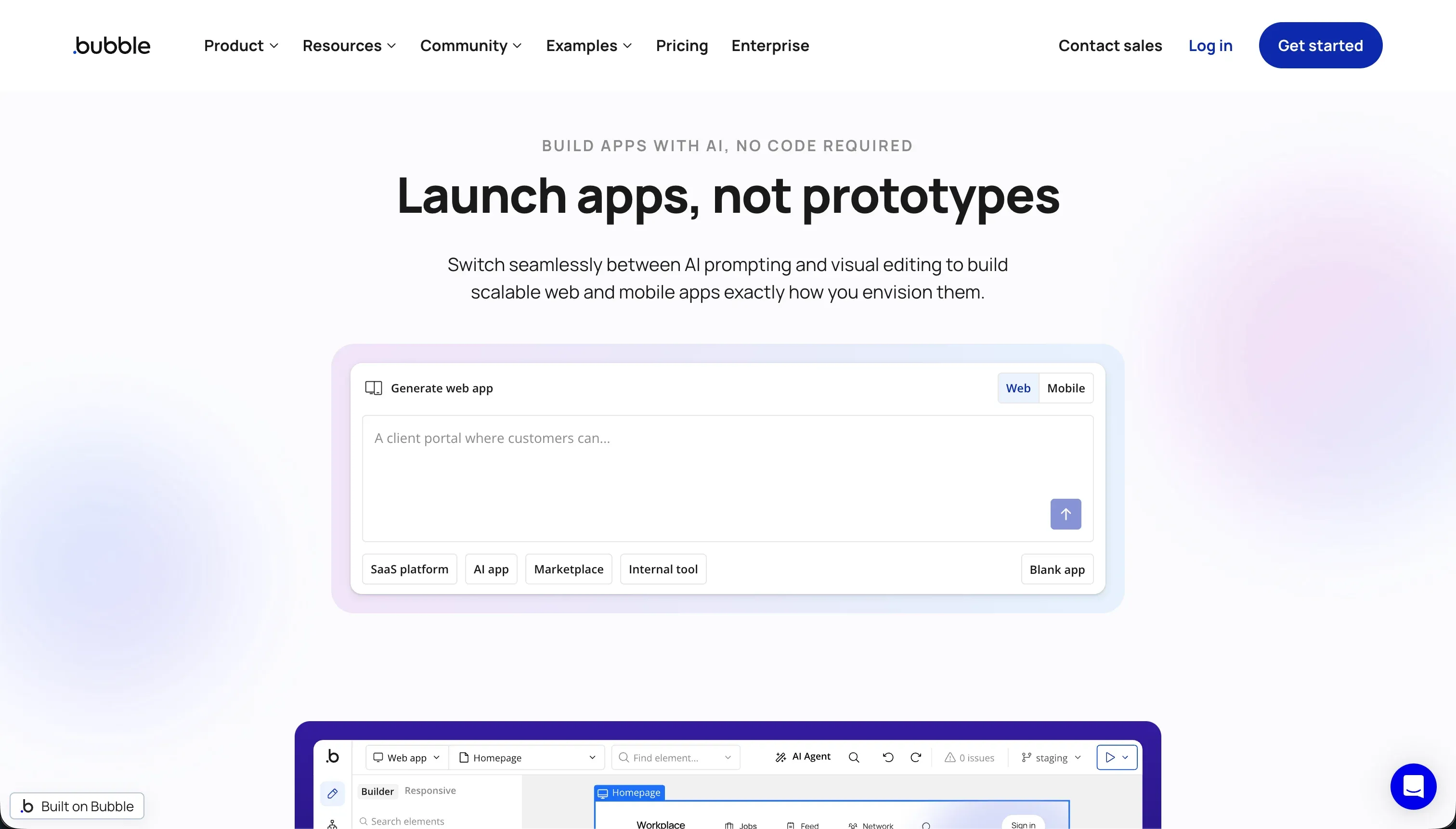 Bubble homepage snapshot
If your CS team needs a platform with unique, multi-sided mechanics, Bubble provides maximum control. It scores an 8.5 on design flexibility and an 8.0 on data & integrations, providing an absolute pixel-level editor and a completely managed relational storage layer. The tradeoff is extreme complexity.
Ease of build scores 5.0, as configuring secure server-side privacy rules, workflows, and database schemas requires developer-like technical architecture skills. Workload-unit pricing is also difficult to forecast, and the complete lack of code export creates a hard platform lock-in if you run into scaling limits.
6. Replit - best for technical teams seeking full code ownership
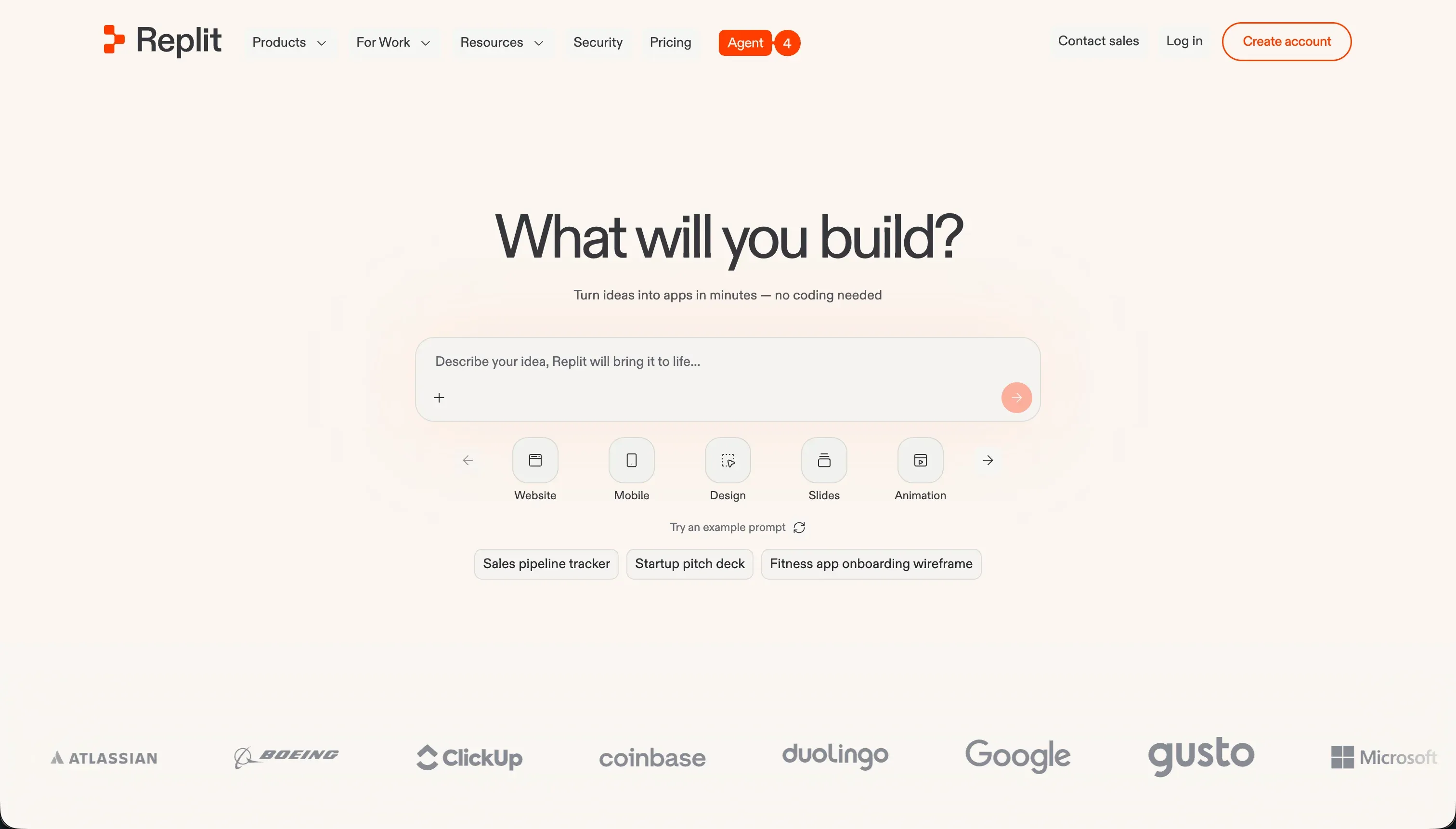 Replit homepage snapshot
For organizations with developer resources, Replit is an outstanding code-first option. It scores an 8.0 on production readiness and an 8.5 on design flexibility, utilizing an autonomous AI agent to generate clean React and Postgres applications. This allows you to build any interface your brand requires and host it on autoscaling containers.
The exclusion is maintainability (7.5) and security (6.0), as per-client data rules live in raw code rather than a visual setting panel. Your team must inspect, secure, and debug the database code, and variable credit billing during testing loops can lead to sudden cost spikes.
How to Shortlist the Right App Builder
Choosing the best platform for your customer success team is a matter of aligning your client-facing goals with your internal technical resources. If you are building external client onboarding check-ins, joint action plans, or quarterly review dashboards, shortlist Softr.
Its flat tiered pricing and robust, pre-built client authentication eliminate the security risks of data leaks and the scalability limits of per-user billing.
If you are focusing heavily on internal account tracking and simple metric visualizers, pair it with Airtable or Glide for rapid database setup. For teams with active developer support who need to write custom rules over high-volume SQL databases, Retool or Replit provide the necessary API connectivity and code-export security.
We recommend implementing a pilot with one mock account, three users with distinct permission roles, and a single file-sharing flow to verify how easily your team can maintain the app over time. To analyze how we weight and score overall platform performance across these business operations, review our complete evaluation methodology.