




What Customer Feedback Apps Actually Require
A professional customer feedback app represents a delicate workflow constraint. It is not simply a public board for random upvotes. Instead, enterprise product managers and customer success leaders require permissioned environments: clients must securely log in, verify their context, submit structured critiques, and monitor development statuses.
This narrow workflow demands specific platform balances across our six core criteria.
First, security and access control decides the platform hierarchy. External clients must remain isolated, ensuring Company A never glimpses the proprietary bug tickets or specific workflows of Company B. Second, production readiness is highly critical, as your workspace needs built-in auth, custom email invitations, and reliable hosting that never fails under customer evaluation.
Third, maintainability keeps the software alive. A product manager should be capable of editing fields, altering permission states, and adjusting sorting rules without triggering a technical development workflow or re-prompting an AI agent.
While design flexibility is useful for aligning with company brand guidelines, it remains secondary to safe data isolation, system uptime, and a robust data and integrations model.
Connecting the feedback intake engine directly to the CRM, active task-tracking software, or a clean PostgreSQL database ensures that customer comments translate directly into developer priorities rather than remaining isolated in separate tools.
The use-case comparison
| Platform | Overall | Advantage | Main reason to exclude it |
|---|---|---|---|
| Softr | 8.1 | Pre-built user logins, secure role-based portals, and flat monthly subscription pricing. | You require a fully bespoke visual canvas or native iOS and Android store distribution. |
| Glide | 6.3 | Scaffolds polished phone-first logs directly from spreadsheets under short timelines. | Per-seat fees scale aggressively past 100 external participants. |
| Airtable | 6.3 | Approachables database structure for team-level triage and tag organization. | Desktop-centric interfaces lack client onboarding flows and record-level filters. |
| Retool | 6.8 | High data density and direct integration to query external developer APIs. | Demands SQL and JavaScript fluency for basic layout configurations. |
| Bubble | 6.8 | Visual database flexibility to construct custom conditional workflows. | Steep learning path and unpredictable cost scaling from workload units. |
| Replit | 7.4 | Agent-built custom web applications with full output of exportable source code. | Requires technical developers to manually test and maintain system code. |
1. Softr - best for permissioned portals and internal dashboards
 Softr homepage snapshot
For teams seeking to deploy professional customer portals or internal dashboards, Softr presents the highest-scoring foundation in this analysis. The builder scores 8.5 for security and access control alongside 8.5 for production readiness.
These scores reflect its visual pre-built infrastructure: user authentication, static and dynamic user groups, page rules, and row-level restrictions are native configurations, not custom code or prompted guesses. This ensures customers safely submit feedback and view roadmap responses specific to their account.
Maintainability scores an impressive 9.0, meaning product managers can tweak interfaces visually without risking breakage. However, design flexibility scores 5.5, meaning teams must accept a structured block layout rather than a pixel-perfect, freeform design canvas. Buy it to unify client-facing intake portals with secure internal administration panels.
2. Glide - best for mobile-responsive spreadsheets
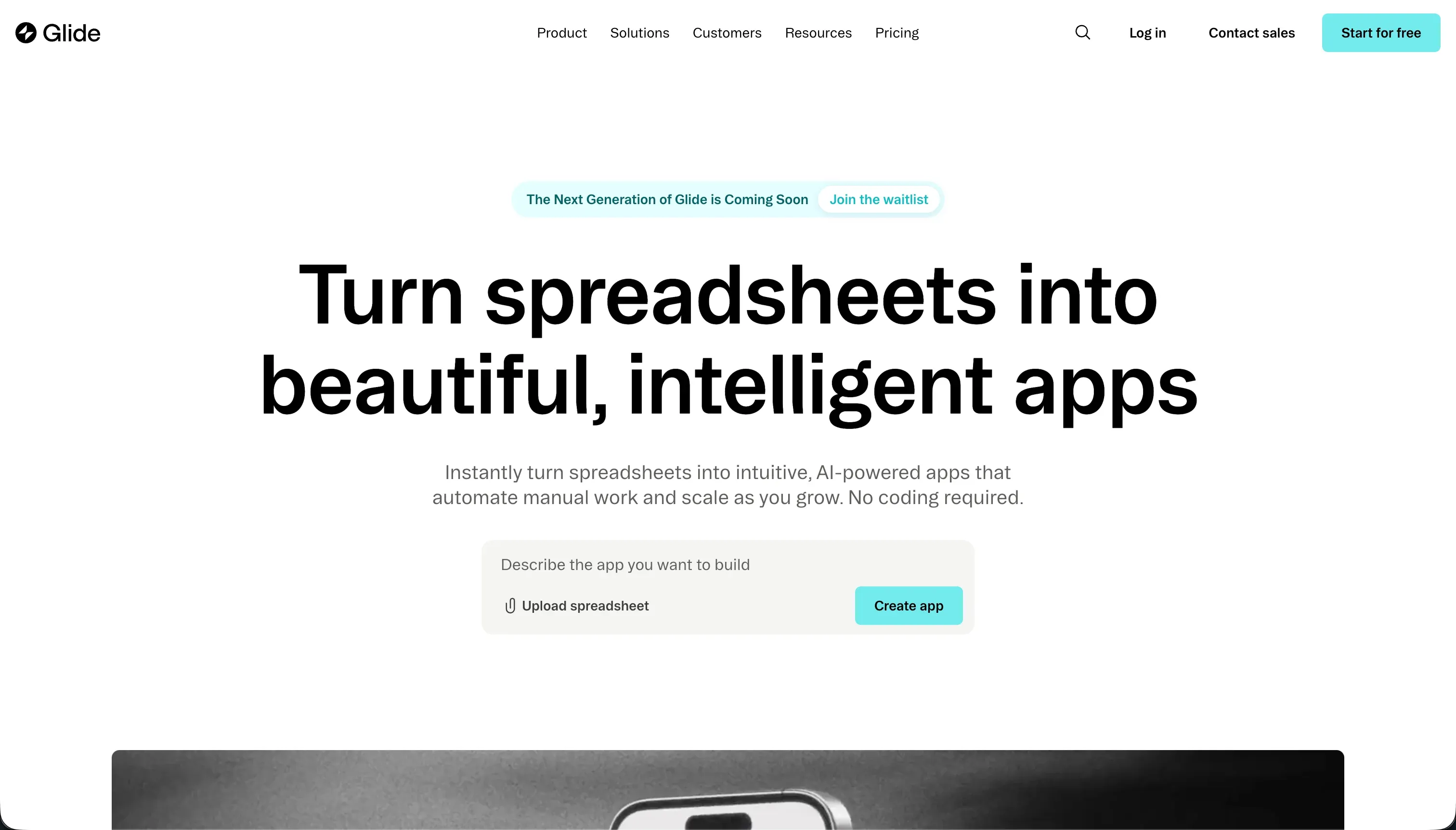 Glide homepage snapshot
If the business workflow relies heavily on existing spreadsheets, Glide provides an elegant mobile layout layer. It scores 8.5 for ease of build by instantly scaffolding clean, telephone-first forms from Google Sheets or Airtable data. The components are responsive by default, rendering as highly professional cards or list views. However, production readiness drops to 6.5.
This reduction stems from thin permission controls for multi-tenant setups and the reality that Glide’s pricing structure scales poorly for external audiences, imposing steep per-seat fees that make large user populations expensive. Avoid Glide if your application demands granular row-level safety where clients need entirely isolated custom workspaces.
3. Airtable - best for internal database categorization
When feedback must be aggregated from multiple channels, Airtable represents a top-tier relational database. It scores 8.0 on data and integrations, enabling teams to build tables with complex relational fields, lookups, and multi-source sync states. Yet, production readiness scores 5.5 and security and access control sits at 5.0.
Airtable Interface Designer lacks native external login screens, onboarding portals, and robust page-level rules. This limits the platform to internal customer success roles. Guest licensing is also costly. We recommend using Airtable to structure and process relational customer comments, but pairing the workspace with an external interface builder to stay cost-effective and secure.
- 8.0 on data and integrations
- Complex relational fields and lookups
- 5.0 on security and access control
- Costly guest licensing fees
- Limited to internal CS roles
- Retains multi-source sync states
- Adds external login screens
- Includes onboarding portals
- Enforces page-level rules
- Keeps deployment cost-effective
4. Retool - best for developer-led back-office operations
 Retool homepage snapshot
For product engineering groups managing feedback directly within production pipelines, Retool is the dominant internal tool. It enables direct connectivity to SQL databases and REST APIs, scoring 8.5 for data and integrations. This allows engineers to build dashboards that join feedback inputs with Jira API keys or central databases. But ease of build scores a low 4.0.
Setting up secure routes requires writing custom code, SQL queries, and JavaScript hooks, excluding general business teams. Furthermore, login logic is not native for external audiences. Choose Retool strictly as a back-office support console for technical support operators who understand SQL.
5. Bubble - best for custom voting social networks
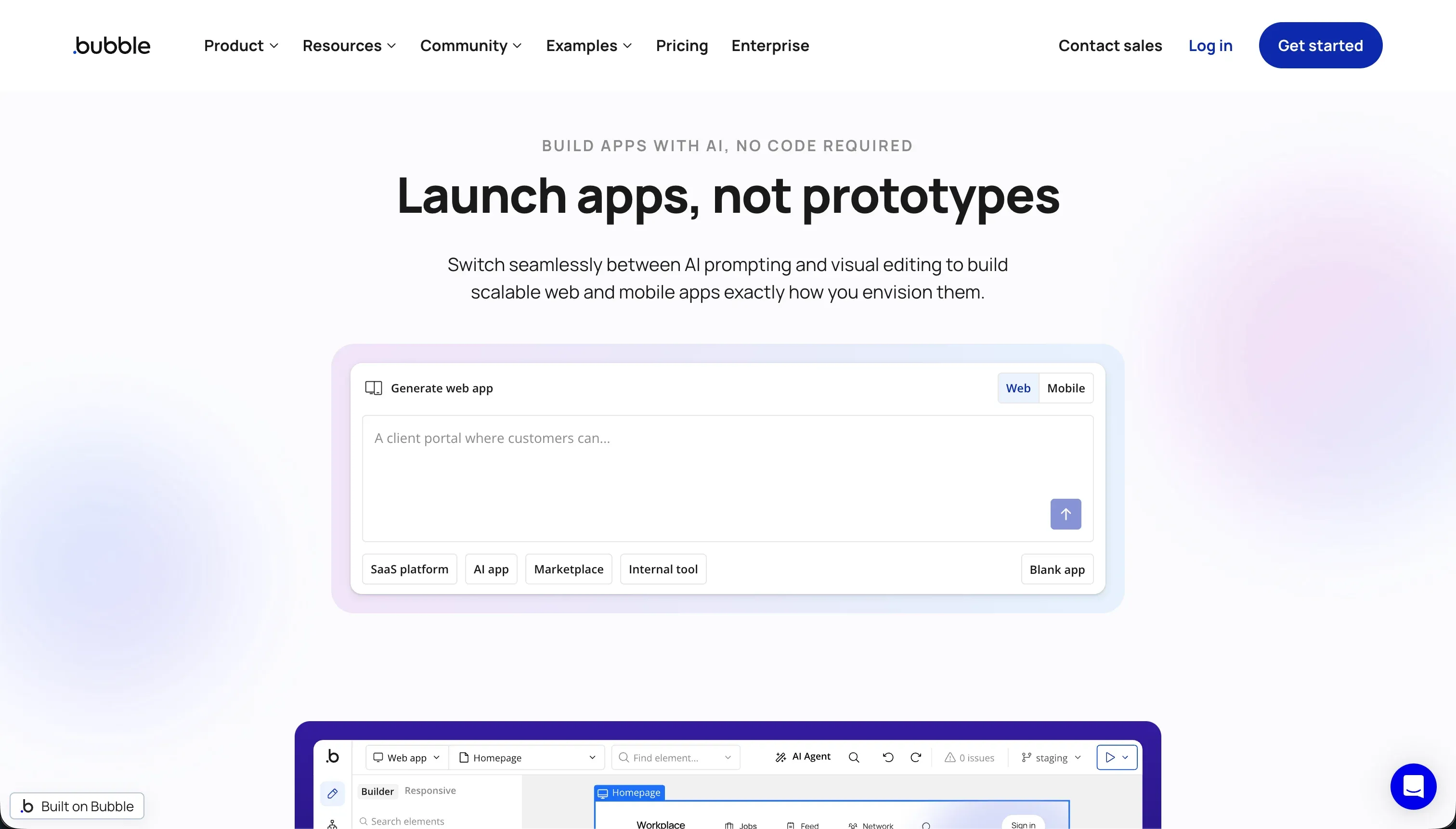 Bubble homepage snapshot
When a project requires a highly styled public upvote forum with custom gamification profiles, Bubble provides deep logic control. It scores 8.5 on design flexibility, allowing a custom responsive layout. You can schedule backend automated triggers and structure multi-tenant custom actions with pixel-level precision.
However, ease of build scores 5.0 due to a visual development interface that resembles writing code. Security and access control scores 6.5; database rules must be configured manually, and errors fail silently. If you want to bypass template restrictions, Bubble is competent, but the setup adds heavy overhead for straightforward business feedback apps.
6. Replit - best for absolute code ownership
 Replit homepage snapshot
For technical startups prioritizing complete platform control, Replit uses an autonomous agent to build custom customer analysis engines as real, exportable code. The tool scores 8.0 for production readiness and 8.5 for design flexibility. Product managers describe exact app concepts, and the system publishes standard directories on managed, auto-scaling servers.
However, security and access control scores 6.0 because per-client data rules live in the generated code itself. This places the burden of auditing security, dependency drift, and bugs directly back on your internal software development team. It is a powerful engine, provided you have real developers to maintain it.
How to Shortlist the Perfect Feedback Builder
Selecting the incorrect software builder for customer reviews usually introduces major administrative overhead.
If you are building secure client feedback portals or enterprise dashboards, review our dedicated guides for customer success teams, internal dashboards and reporting, and client portals to align your requirements.
Ensure your team validates the platform structure by comparing flat-rate subscriptions with usage-priced products, as high volumes of customer reviews can cause unexpected billing spikes. To understand our evaluation criteria and how each score is determined, read our complete methodology overview.