


What agencies actually need from an app builder
Agencies buy app builders for a different reason than internal teams or solo founders. The goal is not just to launch one app quickly. It is to deliver client work profitably, repeat the process across accounts, and avoid inheriting endless maintenance work after handoff. That changes what matters.
First, agencies need strong ease of build. Every extra hour spent wiring forms, roles, or CRUD flows cuts margin on fixed-fee projects. Visual scaffolding, reusable blocks, and clear admin workflows matter more here than in-house experimentation tools. Second, production readiness is critical.
Client apps need dependable hosting, stable auth, usable databases, and a deployment model that will not fall apart when a prospect becomes a real customer.
Third, maintainability is often the hidden deciding factor. Agencies rarely lose money on the first version. They lose money on month-six change requests, broken automations, and hard-to-debug visual logic. Platforms that keep edits simple and reduce accidental regressions score better for service delivery.
Fourth, security and access control are non-negotiable. Client portals, dashboards, and partner apps need dependable permissions, tenant separation, and safe ways to manage external users.
Fifth, data and integrations matter because agencies usually inherit messy client stacks. The winning platform must connect cleanly to spreadsheets, CRMs, SQL databases, internal tools, and APIs without creating brittle workarounds. Sixth, design flexibility determines whether a team can sell premium custom work or only standardized portals.
Some agencies need speed and repeatability more than pixel precision, while others need near-total frontend control to justify higher retainers.
That is why the best agency app builder is rarely the one with the flashiest demo. The right choice depends on whether your delivery model centers on repeatable portals, custom web apps, spreadsheet-based operations tools, or code-first client projects with long-term ownership requirements.
The use-case comparison
| Platform | Overall | Advantage | Main reason to exclude it |
|---|---|---|---|
| Softr | 8.1 | Best mix of reusable portals, auth, and permissions for client delivery | Too restrictive for highly bespoke frontend work |
| WeWeb | 6.2 | Excellent frontend control with export options for agencies needing polished custom UIs | Requires a separate backend and more implementation effort |
| Replit | 7.4 | True code ownership and flexible full-stack builds with minimal platform lock-in | Not ideal for non-technical teams or low-support clients |
| Bubble | 6.8 | Very strong for complex workflows, relational data, and transactional app logic | Learning curve, maintainability issues, and proprietary lock-in |
| Glide | 6.3 | Fastest route to lightweight internal tools and spreadsheet-driven apps | Seat pricing and layout limits reduce fit for large external deployments |
| v0 | 5.8 | Exceptional speed for generating modern React interfaces and concepts | Not a complete application platform without separate backend tooling |
1. Softr - best for repeatable client portals
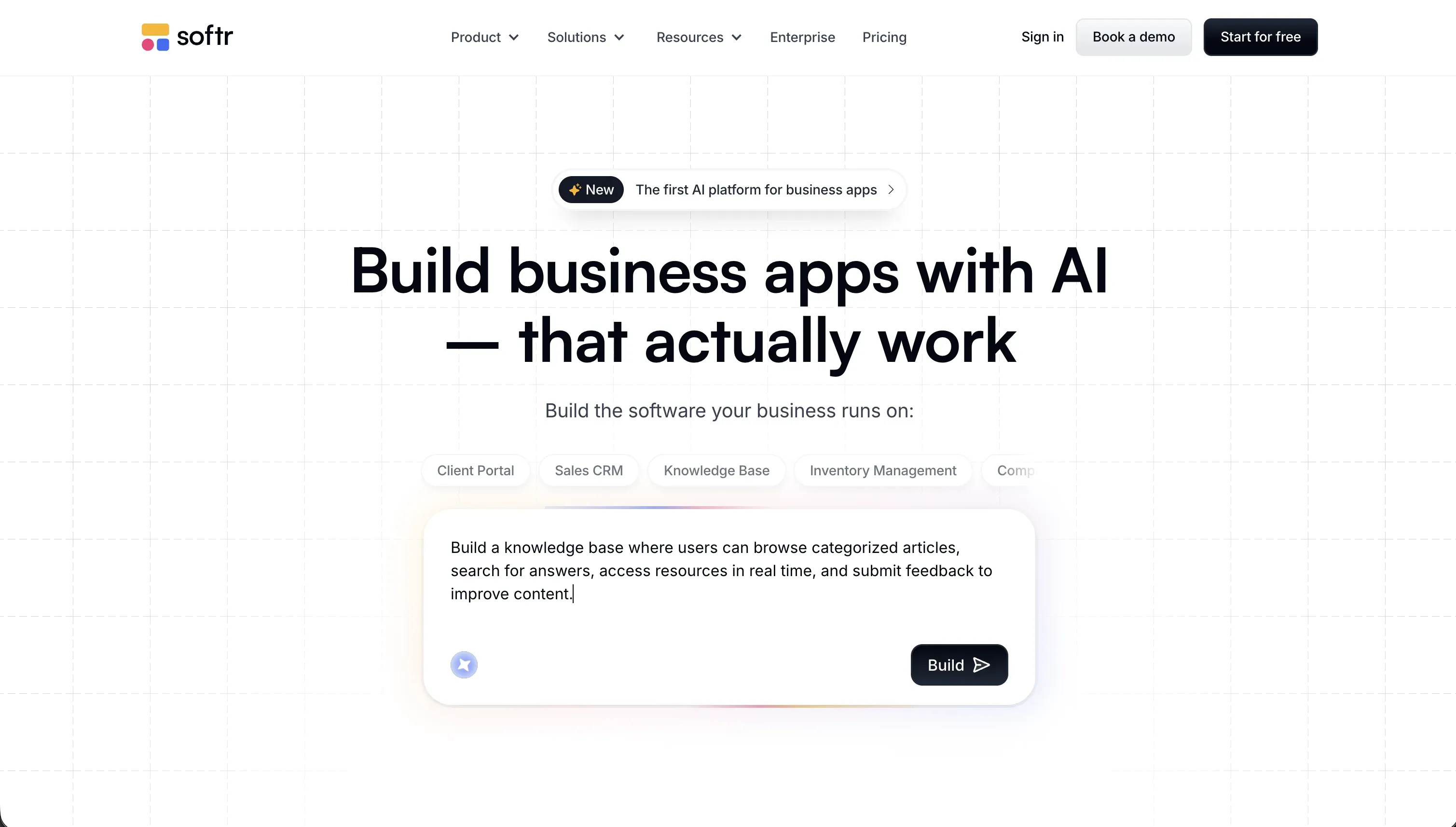 Softr homepage snapshot
For most agencies, Softr is the safest default because it aligns with how service teams actually make money. It scores especially well on ease of build and maintainability, with practical strengths in prebuilt blocks, built-in authentication, user groups, and straightforward portal patterns.
Those features reduce the time needed to launch client dashboards, partner portals, directories, and internal operations tools. Security and access control are also a major advantage because role-based visibility comes ready to use instead of being stitched together manually.
Softr is strongest when your agency wants a repeatable delivery model. You can standardize onboarding, template project structures, and support processes across multiple accounts. That makes it easier for project managers and less technical operators to own updates after launch, which protects margins on small and mid-sized engagements.
The concrete exclusion is premium custom frontend work. If a client expects unusual motion, highly bespoke layouts, or a branded web app that should not feel template-driven, Softr becomes limiting. Its design flexibility trails tools like WeWeb and code-first options. It is also a weaker fit if your team needs full code export or wants total control over infrastructure.
- Fast builds with prebuilt blocks
- Built-in auth and user groups
- Role-based visibility ready to use
- Repeatable delivery across accounts
- Non-technical staff own updates
- Bespoke, motion-heavy frontends
- Layouts that shouldn't feel templated
- Design flexibility trails WeWeb
- No full code export
- No total infrastructure control
2. WeWeb - best for custom frontends with agency handoff needs
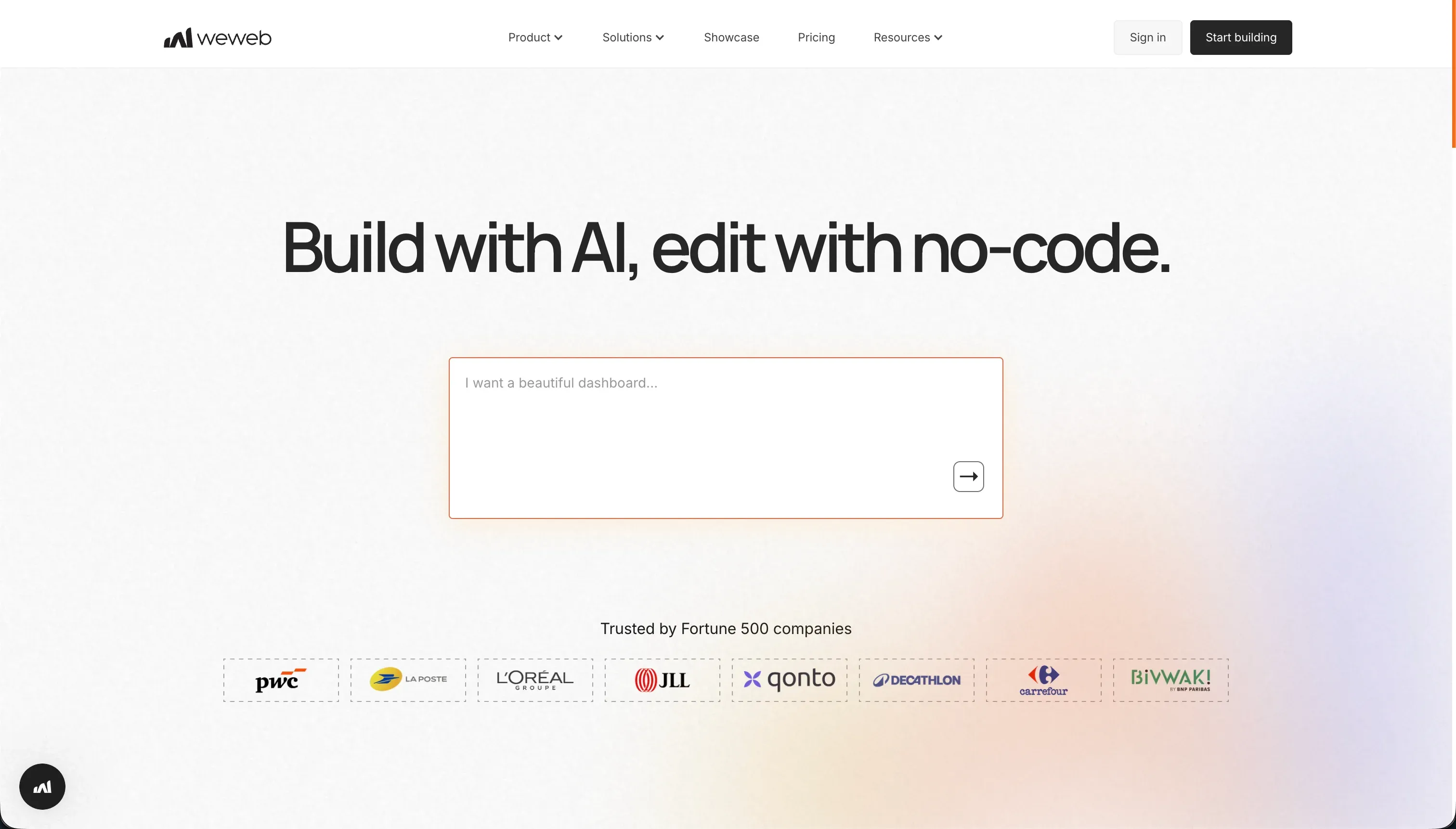 WeWeb homepage snapshot
Agencies that sell polished custom interfaces should seriously consider WeWeb. It performs best on design flexibility, where its visual builder gives much deeper layout control than template-led tools.
Teams can work with responsive sections, CSS-style positioning, and modern frontend patterns that better match high-end client design requirements. For agencies concerned about long-term ownership, its export path is a meaningful advantage compared with closed no-code platforms.
WeWeb also fits agencies that already have a preferred backend stack. If your developers are comfortable pairing it with Supabase, Xano, or another API-first backend, you can create strong client experiences while preserving architecture options. That makes it appealing for custom portals, member products, and branded web apps where visual quality is part of the sale.
The clear exclusion is speed for non-technical delivery teams. WeWeb is not the best fit if your agency wants junior operators to spin up apps with minimal setup. Because it lacks a native database and depends on external backend configuration, implementation is slower and more technical. If the project is a standard client portal rather than a custom product, Softr is usually the more efficient choice.
3. Replit - best for code-first agency delivery
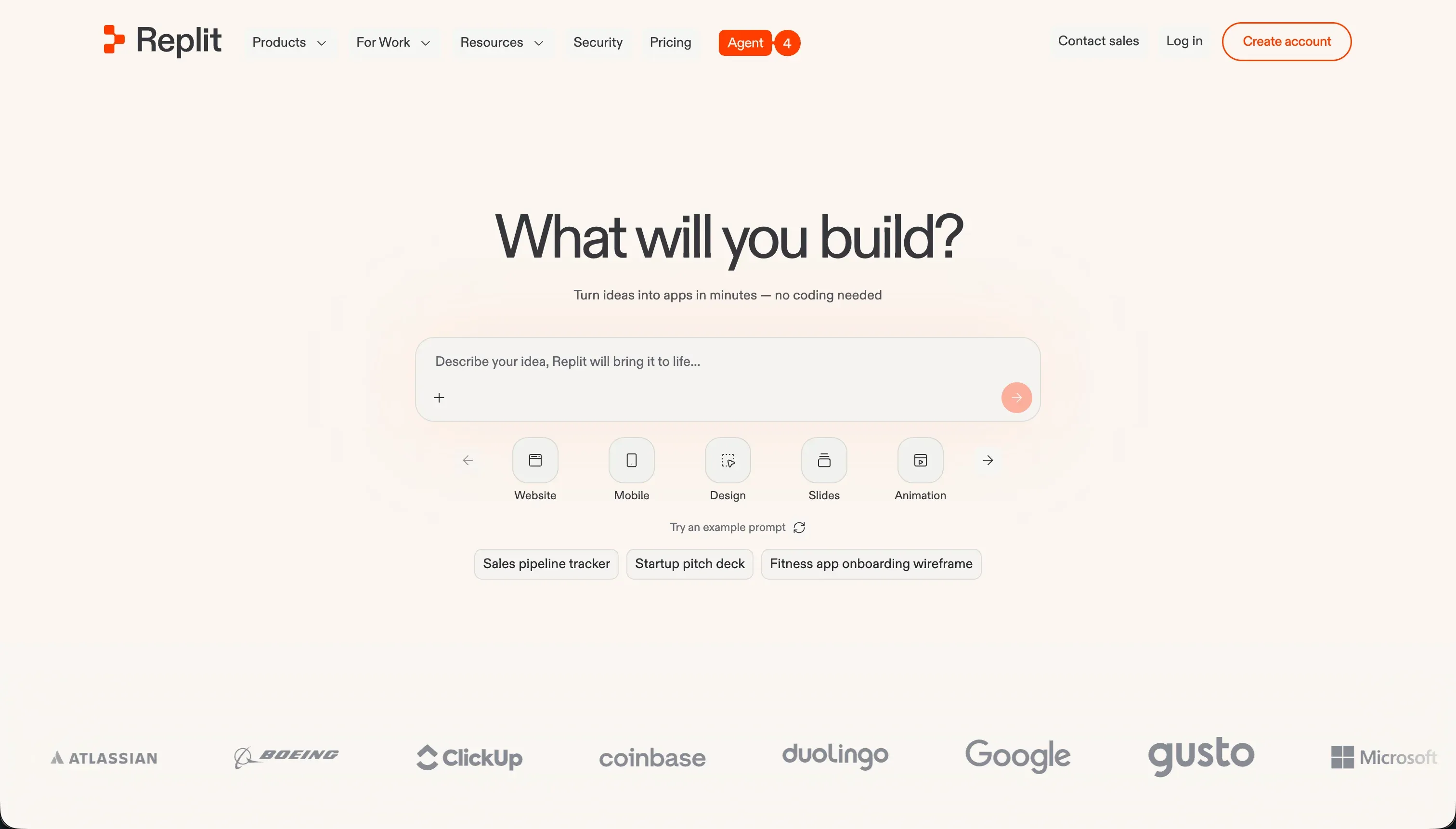 Replit homepage snapshot
For agencies that want maximum control and minimal lock-in, Replit is one of the strongest options available. Its main advantage is simple: you are building real software, not just configuring a proprietary visual layer.
That translates into strong scores for production readiness and data flexibility, especially when your team wants full-stack apps, custom APIs, and developer-grade deployment workflows. Replit also supports fast iteration with AI-assisted coding, which can shorten build cycles for technical teams.
This makes it a compelling choice for agencies that already employ developers and expect clients to ask for custom business logic, unusual integrations, or long-term feature expansion. Code ownership is especially valuable when handoff terms require the client to take infrastructure and source control in-house later.
The concrete exclusion is low-tech service delivery. Replit is a poor fit if your team does not have developers who can review generated code, debug issues, and enforce architecture discipline. Security and access control also depend more on your implementation than on platform defaults.
If your agency sells packaged portals with predictable requirements, a governed builder like Softr will usually create less support risk.
4. Bubble - best for complex logic-heavy client apps
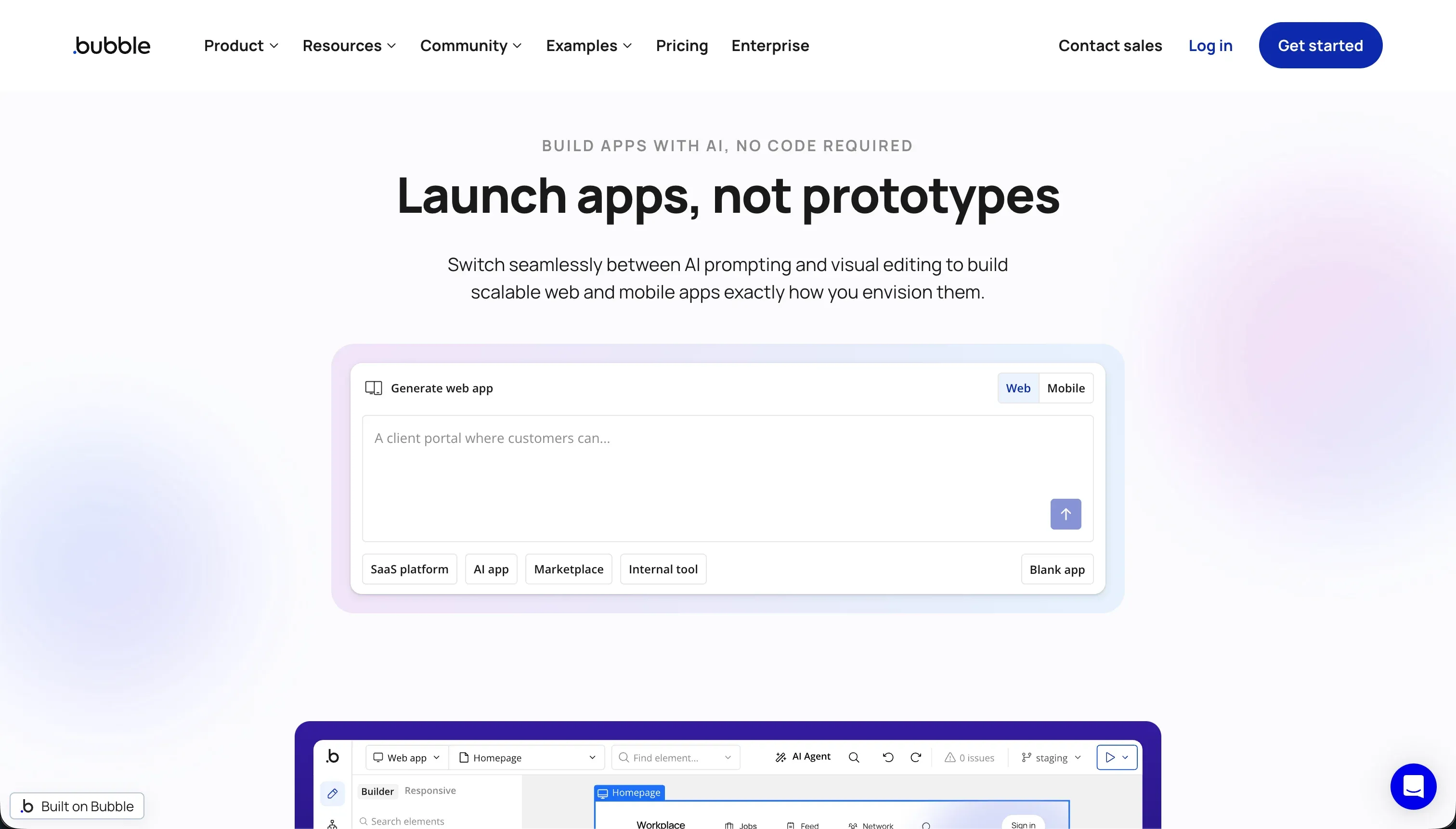 Bubble homepage snapshot
Bubble remains relevant for agencies building apps with intricate workflows, dense relational data, and transactional logic. It scores well on data handling and logic depth because its visual database and workflow engine can support more complex use cases than lighter portal builders.
Marketplaces, approval systems, booking flows, and internal operations software are all realistic agency projects on Bubble when the team knows the platform well.
Bubble also offers more visual flexibility than Softr or Glide, which helps agencies pitch custom applications without going fully code-first. For some teams, that middle ground is attractive. You can build sophisticated behavior without assembling a separate frontend and backend stack from scratch.
The exclusion is maintainability at scale. Large Bubble builds can become hard to debug, hard to document, and expensive to evolve when workflows multiply. There is also no true code export path, so lock-in is real. Agencies that prioritize clean client handoff, internal standardization, or a lightweight support burden should be cautious.
If complexity is moderate rather than extreme, WeWeb plus a backend or even Softr may be the more durable delivery model.
5. Glide - best for lightweight operations apps
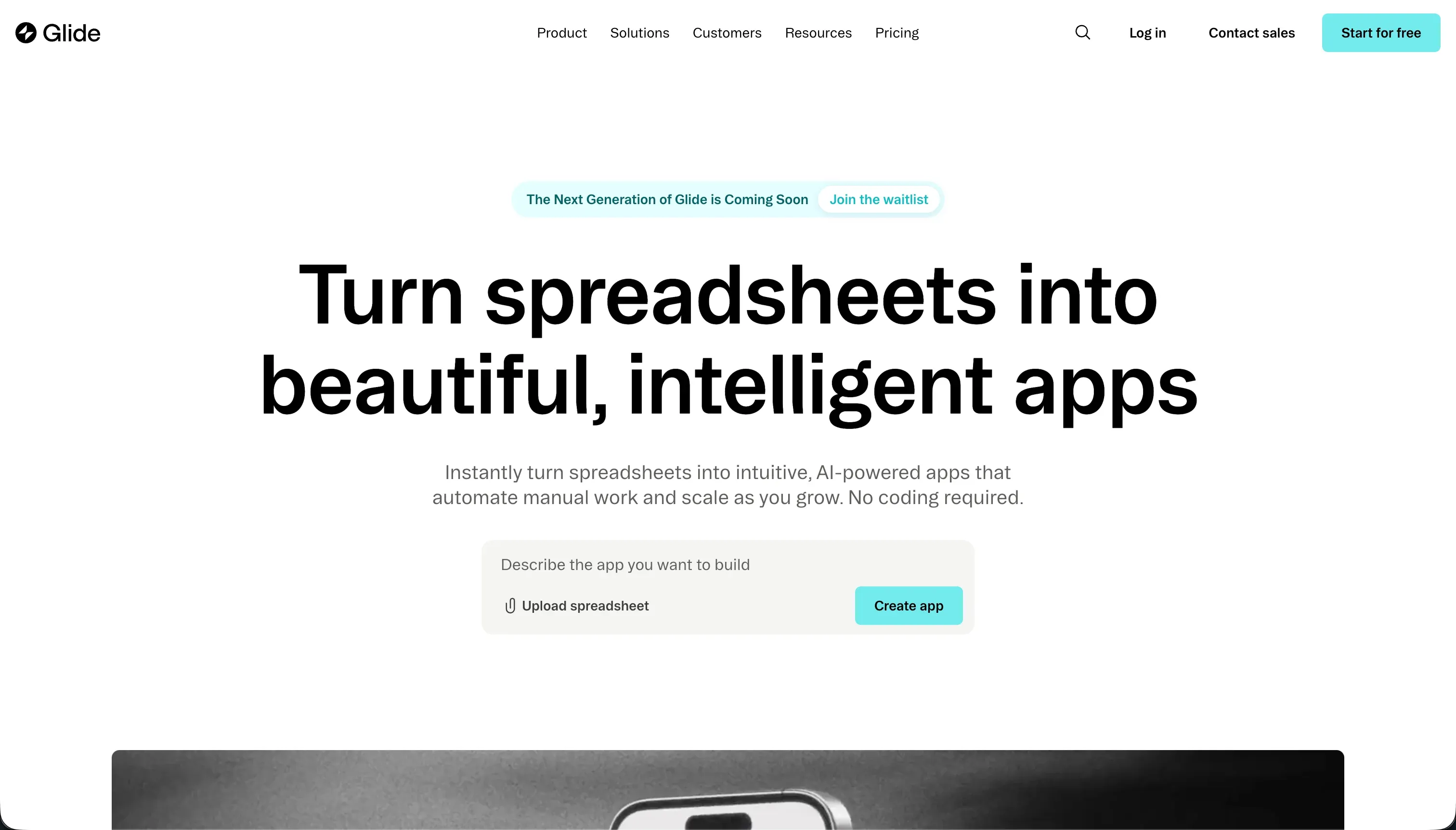 Glide homepage snapshot
Glide earns its place because it solves a very common agency job extremely well: turning operational data into a usable app fast. It scores highly on ease of build thanks to its spreadsheet-style setup, approachable editor, and quick path from raw client data to working interfaces.
For internal tools, field team apps, approvals, resource tracking, and lightweight dashboards, Glide can dramatically reduce project time.
This is particularly valuable for agencies selling smaller packaged engagements. If a client mainly wants a simple app over Google Sheets, Excel, or a basic table structure, Glide often provides the fastest route to launch with the lowest implementation overhead. It can also work well for proof-of-concept projects where speed matters more than frontend uniqueness.
The concrete exclusion is large external user bases or premium custom design. Glide’s layout system is more constrained than tools aimed at custom web products, and seat-based pricing can get uncomfortable when many client users need access. It is not the right option for agencies planning to scale customer-facing portals broadly.
Once a project needs deeper branding, complex permissions, or richer UX patterns, Softr, WeWeb, or Bubble usually become better fits.
6. v0 - best for rapid UI ideation and developer handoff
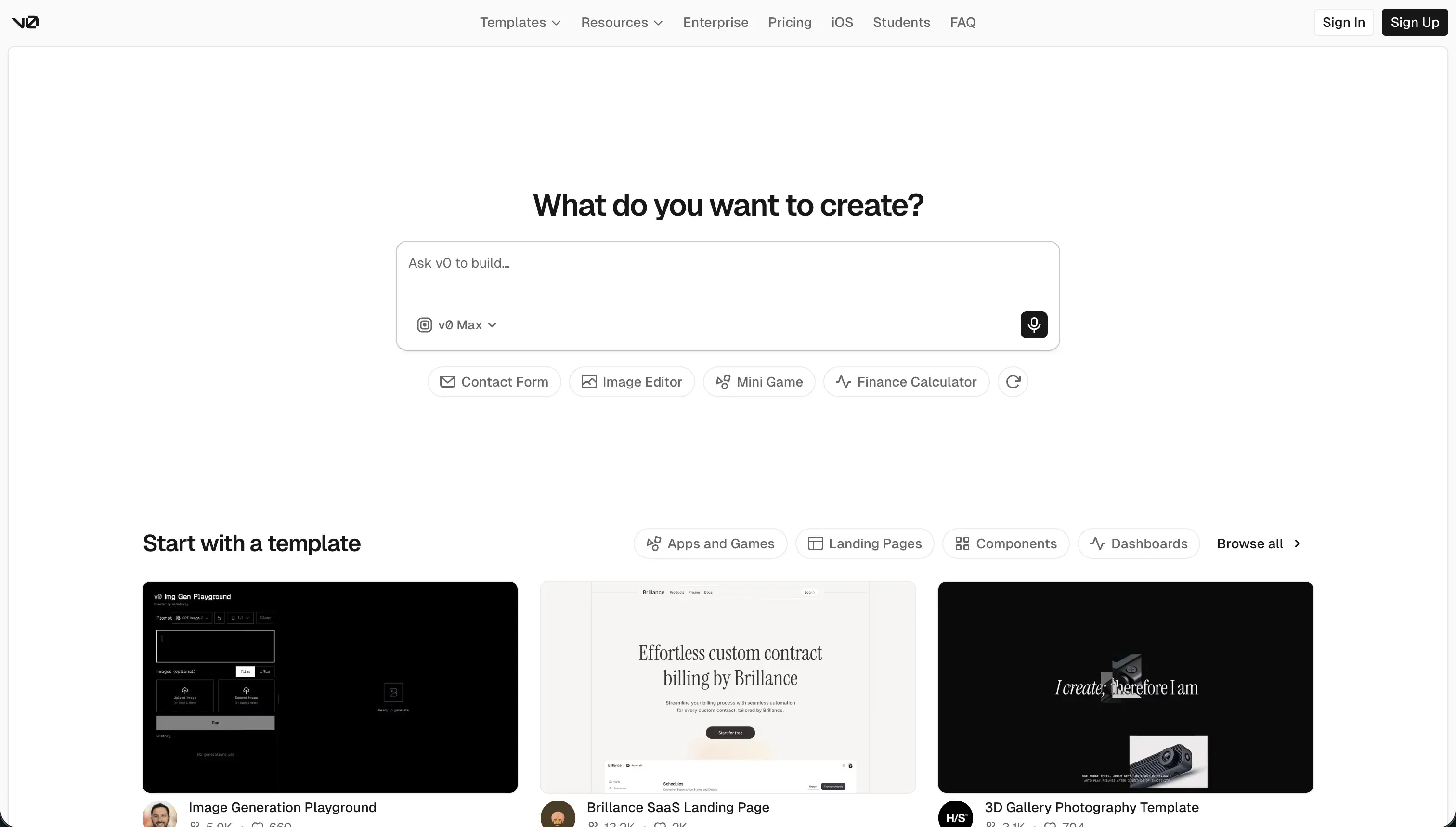 v0 homepage snapshot
v0 is best understood as a powerful accelerator for interface generation rather than a full agency app stack. Its biggest strength is design speed. Teams can prompt modern React screens, iterate on layouts quickly, and produce presentable concepts for clients far faster than hand-coding every component from scratch.
That gives it a strong score on design flexibility and makes it valuable in agencies where sales, design, and engineering collaborate tightly.
It is most useful when paired with a real development workflow. Agencies can use v0 to prototype dashboards, admin panels, marketing pages, and product surfaces, then move those outputs into a broader React application with their own backend and auth setup. That makes it a legitimate tool in code-first shops.
The exclusion is straightforward: v0 is not enough on its own for a client app launch. It does not provide a complete database, permissions model, or deployment-ready application architecture in the way Softr, Bubble, or even Replit can. If your team needs a managed builder rather than a UI generator, v0 should stay in the design and frontend layer, not become the core platform decision.
How agencies should shortlist the right platform
Start by segmenting your client work into delivery patterns, not industries. If most projects are repeatable portals, partner hubs, or dashboards with external users, shortlist Softr first. If you sell high-design custom frontends, compare WeWeb against a code-first stack like Replit. If your projects are mostly lightweight internal tools over tabular data, Glide deserves a faster look than teams often give it.
Next, evaluate who owns post-launch support. A platform that looks efficient during presales can become unprofitable if every small client edit requires a developer. That is why maintainability and permissions should be tested in a live trial, not judged from marketing pages alone. Use the same scorecard across two or three realistic sample builds, then compare long-term support effort, not just initial build speed.
Finally, pressure-test handoff and pricing. Ask whether the client can own the app later, what happens to hosting, and how user-based pricing changes at scale. Our methodology explains the criteria behind these rankings, and the build vs buy guide gives a practical process for running your own shortlist with real scenarios.