




What Small and Medium Businesses Need in an App Builder
Small and medium businesses usually buy app builders to solve a practical problem, not to experiment with software architecture. They need to replace spreadsheets, email chains, and manual handoffs with tools that staff can run without a full engineering team. That usually means internal systems for operations, lightweight CRMs, approval workflows, customer portals, inventory trackers, or vendor dashboards.
The right platform is not simply the one with the most features. It is the one that reduces ongoing effort while still giving enough structure, control, and flexibility to support real business processes.
Our six criteria matter differently for SMBs than for large enterprises. First, ease of build measures how quickly a manager, operator, or founder can launch a working app. If basic setup takes weeks, the tool is probably too heavy for this use case.
Second, production readiness looks at whether hosting, authentication, forms, and deployment are already handled. SMB buyers benefit most from platforms that remove infrastructure decisions.
Third, maintainability is often the deciding factor. Processes change constantly in smaller companies, so the app must be easy to update without breaking permissions, workflows, or layouts. Fourth, security and access control matter because many SMB apps are shared with customers, contractors, or suppliers. If the platform cannot support clean role-based visibility, it creates operational risk.
Fifth, data and integrations determine whether the app can connect to existing sources like spreadsheets, SQL databases, CRMs, or Airtable bases without expensive middleware. Sixth, design flexibility matters, but usually after the first five criteria. Most SMBs need clear branding and usable interfaces, not unlimited front-end freedom.
For this use case, the best builders combine fast setup, simple governance, reliable permissions, and pricing that stays understandable as usage grows. That is why tools built around operational apps, structured data, and repeatable maintenance tend to outperform more open-ended builders for most SMB teams.
The use-case comparison
| Platform | Overall | Advantage | Main reason to exclude it |
|---|---|---|---|
| Softr | 8.1 | Pre-built auth, visual user groups, and predictable flat-tier pricing. | No code export and a block-based layout ceiling. |
| Glide | 6.3 | Very fast app generation directly from spreadsheets. | External user pricing becomes expensive at scale. |
| Airtable | 6.3 | Best-in-class relational spreadsheet database experience. | Limited external-facing permissions and rigid interfaces. |
| Replit | 7.4 | Real, exportable code on managed deployment infrastructure. | Needs technical ownership and variable credit usage. |
| Bubble | 6.8 | Deep workflow logic and highly customizable app behavior. | Harder to learn and harder to budget predictably. |
| Retool | 6.8 | Excellent internal tools layer with direct database access. | SQL and JavaScript skills are usually required. |
1. Softr - best overall for SMB business operations and portals
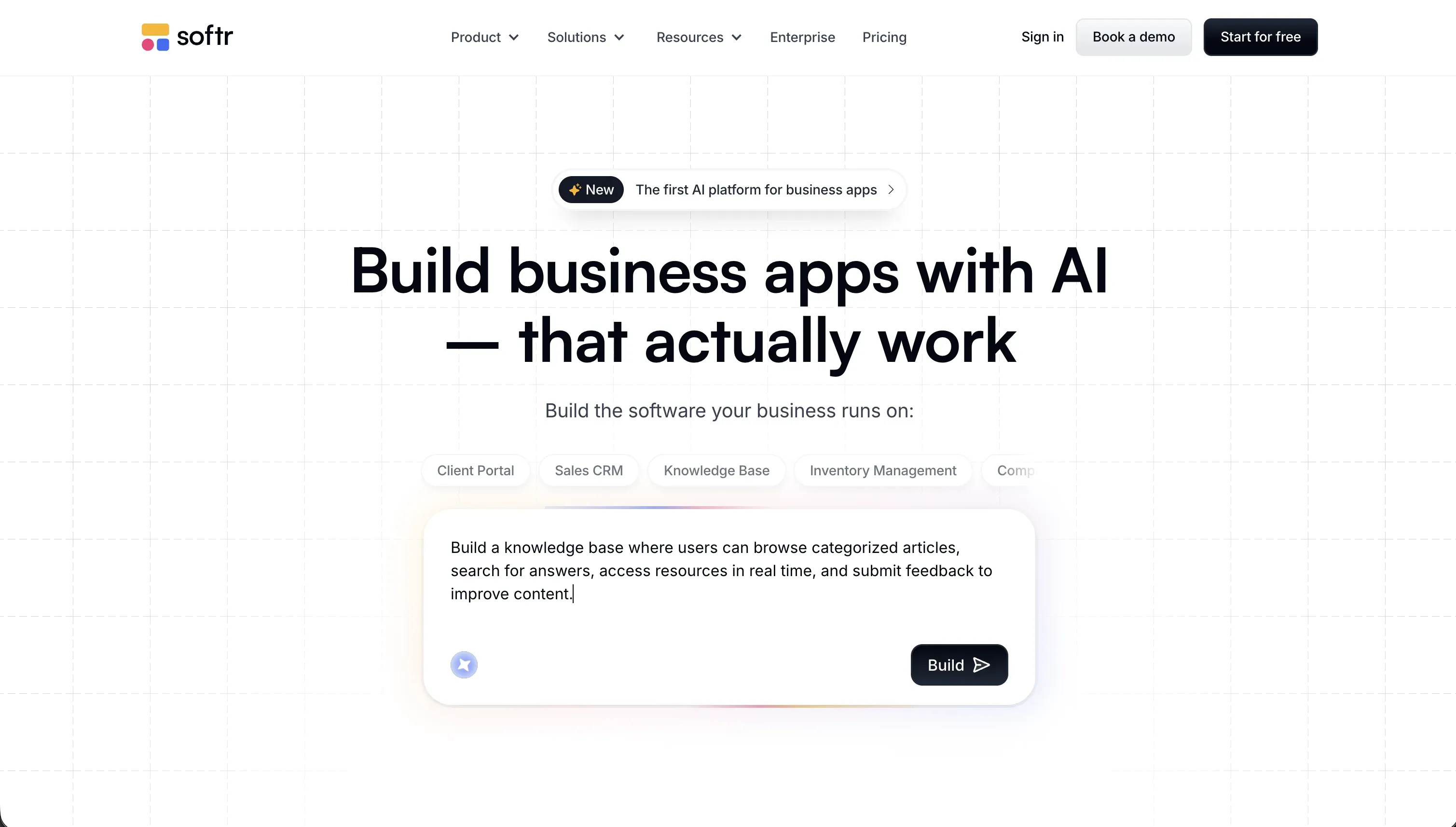 Softr homepage snapshot
Softr ranks first because it matches the way most SMBs actually operate. Instead of asking a small team to piece together hosting, authentication, permissions, and interface logic from scratch, it provides those layers as part of the core product.
That is why it scores especially well on ease of build and maintainability, both at 9.0, while also performing strongly on security and production readiness.
A founder or operations manager can launch internal tools, client portals, CRMs, or directories without needing to own a custom codebase.
Softr is strongest when you care about clean user roles, straightforward edits, and stable monthly planning. It connects well to common SMB data sources, including Airtable, Google Sheets, SQL, and its own native database. The platform is also easier to hand off internally than more flexible builders, which matters when whoever created the app may not be the person maintaining it a year later.
The clear exclusion is native mobile distribution. If you need a true iOS or Android utility app for app store deployment, Softr is not the right fit because it focuses on responsive web apps. It is also less suitable when highly custom front-end behavior matters more than operational speed.
2. Glide - best for small-scale mobile team operations
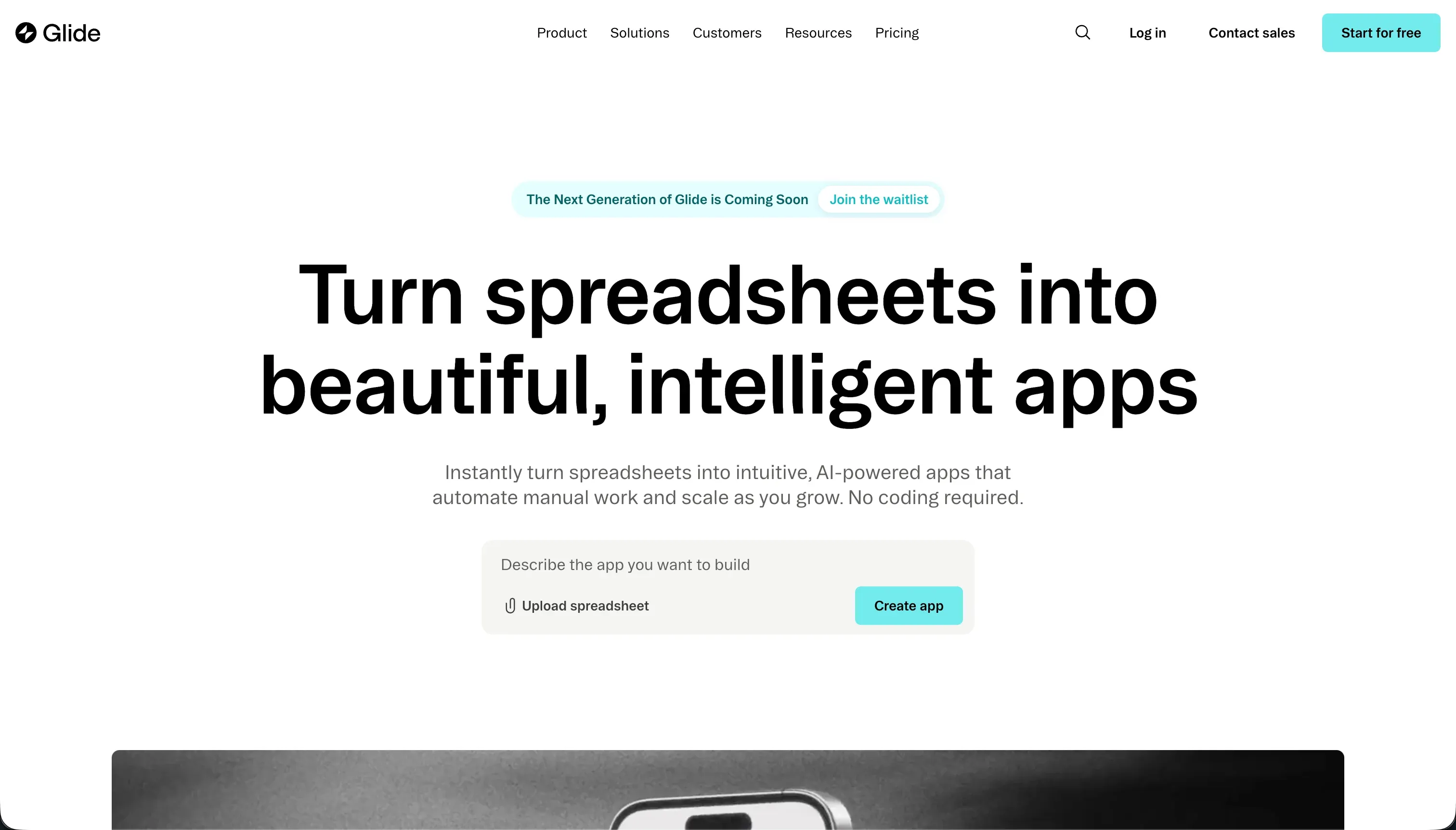 Glide homepage snapshot
Glide is one of the fastest ways to turn spreadsheet data into a polished app, which makes it especially attractive for SMB teams running field operations, inventory lists, basic CRMs, and staff workflows. Its ease of build score of 8.5 reflects how little setup is needed to get a working product in front of users. For managers who already live in tables, Glide can feel almost instant.
It works best when the app logic is fairly straightforward and when user groups are limited. Teams can build clean interfaces quickly, and the mobile-responsive experience is often better out of the box than heavier no-code products. That speed is Glide’s biggest advantage for smaller rollouts.
The tradeoff appears in long-term governance and cost structure. Maintainability sits at 6.5 and security at 5.5 because permission setups are less robust for more complex external use cases. Pricing is the other major caveat. External user counts can push costs up quickly, especially for customer-facing portals with many logins.
Exclude Glide if you expect hundreds of clients, partners, or vendors to access the app regularly. In that scenario, a flatter pricing model like Softr is usually safer.
3. Airtable - best database-first option for internal operations
Airtable remains a top choice when your main need is a strong operational database that non-technical staff can understand. It is excellent for organizing relational data, building lightweight automations, and managing internal workflows through familiar spreadsheet-like structures. Its data and integrations score of 8.0 reflects how capable it is as a business system of record.
For SMBs, Airtable is often best as the data layer rather than the full application layer. Teams can model vendors, projects, assets, support requests, or sales pipelines quickly, and Interface Designer gives them a usable way to surface that data internally. This makes Airtable especially appealing for operations teams that want structure without code.
Its main weakness is external access control. Security and access control score only 5.0 because Airtable is less suited to secure, client-facing experiences with granular row-level visibility. Guest pricing can also rise quickly if many outside users need access.
Exclude Airtable as your primary front-end builder if your goal is a white-labeled portal for customers or partners. In those cases, Airtable often works better paired with a dedicated front-end builder such as Softr.
4. Replit - best for SMBs that want real code ownership
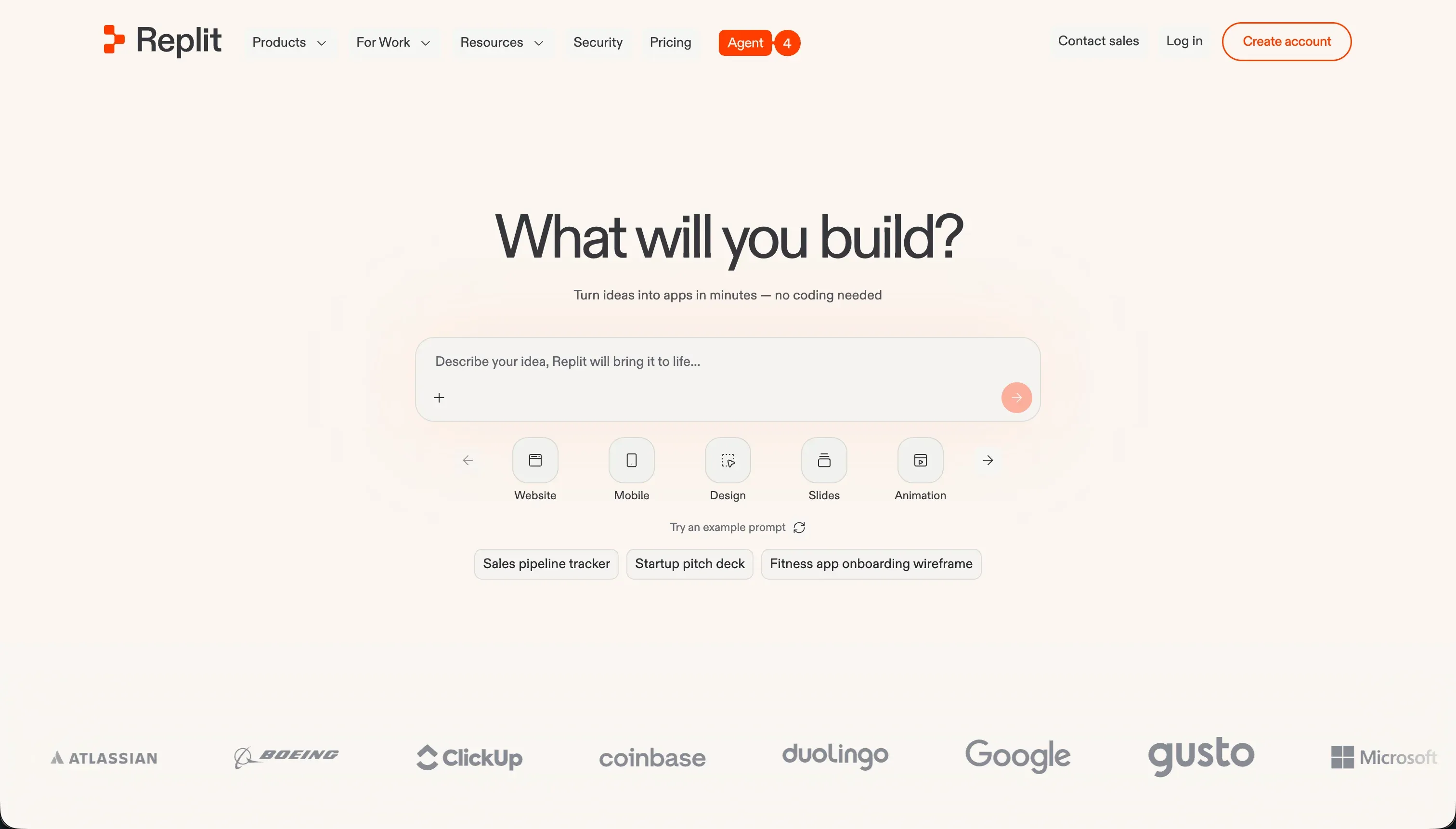 Replit homepage snapshot
Replit is the strongest option here for SMBs that have technical resources and want real code instead of a proprietary visual abstraction.
It stands out for design flexibility at 8.5 and production readiness at 8.0 because teams can generate, edit, and deploy custom applications on managed infrastructure without assembling a full DevOps stack. That is a meaningful advantage for companies that expect their needs to outgrow no-code constraints.
Replit is particularly compelling when the business requires unusual workflows, custom logic, or a product direction that may evolve into a more software-heavy operation. Code portability is also a major benefit. Unlike most no-code platforms, you are not locked into a visual runtime that cannot be exported.
The exclusion is straightforward: do not choose Replit if nobody on your team can review code, investigate bugs, and manage security over time. Even with AI assistance, technical ownership is still necessary. The other caution is pricing variability, since usage can rise during debugging or iteration. For a non-technical SMB seeking operational simplicity, a governed builder like Softr is usually the better fit.
5. Bubble - best for very custom workflow-heavy applications
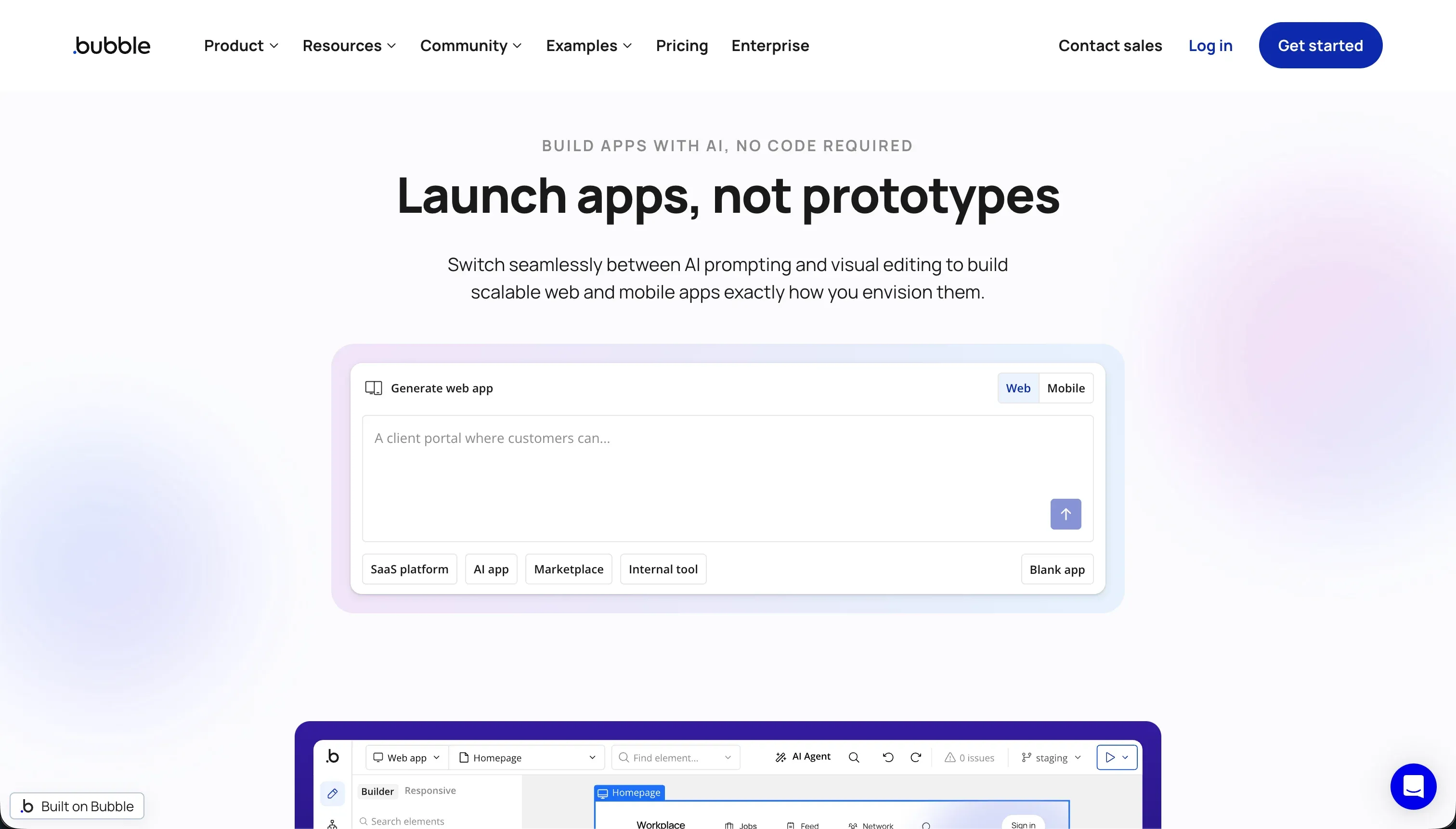 Bubble homepage snapshot
Bubble is still one of the most capable no-code platforms for building complex web apps. It earns strong marks for design flexibility at 8.5 and can support sophisticated workflows, custom data structures, user states, and plugin-based extensions.
If your SMB is effectively building a custom SaaS product, Bubble may offer the broadest visual feature set without moving fully into hand-coded development.
That power comes with real operating costs. Ease of build scores only 5.0 because Bubble requires more architectural thinking than the average SMB buyer expects. Database modeling, privacy rules, and workflow logic all demand care, and mistakes are easier to make than on more opinionated platforms. Maintainability at 6.0 reflects how quickly visual logic can become difficult to audit.
Bubble should be excluded when the need is a simple internal tool, a quick client portal, or a business app that non-technical staff must comfortably update. It also becomes harder to budget because workload-based pricing can rise with inefficient queries or heavier usage. For lean teams, that unpredictability matters.
- Design flexibility 8.5
- Sophisticated workflows and custom data structures
- Plugin-based extensions
- Broadest visual feature set without hand-coding
- Ease of build 5.0
- Maintainability 6.0, logic gets hard to audit
- Workload pricing rises with heavier usage
- Needs architectural care non-technical staff lack
6. Retool - best for developer-led internal admin tooling
 Retool homepage snapshot
Retool earns its place because it is exceptionally effective for internal tools when a technical team already exists. It scores 8.5 on data and integrations thanks to direct connections to SQL databases, APIs, and other operational systems.
For engineering, analytics, and operations teams that need admin panels, approval tools, and high-density dashboards, Retool can dramatically reduce build time.
Its strength is not simplicity for non-technical users. Ease of build is only 4.0 because meaningful apps usually require SQL, JavaScript, or both. That makes Retool less of a general SMB app builder and more of a productivity layer for technical organizations.
It is excellent at exposing and manipulating existing systems, but not ideal for buyers who want business users to build and maintain the application independently.
The concrete exclusion is customer-facing or partner-facing software. Per-seat economics and the developer-oriented setup make Retool a poor fit for portals with many external users. If your requirement is an internal admin console for a technical company, Retool is strong. If your requirement is a secure operational app for broad business use, Softr or Glide will usually be easier to sustain.
How to Shortlist and Run Your First SMB App Pilot
Start by narrowing the field based on who will maintain the app after launch, not just who can build the first version. If the day-to-day owner will be an operations manager, founder, or admin team, prioritize platforms that score well on maintainability and permissions. If a developer will own the system, include one code-based option in your shortlist.
For most SMBs, a two-tool shortlist is enough. One option should be a practical operations builder such as Softr or Glide. The second should reflect your technical ceiling, which may mean Replit if your team wants code ownership, or Airtable if your main priority is a structured data layer.
Use related guides like best internal tools, best client portals, and our methodology to confirm which criteria matter most for your use case.
Run a pilot with a real workflow, not a blank demo. Import actual data, create at least two user roles, test one approval or submission flow, and measure how long a non-technical teammate needs to make a change. That exercise will reveal whether the platform is truly sustainable for your business.