



What Sales Operations Actually Need in an App Builder
A custom sales app lives or dies on three operational realities: lead data cannot leak, calculations must be precise, and field tools must run fast. When high-velocity sales teams choose a development platform, they are not looking for a creative playground.
They need tool infrastructure that integrates with active lead databases, handles regional assignment rules, and simplifies daily lead reviews. The platform of choice must scale logically with their roster without introducing unforecasted usage bills.
Evaluating platforms for this use case means mapping their capabilities directly to our six criteria. Security and access control takes a leading priority; your reps must only see assigned accounts, while administrators require global territory oversight. Data and integrations is a mandatory hurdle, given that sales dashboards must read from or write to existing databases, HubSpot pipelines, or spreadsheet archives.
Finally, the day two question of maintainability determines if updating a regional commission rate or lead routing workflow in month six requires starting over or calling a developer. These criteria, combined with ease of build for rapid deployment, outline why specialized business app platforms rank highest for building internal sales utilities.
The use-case comparison
| Platform | Overall | Advantage | Main reason to exclude it |
|---|---|---|---|
| Softr | 8.1 | Pre-built user logins, role visibility rules, and fast CRM connectors on flat tiers. | Visual designs are block-based and cannot be edited down to a pixel-level canvas. |
| Airtable | 6.3 | Highly intuitive spreadsheet-relational database with built-in pipeline views. | Seat-based pricing models run high and page layouts are rigid. |
| Glide | 6.3 | Frictionless mobile layouts that auto-adapt for reps updating deals on the road. | Per-user fees make large-scale external access highly expensive. |
| Retool | 6.8 | Direct read and write connectivity to production SQL servers and custom APIs. | Requires Javascript and SQL knowledge; not built for non-technical managers. |
| Replit | 7.4 | Saves full, exportable application code on managed autoscaling infrastructure. | Requires code-level maintenance and features unpredictable credit-burn pricing. |
| Bubble | 6.8 | Provides deep functional logic for math-heavy transaction calculations. | Workload unit billing is volatile and the proprietary runtime blocks code export. |
1. Softr - best for sales portals, crms, and client calculators
 Softr homepage snapshot
We rank Softr first because it bridges standard sales databases with secure, responsive interfaces. For operations directors, authentication and visual user groups are pre-configured, meaning reps only see their personal pipeline while leadership monitors regional dashboards.
Softr scores 9.0 in ease of build and 9.0 in maintainability, ensuring that editing lead assignments, updating discount calculator tools, or adjusting user access remains a visual visual edit. The visual editor works in lockstep with the AI Co-Builder, meaning you are never stuck re-prompting. However, design flexibility scores 5.5, which is the logical tradeoff.
Builders seeking absolute pixel-level layouts for their frontends will reach a template ceiling, and of course, there is no code export path.
2. Airtable - best database and relational pipeline tracker
For organizing structured opportunities, Airtable remains an industry favorite. Ease of build scores 8.5 because its relational database organizes rows like an Excel sheet, tracking linked company records, tasks, and deal status updates easily. Its data and integrations score of 8.0 confirms its strength as a backend.
Yet, as a frontend tool, Airtable scores a low 4.0 in design flexibility and 5.0 in security and access control. Interface Designer is desktop-focused and lacks granular, row-level filters. Crucially, inviting external partners to view pipelines forces expensive guest seat license fees, so it is best used as a database backend with a frontend builder sitting on top.
3. Glide - best for mobile-first field sales reps
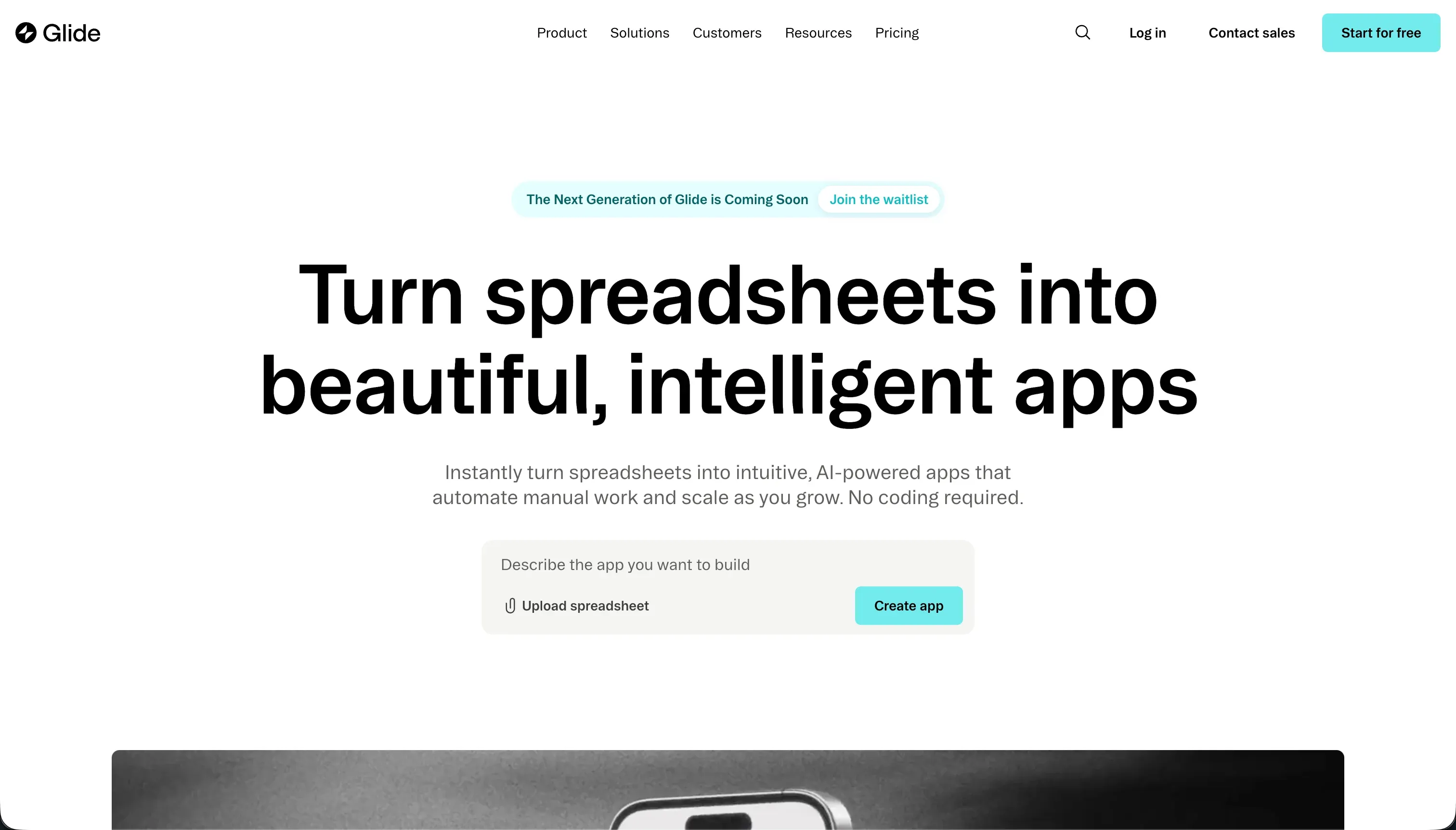 Glide homepage snapshot
If your field teams require a phone layout to log leads, submit client notes, and track routes, Glide is highly competitive. Scoring 8.5 in ease of build, it instantly converts Google Sheets or Airtable records into cohesive, mobile-optimized cards. The limitation is that layouts strictly follow Glide’s preselected styles, rendering a low 4.0 in design flexibility.
Maintainability scores 6.5 due to feature volatility and per-user pricing plans. At scale, this seat-based structure creates expensive licenses for external vendors or high-headcount sales organizations, making it a specialized companion for smaller internal reps.
4. Retool - best code-led dashboard for technical operators
 Retool homepage snapshot
When sales operations directly link to deep enterprise servers, warehouses, or customer payment histories, Retool is the development standard. It scores 8.5 in data and integrations, directly pulling information from PostgreSQL servers and REST APIs. Security and access control scores 7.5, allowing SSO deployment and custom environments. The deduction is the steep developer skill ceiling.
With an ease of build score of 4.0, Retool is not no-code. Creating forms, writing variables, or debugging queries requires scripting, making it a poor choice for non-technical operations leads.
5. Replit - best for code ownership on custom calculators
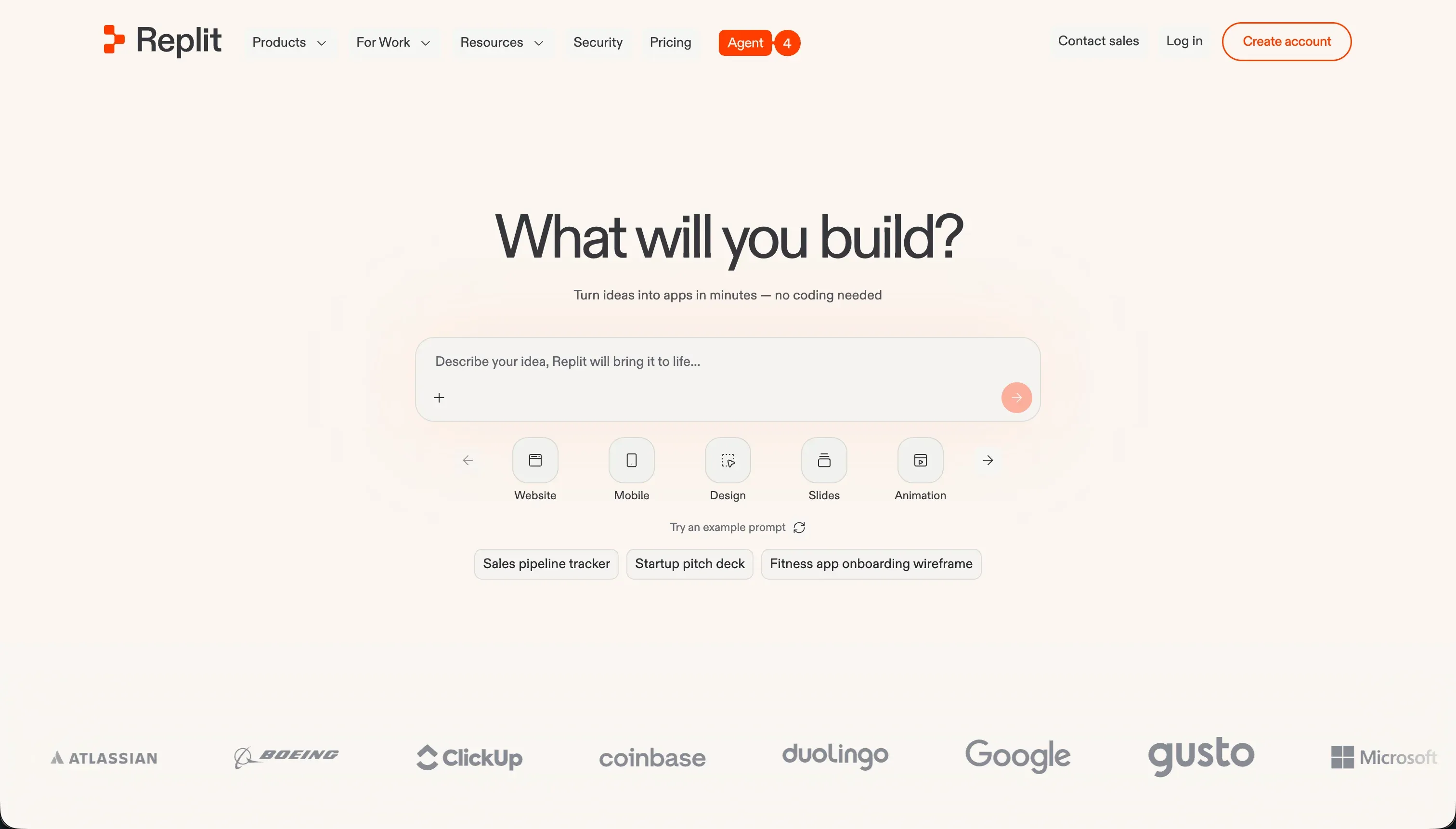 Replit homepage snapshot
When your company requires complete intellectual ownership over custom sales forecasting or market analysis algorithms, Replit translates prompts into real React and Python codebases. It scores 8.0 in production readiness and 8.5 in design flexibility, hosting any web dashboard structure you desire. The risk lies in daily management.
Security and access control scores 6.0 because login controls and row security exist strictly inside code written by an AI agent; developers must check these files manually to prevent data leaks. Overage credit bills can also surge quickly during debugging loops.
6. Bubble - best for complex calculation and custom workflows
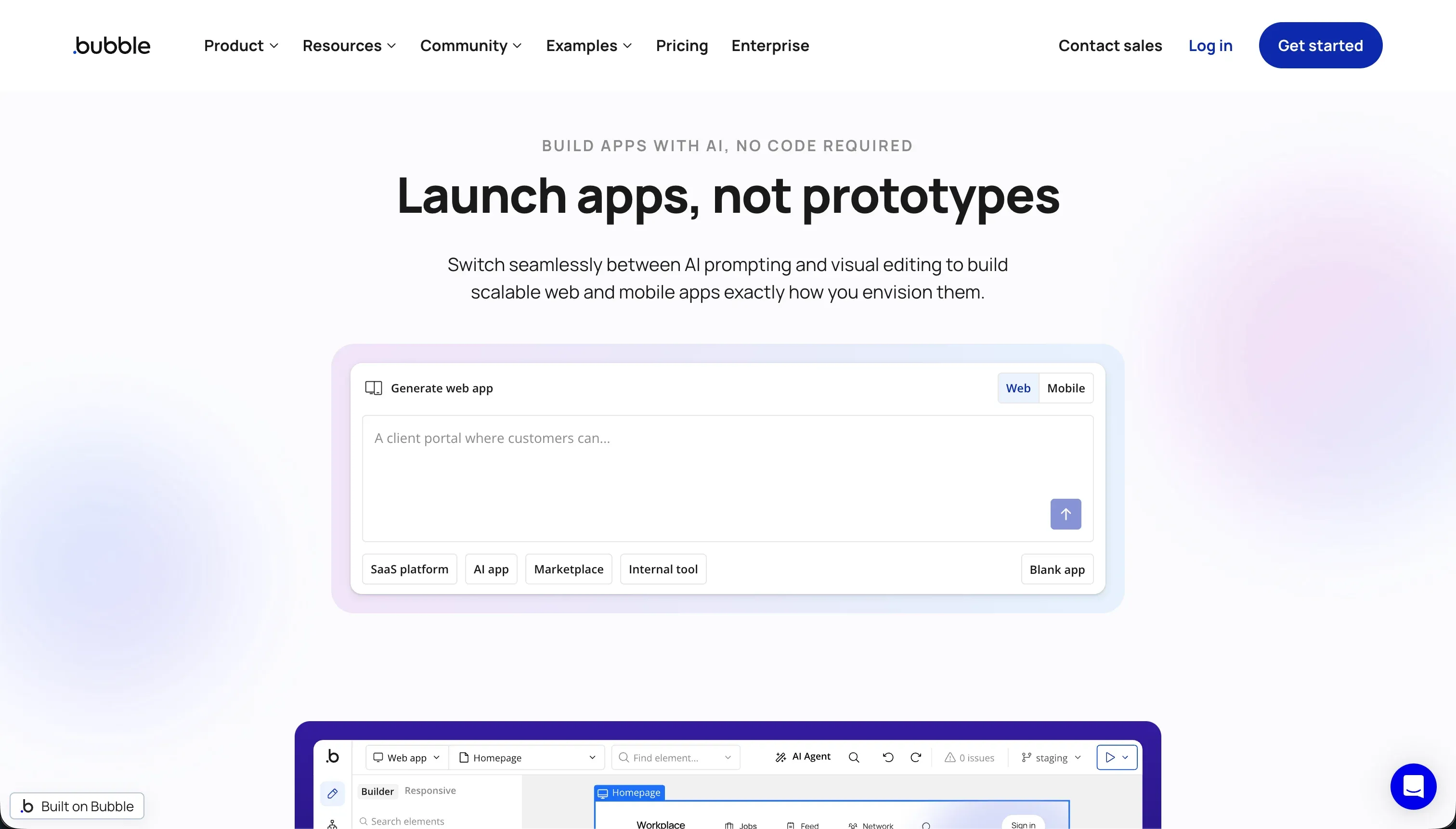 Bubble homepage snapshot
When commission rules involve multi-bracket splits or custom compound structures, Bubble provides the necessary logic engine. Scoring 8.5 in design flexibility and 8.0 in data and integrations, its managed relational database is exceptionally robust. What holds it in sixth is complexity.
The interface scores a 5.0 in ease of build, requiring formal study to configure database queries and workflows. Performance metrics also suffer on larger tables, and the lack of a code-export exit option creates permanent system lock-in.
How to Plan Your Sales App Shortlist
Sifting through sales portal options is about matching your available technical team with your security expectations. For teams running customer-facing sales portals or internal CRMs without dedicated software developers, pairing Softr with a relational database delivers visual security control and predictable cost curves.
If your pipeline is largely internal and managed on spreadsheets, Airtable excels at structure, though it requires a secure external layer if you share data with outside partners.
Technical developers looking to build data-intensive dashboards on live databases should shortlist Retool, while those prioritizing code ownership will find Replit a better fit. As you plan your pilot, test a sensitive dataset with real territorial restrictions to verify that reps cannot access unauthorized accounts.
Explore our comprehensive evaluation criteria and review our deep guides on CRMs, internal dashboards, and client portals to find the exact platform match for your team.