




What Professional Services Firms Actually Need
Professional services firms operate in an environment where speed, trust, and confidentiality decide client relationships. Building custom applications for this use case means evaluating platforms based on how they handle sensitive interactions such as secure resource sharing, custom paperwork signing, client onboarding, and project status monitoring.
To build an app that client accounts can trust, firms must look beyond cosmetic design and analyze core functional architecture.
Firms require an infrastructure that addresses several criteria to be effective. First, Ease of build handles how quickly your team can spin up a client portal, process documents, or track projects.
Second, Production readiness and Security & access control dictate whether the platform includes pre-built authentication, magic links, user groups, and strict row-level data restrictions. In professional services, Client A must never see the billing, files, or tasks of Client B. A single security configuration error can cause a critical data spill.
Furthermore, Maintainability governs how easily your operational managers can update forms, modify fields, or edit workflows on day two without breaking existing portals or calling developers. Data & integrations covers how smoothly the platform connects to your existing records in Airtable, Google Sheets, or SQL databases.
Finally, Design flexibility allows you to inject custom logos, fonts, and branding to establish a polished, trustworthy customer-facing workspace.
While a high design ceiling is attractive, professional services firms should optimize for platforms with solid authentication, granular record-level permissions, and predictable flat-tier pricing. For standard operations, a maintainable no-code environment that runs securely on Day Two is always a safer, more economical purchase than a complex, generative code experiment.
The use-case comparison
| Platform | Overall | Advantage | Main reason to exclude it |
|---|---|---|---|
| Softr | 8.1 | Pre-built customer auth, visual dynamic user groups, SOC 2 compliance | No source code export and block-based layout boundaries |
| Replit | 7.4 | Full application code ownership, unconstrained frontends, and custom integrations | Requires technical developers to maintain code and manage billing spikes |
| Bubble | 6.8 | Bespoke transactional workflows, managed relational data layers, and visual equations | Steep conceptual learning curve and usage-based workload unit costs |
| Glide | 6.3 | Fastest spreadsheet-to-app migration with mobile-first template layouts | Restrictive styling guidelines and expensive per-seat pricing limits |
| Airtable | 6.3 | Most approachable spreadsheet-relational database for internal project managers | Desktop-centric design, lacking native portal logins and row-level visual permissions |
| WeWeb | 6.2 | Advanced CSS visual controls, single page application speed, and clean Vue.js export | No built-in database layer, requiring complex decoupled platform configurations |
1. Softr - best for client portals and secure document workflows
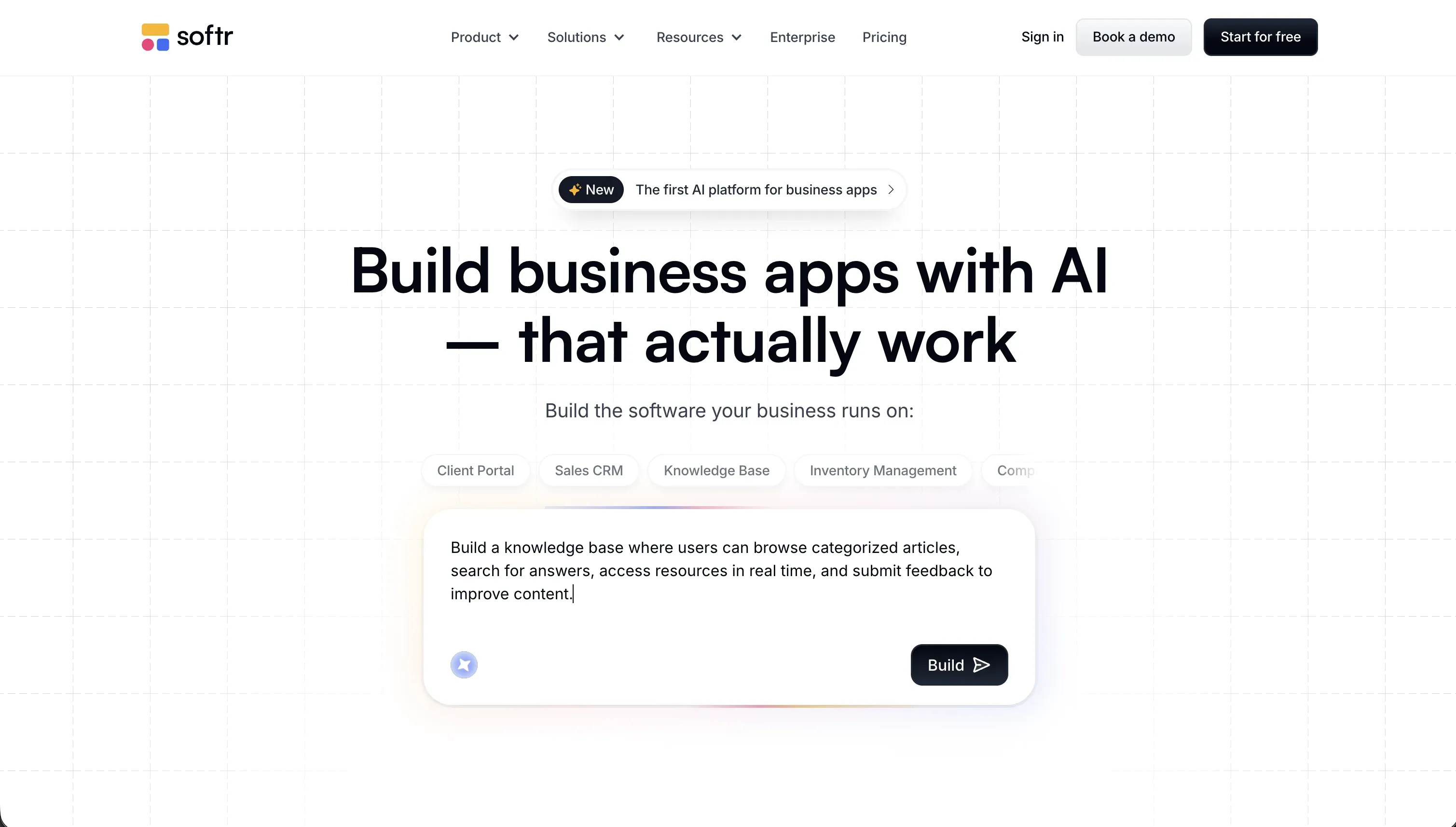 Softr homepage snapshot
For professional services firms, Softr ranks first because its core architecture is tailored for client portals, document workflows, and onboarding. It achieves an outstanding Ease of build score of 9.0 and a Maintainability score of 9.0 because its creation paths are incredibly streamlined.
The platform integrates a context-aware AI Co-Builder with manual visual block settings, letting non-technical managers edit interfaces, update permission levels, or adjust database schemas without needing code. This approach solves the day-two maintainability issues that plague generated code bases.
Crucially, Softr scores 8.5 in Security & access control and 8.5 in Production readiness. It delivers pre-configured authentication, Google sign-in, magic links, user groups, and row-level data isolation natively. This lets firms safely publish files and secure resources on day one with SOC 2 Type II compliance.
For larger organizations, IT departments safely deploy Softr to empower departmental builders to replace spreadsheets while preventing shadow IT. Flat-rate pricing like the Pro plan at $99 a month billed annually handles up to 10 Team and 50 Client app users predictably.
Exclusion: Firms looking for high visual customization or pixel-perfect layout design will be restricted by Softr’s native block-based layout engine, which scores 5.5 for design flexibility.
2. Replit - best for code-first firms and developer-led custom portals
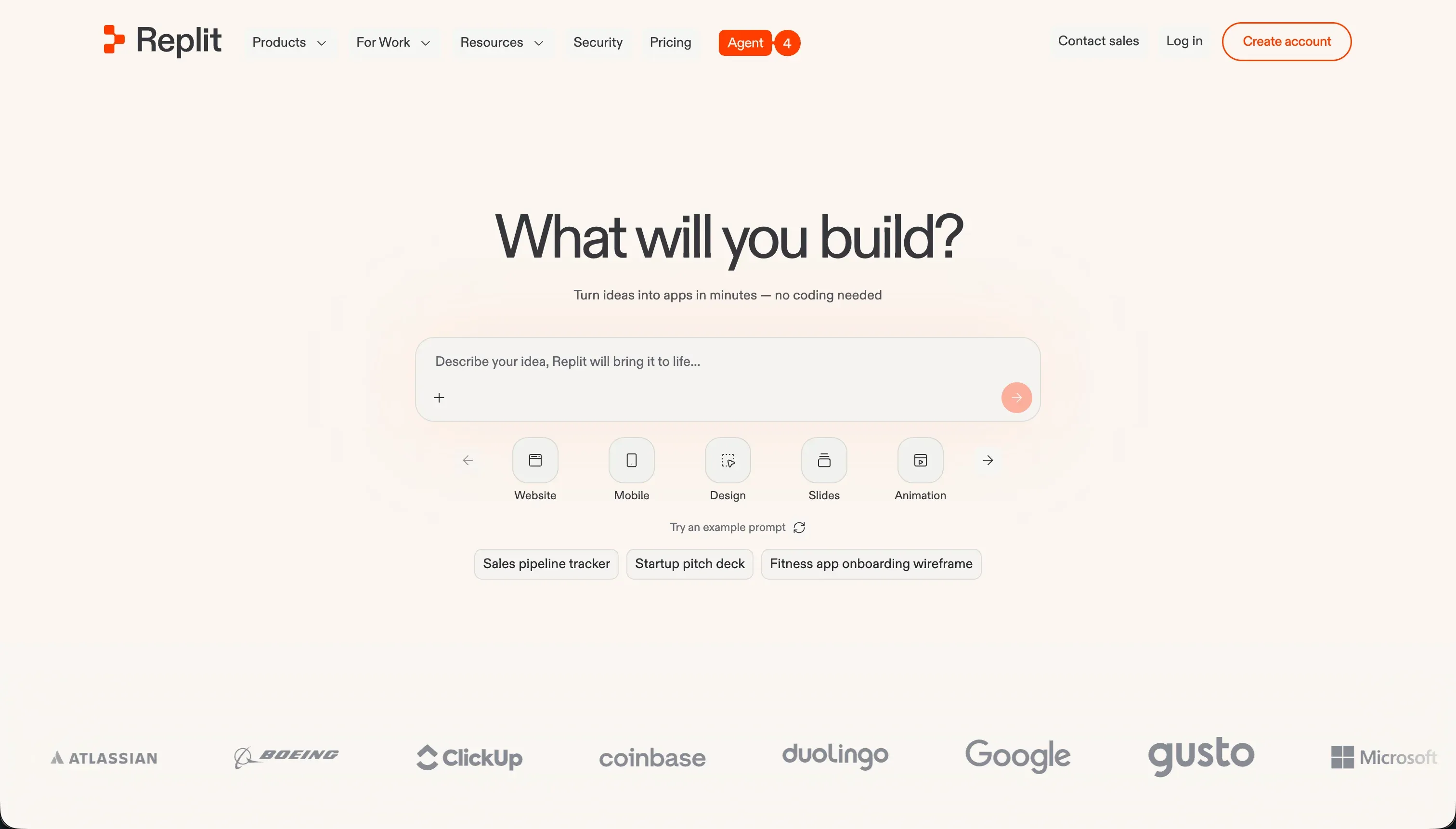 Replit homepage snapshot
For agencies with engineering talent, Replit presents the strongest code-first path to custom software. The Replit Agent builds and deploys applications as standard, exportable code on managed, autoscaling cloud servers, scoring an 8.0 for Production readiness.
Because it hosts real files, developers can write tailored styling variables and establish complex, proprietary calculations, earning a Design flexibility score of 8.5.
However, this developer flexibility introduces a maintenance burden. Security & access control scores 6.0 because roles and permissions live directly in agent-written code. To ensure client data remains private, a technical staff member must manually audit every piece of database middleware and logic.
Furthermore, the billing structure is based on agent effort, meaning runaway troubleshooting runs can cause sudden billing overages.
Exclusion: Do not build your portal on Replit if your firm lack developers to regularly review logs, update dependency libraries, and debug runtime errors.
3. Bubble - best for complex transactional logic and visual equations
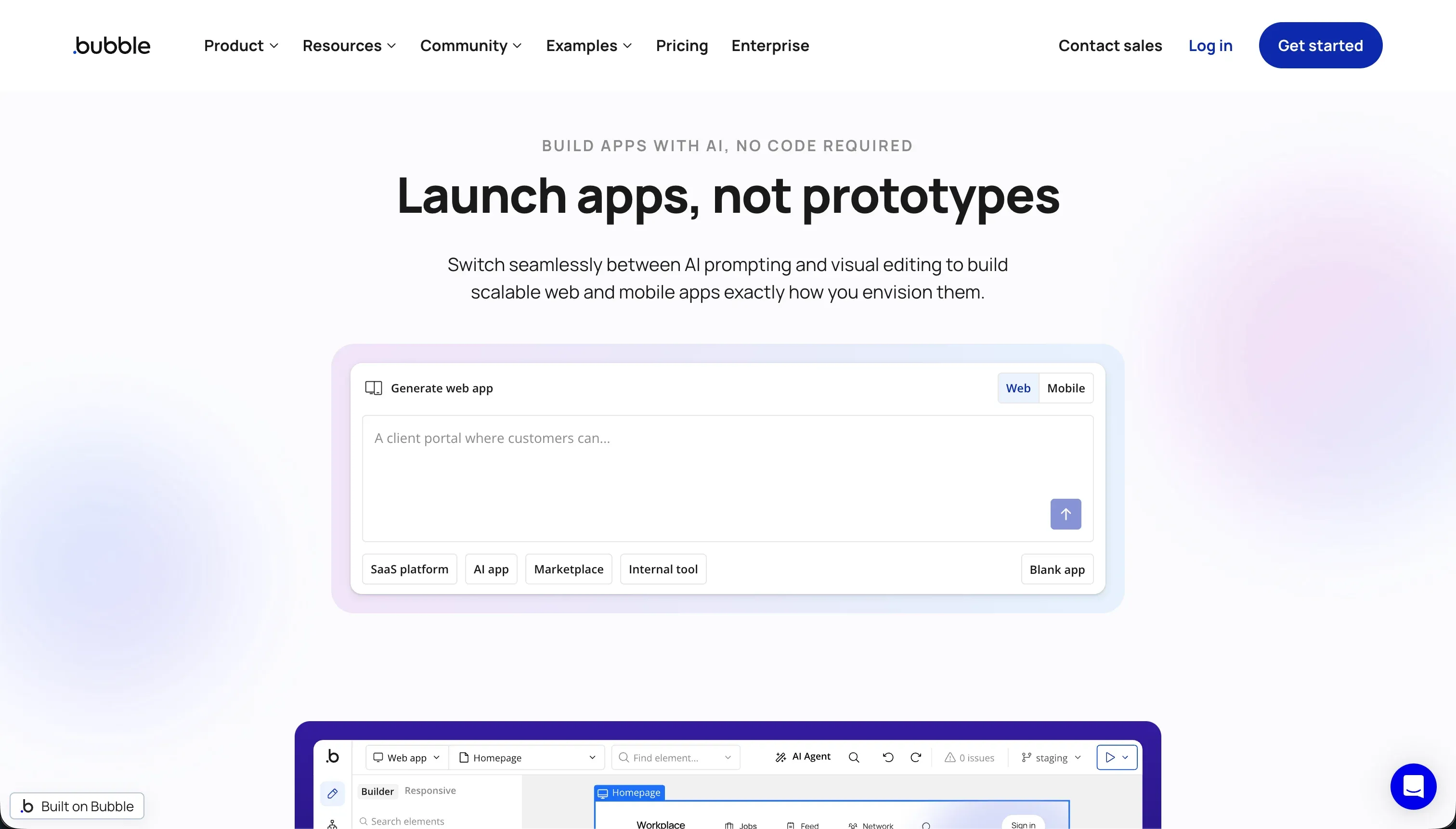 Bubble homepage snapshot
Firms requiring deep, layered logic for multi-step approval chains or client matchmaking will find Bubble highly capable. It secures a 8.5 score for Design flexibility and a 8.0 for Data & integrations. Its relational database, workflow builder, server-side data isolation paths, and massive library of over 8,000 plugins let you control every pixel and operation.
This depth comes with a steep conceptual learning curve, resulting in an Ease of build score of 5.0. Establishing secure role-based portals requires database-level rules that are non-trivial to configure, and visual development panels are prone to workflow sprawl on large-scale databases. Additionally, Bubble does not support code export, creating total platform dependency.
Exclusion: Avoid choosing Bubble if you require a simple, predictable operational budget, as its workload-unit pricing model can trigger expensive, unoptimized billing spikes.
4. Glide - best for small-scale spreadsheet-backed operational tools
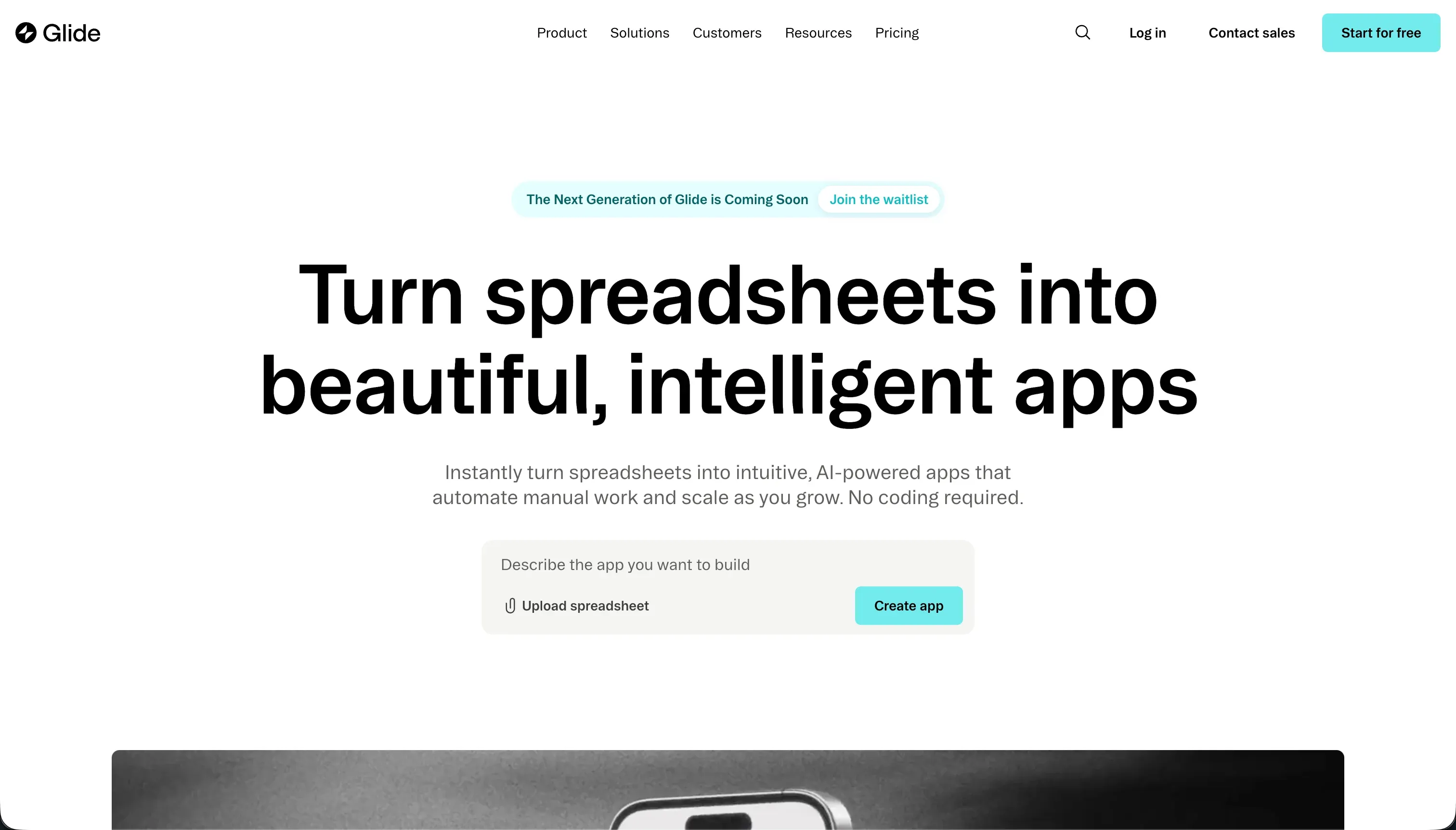 Glide homepage snapshot
When a consulting firm needs to quickly transition internal Google Sheets or Excel files into clean interfaces, Glide is exceptionally efficient. Scoring 8.5 for Ease of build, it maps structured sheets directly to polished visual cards, charts, and maps that look premium on phone screens, with native spreadsheet functions and database AI columns.
Its ultimate ceiling is scaling the client count. Security & access control scores a thinner 5.5 compared to portal-specific platforms because granular external visibility rules are harder to configure cleanly. Additionally, shared user limits are strictly capped under tiers like the $249 a month Business plan before forcing enterprise discussions.
Exclusion: Avoid Glide if you require highly customized on-brand design guidelines, as its layout engine forces templates and restricts custom visual overrides.
5. Airtable - best for internal project tracking and database collaboration
For professional services offices organizing relational project logs, resource sheets, and document pipelines, Airtable remains an class leader, claiming an 8.5 for Ease of build and 8.0 for Data & integrations. Its Interface Designer lets you configure internal dashboards directly on top of dynamic columns without code.
However, it thins out as a client-facing portal. It scores 5.5 on Production readiness and 5.0 on Security & access control because permissions apply primarily at the base level. It lacks native client signup flows, and securing records for individual external users requires expensive guest packs starting at $120 a month for just 15 guests.
Exclusion: Do not utilize Airtable’s Interface Designer for external customer portals or mobile-first applications, as layout pages remain rigid, branded, and desktop-focused.
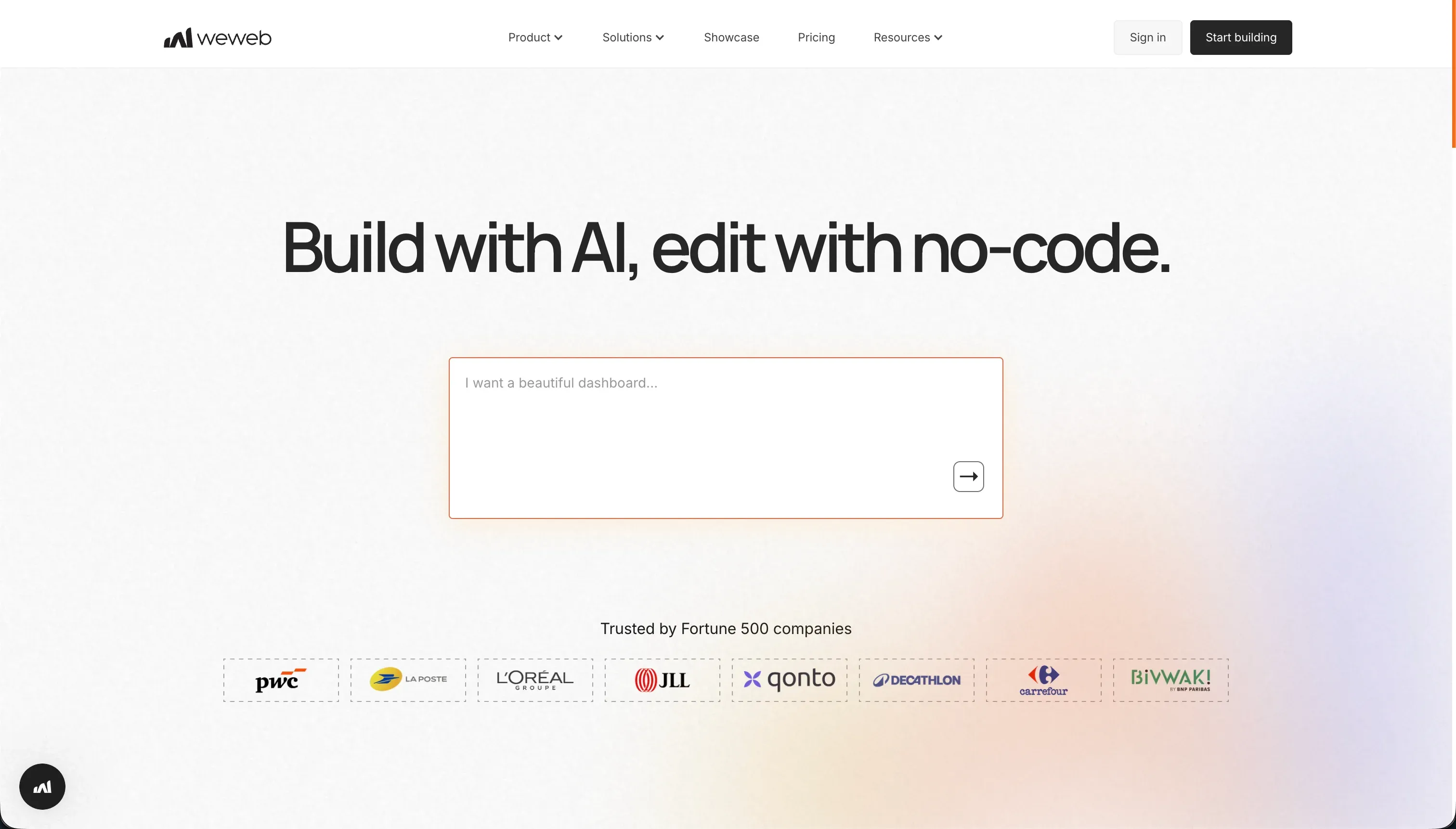
6. WeWeb - best frontend engine for agencies with independent backends
 WeWeb homepage snapshot
Firms seeking to build a polished, high-performance web experience can pair WeWeb with a robust backend database like Supabase or Xano. Responding with an 8.5 score for Design flexibility, WeWeb has a visual layout engine with flexbox, grid, and absolute CSS controls that let you realize exact brand aesthetics, with Vue.js code export on staging plans.
This decoupled design yields an Ease of build score of 4.0 because the platform contains no native database files. Non-technical staff must construct their own token-based login workflows and manage data pipelines across separated dashboards, elevating security configuration risks.
Exclusion: Avoid WeWeb if you need a rapid, unified all-in-one product suite, as staging and custom domains start at a relatively expensive entry price.
How to Shortlist and Begin Your Pilot
To select the correct app-building standard for your professional services firm, do not test every candidate on this list. Instead, map your team’s existing developer skills and budget to two options. If your primary goal is to launch secure customer portals, client onboarding flows, or secure resources without coding, shortlist Softr.
To compare, you can review our specific page comparisons like /best/client-portals, /best/document-management-apps, and /best/client-onboarding-portals to understand how visual building logic operates.
If your firm has a dedicated engineering team that demands absolute code ownership, shortlist Replit and pair it with a database engine, noting the development labor required to secure your user routes.
For complex database relations, run a pilot with Bubble alongside Softr to test how each option impacts client onboarding. To review our evaluation criteria and how criteria scores are calculated, read our complete methodology guidelines.