




What Enterprises Actually Need in an App Builder
At the enterprise level, the software development backlog is a persistent bottleneck. Engineering organizations are routinely forced to prioritize mission-critical core systems, leaving line-of-business departments to manage their custom workflow gaps with manual spreadsheets and fragmented databases.
Resolving this challenge requires tools that empower divisions to build safely without creating shadow IT or introducing security vulnerabilities.
Evaluating platforms for this tier requires matching software traits directly to our six criteria. Security & access control must be bulletproof; it needs visual auditing and direct integration with identity managers (SSO) to protect sensitive corporate assets. Production readiness demands enterprise-grade stability, predictable hosting, and SOC 2 compliance.
Maintainability is the decisive factor for “day two” viability; if changing a workflow requires reviewing thousands of lines of fragile AI-generated scripts or causes silent layout regressions, the application is a liability.
Furthermore, ease of build determines whether business operators can modify their own processes on the fly. Data & integrations must comfortably connect to existing enterprise backends, data warehouses, and custom APIs without exposing credentials on the client side.
Finally, design flexibility should scale sufficiently to align with corporate style systems but preserve strict layout boundaries that ensure responsiveness across all screens. Enterprise application platforms must deliver are safe, scalable, and manageable environments where data boundaries are clearly understood and protected.
The use-case comparison
| Platform | Overall | Advantage | Main reason to exclude it |
|---|---|---|---|
| Retool | 6.8 | Direct SQL write operations, rich developer utilities, and direct VPC self-hosting options | Rigid admin aesthetic and high seat costs that limit client portal scale. |
| Softr | 8.1 | SSO authentication, visual user groups, and zero codebase maintenance debt | Lacks direct layout pixel customization and code export options. |
| Airtable | 6.3 | Highly approachable relational schemas and automated in-base workflows | Restricted to desktop layouts with rigid, non-customized style properties. |
| WeWeb | 6.2 | Clean Vue.js code downloads and complete visual layout flexbox alignment | Has no native storage, requiring separate backend architecture payments. |
| Replit | 7.4 | Real, exportable application repositories and cloud server environments | Every minor logical correction demands developer code oversight. |
| Bubble | 6.8 | Advanced conditional database rules and rich visual logic workflow trees | A proprietary runtime that seals logic and creates full lock-in. |
1. Retool - best for technical teams and system admins
 Retool homepage snapshot
For internal tools built directly by engineering or operations groups, Retool leads our ranking. The platform excels at establishing deep data & integrations (scoring 8.5/10), because it reads and writes databases natively, handles JS logic, and displays data density through 100 prebuilt components.
Version controls, environment staging, and self-hosting options on the Enterprise package provide developers with comfortable, isolated deployment patterns. Security & access control scores 7.5/10; the platform keeps customer credentials safe within your virtual private cloud and logs operations cleanly.
The trade-off is the skill floor. Ease of build scores 4.0/10 because any action beyond simple grids requires SQL, javascript, and query orchestration. Line-of-business managers with no engineering training will reach an immediate limit. Do not use Retool if your goal is building external portals, since its seat-based pricing gets expensive under high user registers and custom authentication must be hand-engineered.
- Native database reads and writes
- Data & integrations 8.5/10
- JS logic and 100 prebuilt components
- Self-hosting in your VPC
- Security & access control 7.5/10
- Ease of build 4.0/10
- Beyond simple grids needs SQL and JS
- Non-engineers hit a wall fast
- Seat pricing punishes external portals
- Custom auth must be hand-engineered
2. Softr - best for IT-governed enterprise departments
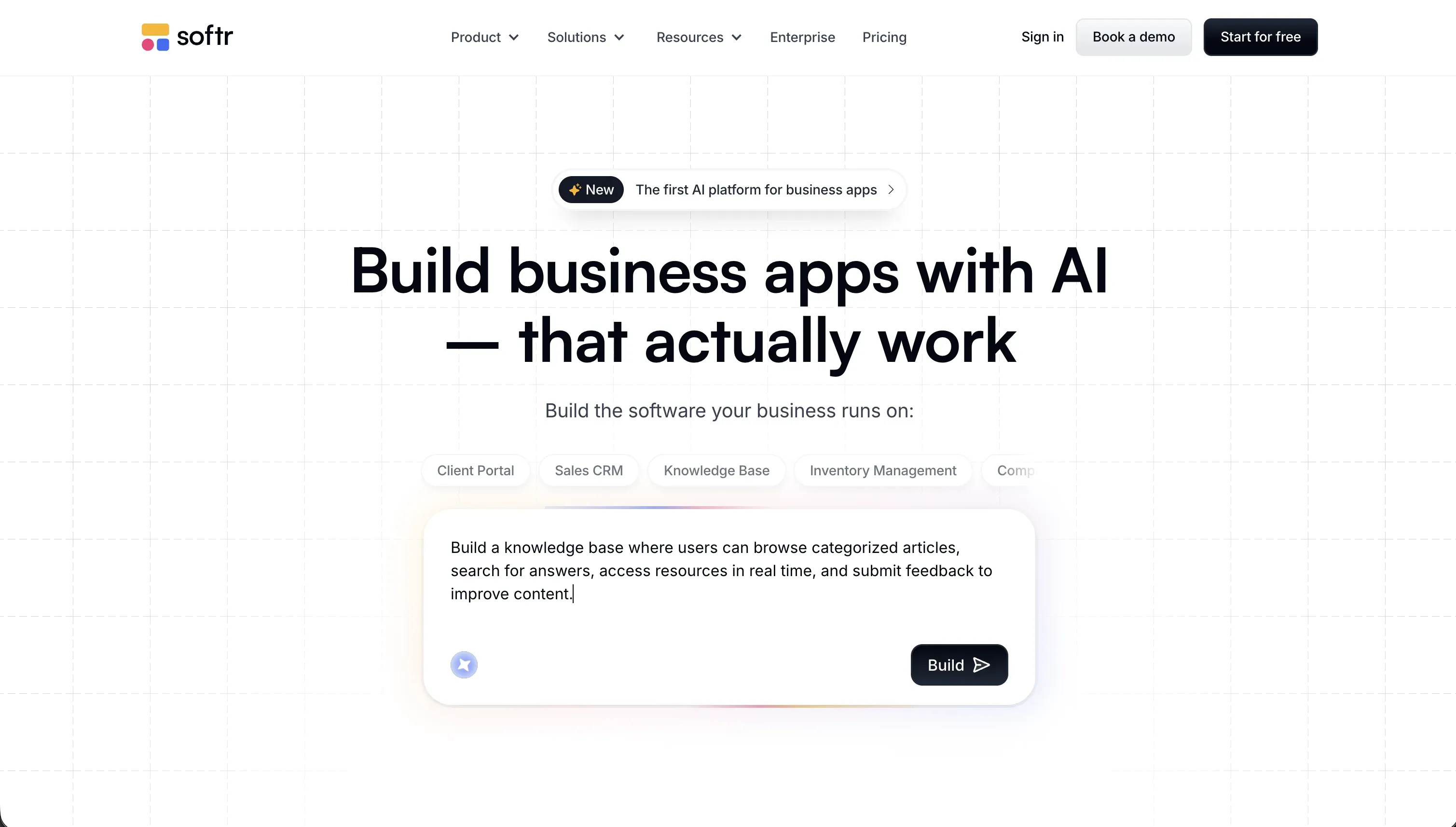 Softr homepage snapshot
Softr is designed for governed, decentralised visual tool building, placing first for line-of-business operational tools. It scores 9.0/10 for ease of build and 9.0/10 for maintainability because there is no generated codebase to preserve or debug. IT groups deploy this platform to let non-technical departments visually produce intranets, client portals, and CRM layers without creating shadow IT risks.
Authentication, global SSO, visual user groups, and row-level visual permissions come standard, removing the security configurations that define raw code builders.
Because of this prebuilt infrastructure, apps built with Softr are secure and functional from day one. Users can securely query Softr Databases or pull data through Airtable, SQL, and REST APIs. Security & access control scores an outstanding 8.5/10.
The honest limit is design flexibility (5.5/10); applications are constructed using prebuilt blocks rather than pixel-level grids. Exclude this platform if you require a tailored retail visual experience or need native app store deployments, since Softr focuses purely on secure web business apps.
3. Airtable - best for simple relational spreadsheets
Airtable provides non-technical staff with the most approachable relational database interface in our index, earning an ease of build score of 8.5/10. The visual layout lets operators quickly set up linked fields, rollups, and manual automations. Using Interface Designer, non-developers can present operational tables as internal trackers.
This approach keeps daily metrics and assets aligned across multiple internal collaborators without custom frontends.
However, it falls third due to enterprise performance limits. Production readiness scores 5.5/10 and security & access control scores a low 5.0/10. Airtable lacks secure, row-level front-end security; permissions exist strictly at the base level, meaning anyone with interface edit rights can access the entire dataset behind it. Performance degrades as databases grow, formulas multiply, or API limits are reached.
Do not buy Airtable as a complete application container if your projects require multi-client billing boundaries or responsive mobile formatting.
4. WeWeb - best for visual code generation
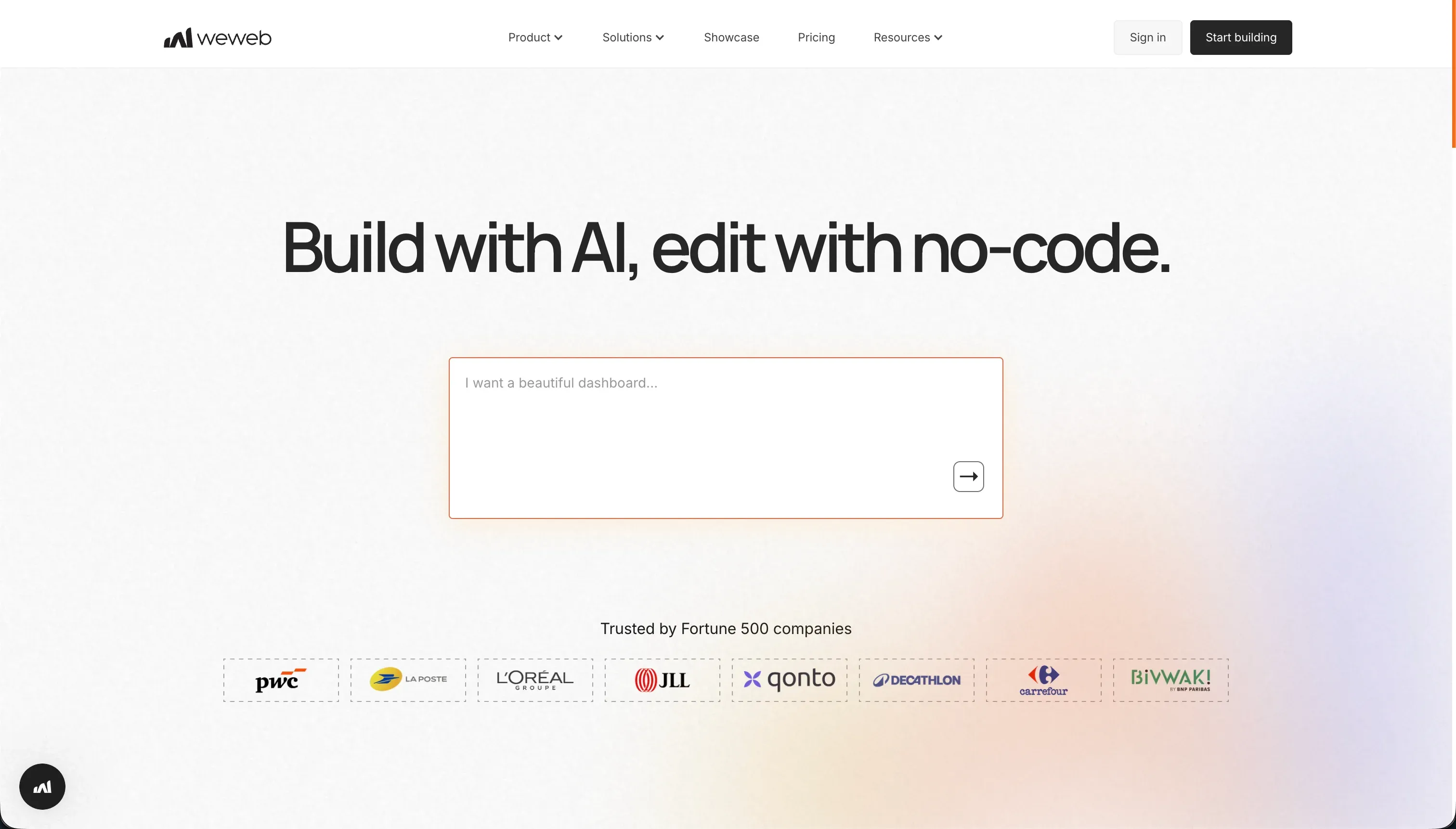 WeWeb homepage snapshot
WeWeb serves enterprise agencies and modern frontend teams looking for pixel-level visual freedom paired with clear Vue.js code export. Design flexibility scores an impressive 8.5/10 because the layout engine exposes flexbox alignment, CSS grid attributes, and custom JS values. For scaling web applications that require clean visual design, WeWeb provides front-end options that simpler block systems cannot match.
The challenge for enterprises is the decoupled architecture. Because there is no native database, builders must establish, secure, and pay for an independent server backend. Token-based user authentication must be wired by hand, dropping security & access control to 5.5/10 and ease of build to 4.0/10.
Maintainability scores 6.0/10 as database updates force developers to manual update queries in both environments. Do not select WeWeb for simple internal operations where setup speed is a key metric.
5. Replit - best for AI-assisted code ownership
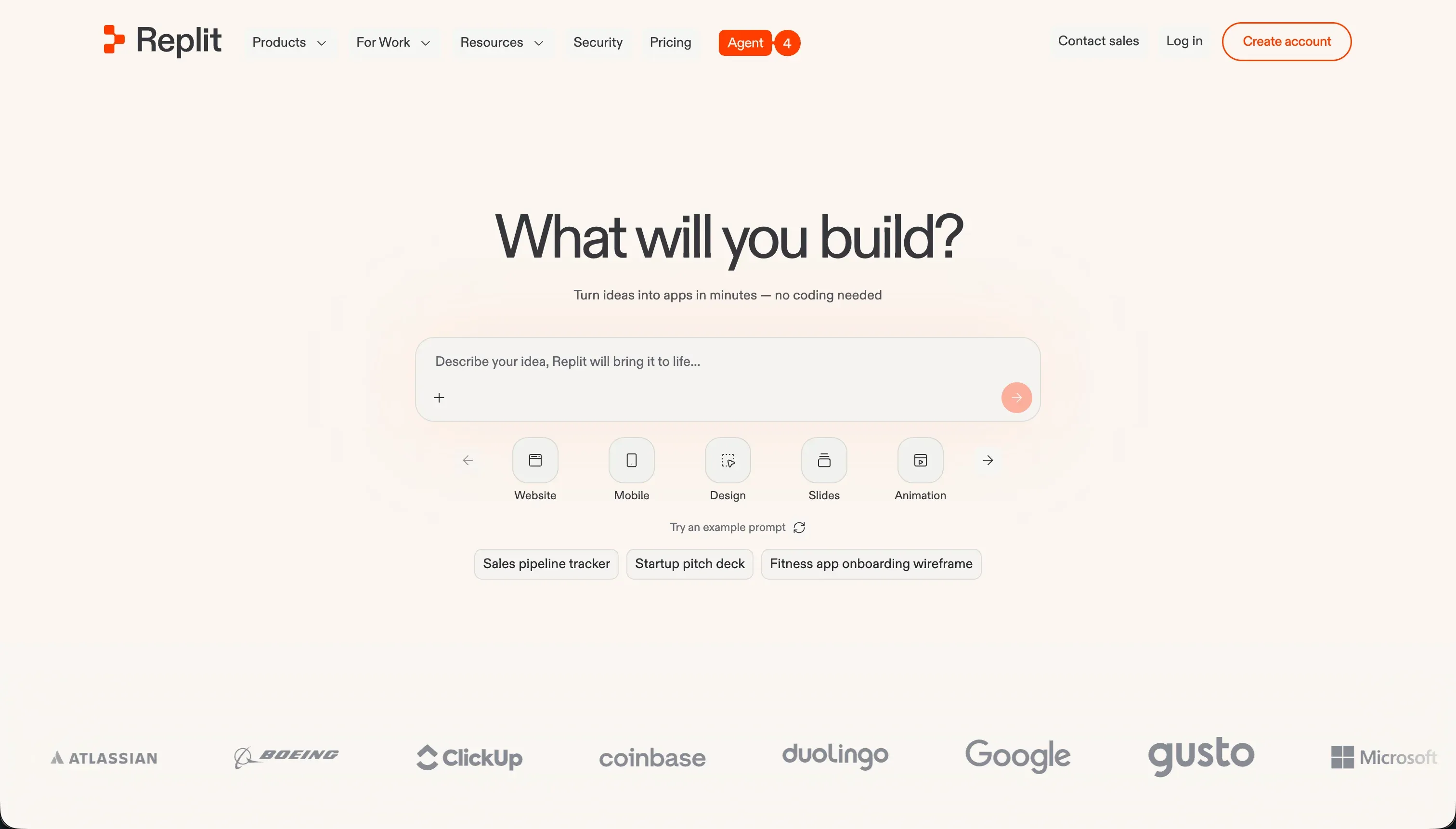 Replit homepage snapshot
Replit Agent changes the balance between visual building and code ownership by scaffolding entire software platforms from plain-language prompts. For enterprise operations that absolutely demand custom code repositories, Replit yields a production readiness score of 8.0/10.
It compiles real code, stores data using high-performance PostgreSQL servers, and establishes clean rollbacks. The output is standardized React and TypeScript code you can host anywhere.
Yet, the maintenance math requires caution. Maintainability scores 7.5/10, but the team must take full responsibility for fixing library conflicts, updating hosting packages, and reviewing security middleware.
Security & access control scores 6.0/10 because data filters live entirely inside agent-written scripts instead of a visual admin page, making validation errors easy to miss. Avoid Replit if your team has no software engineers on hand to read, verify, and take over the raw files the agent generates.
6. Bubble - best for bespoke business algorithms
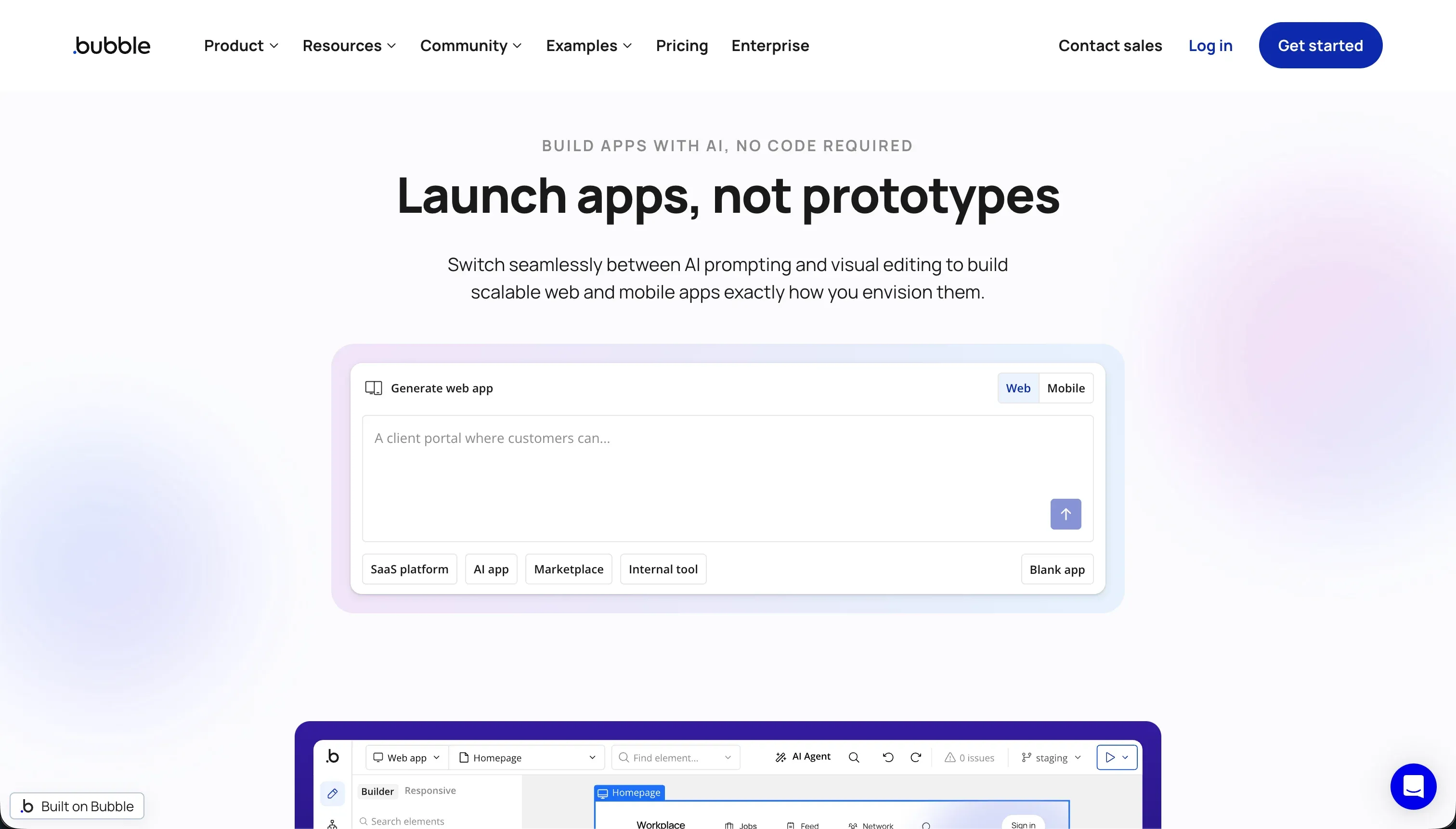 Bubble homepage snapshot
Bubble is a visual full-stack editor that enables users to map complex operational logic and multi-sided directories without writing code. With a design flexibility score of 8.5/10 and a versatile API connector, builders can configure custom multi-tenant workspaces. It features server-side privacy rules and custom user data structures, making it highly flexible for logic-heavy portals.
However, its placement at sixth reflects the high administrative complexity. Ease of build scores 5.0/10 as creating safe privacy parameters requires developer-like architectural knowledge. If database rules are misconfigured, corporate fields risk exposure to the public internet.
Furthermore, the platform utilizes its own proprietary runtime engine, meaning there is no code export path. If your operations team needs reliable tools built this quarter rather than next year, Bubble’s training curve and workload-unit pricing present significant barriers.
Shortlisting the Right Enterprise Platform
Enterprise shortlists should focus on the target builder’s profile and the security model. If your line-of-business departments (such as HR, procurement, or operations) need to solve their own software problems quickly, prioritize visual governors.
In this environment, Softr operates as an IT-governed space where teams can draft intranets or custom dashboards on shared datasets without creating shadow IT. For these business use cases, you can read our comparison of the best /best/operations-teams and /best/employee-intranets-and-hr-apps.
If the application demands developer-led management of live SQL databases, prioritize /best/internal-tools where Retool is the leading candidate. This ensures engineers can directly query production resources using code blocks while bypassing back-end hosting tasks.
Avoid buying pure code-generation services or unmanaged builders unless you have developer bandwidth to manually audit security rules, isolate databases, and manage code-level maintenance. We lay out our comprehensive platform evaluation standards on our methodology page.