



What contract management apps actually require
Developing a contract management application is fundamentally different from building a standard administrative tracker. Contract data is highly sensitive, requires variable multi-party access, and relies on sequential approval states. To evaluate these specialized development platforms, we measure performance against six defined criteria.
First, security & access control is the absolute priority. An organization cannot risk legal documents leaking to the public or external vendors seeing third-party rates. This demands precise, server-side row-level security so that users see only assigned records. Next, production readiness dictates whether the platform supports secure authentication, SOC 2 compliance, and stable hosting from day one.
Maintainability determines whether legal operations teams can adjust business logic or amend metadata fields in year two without repeating a complex development cycle.
Data & integrations are also critical: platforms must easily ingest active legal tables, handle parent-child relationships like contracts linked to entities, and interface with PDF engines. Meanwhile, ease of build determines how quickly a business team can scaffold the initial operational cockpit.
While design flexibility is helpful for matching exact brand guidelines on public portals, utility and data security must dictate the architecture. Platforms that score high on permissions, reliable workflow hosting, and flat-rate external licensing consistently outperform highly flexible, raw code-generation sandboxes.
The use-case comparison
| Platform | Overall | Advantage | Main reason to exclude it |
|---|---|---|---|
| Softr | 8.1 | Pre-built external login, visual user groups, and flat pricing scaling up to hundreds of users | Visual custom-layout ceiling is restricted to pre-built blocks on a non-freeform canvas |
| Retool | 6.8 | Direct read-write access to internal SQL legal databases and dense, custom developer tools | Per-seat fees penalize external vendor portals, and setup requires SQL and JavaScript |
| Bubble | 6.8 | Deep visual logic workflows and pixel-perfect design freedom over custom database tables | No direct code export, steep learning curve, and variable workload-unit billing spikes |
| Replit | 7.4 | Real, exportable application code on containerized cloud servers without design templates | No natural visual dashboard, requiring a developer to maintain and update code-level routes |
| Glide | 6.3 | Fast default spreadsheet mapping with polished, mobile-friendly interface components | Seat-based billing climbs quickly, and template blocks restrict custom legal operations layout |
| Airtable | 6.3 | Exceptional spreadsheet-level database modeling with multiple flexible operational views | Lacks safe record-level security, forcing expensive guest seat pricing options for portals |
1. Softr - best overall for contract portals and client tracking
 Softr homepage snapshot
For teams seeking a secure operational gateway, Softr ranks first. It scores 8.5 for both security & access control and production readiness. Instead of writing custom database schemas and middleware to guarantee privacy, builders use visual User Groups and Global Data Restrictions that filter records server-side. This ensures external vendors only ever receive their own contracts in the browser, while internal managers access the complete master database, with no front-end filters to bypass and no row-level security policies to misconfigure. You verify each view by previewing the app as that user group before publishing, and groups can auto-assign from a database field like “Counterparty” so access stays correct as contracts are added.
The contract records belong in native Softr Databases, where agreements link relationally to clients, renewal dates, and signed documents, with rollups that surface total contract value or count expiring agreements automatically. If your data already lives in Airtable or Google Sheets, Softr connects to those and 17 other sources too. Workflows then automate the lifecycle: a contract nearing its renewal date can trigger an instant reminder, route a record for approval, or call a document-generation service over HTTP, all configured visually rather than coded. Flat per-tier pricing ($99/mo Pro, billed annually, with 10 Team app users expandable to 50 plus 50 Client app users expandable to 250) keeps a growing vendor or client roster off a per-seat treadmill, and the model spans solo operators up to legal and ops teams deploying governed contract tools across departments.
Maintainability scores 9.0 because you can alter permissions or dynamic layouts directly without code, so the portal stays easy to evolve long after launch. While its design flexibility score of 5.5 means you are restricted from altering custom component grids, the safety on business data is unmatched. Do not buy if your exit path requires exporting raw codebase files; for that code-first route Replit is the honest pick, but for a secure contract portal with real permissions live this week, Softr leads. See how the same foundation handles secure files in our guide to the best document management apps.
2. Retool - best for engineered internal legal operations
 Retool homepage snapshot
If your contract operations live inside centralized SQL engines and require custom JavaScript tools, Retool is the industrial option. It scores 8.5 for data & integrations, linking to PostgreSQL and warehouse APIs. It excels for internal dashboard creation, utilizing Git-based version control on enterprise plans to keep systems stable.
Security & access control scores 7.5, reflecting excellent SAML SSO support. However, ease of build scores a low 4.0; non-technical coordinators cannot build without engineering. Do not buy for customer portals, as user-seat pricing scales costs rapidly.
3. Bubble - best for custom approval logic and routing design
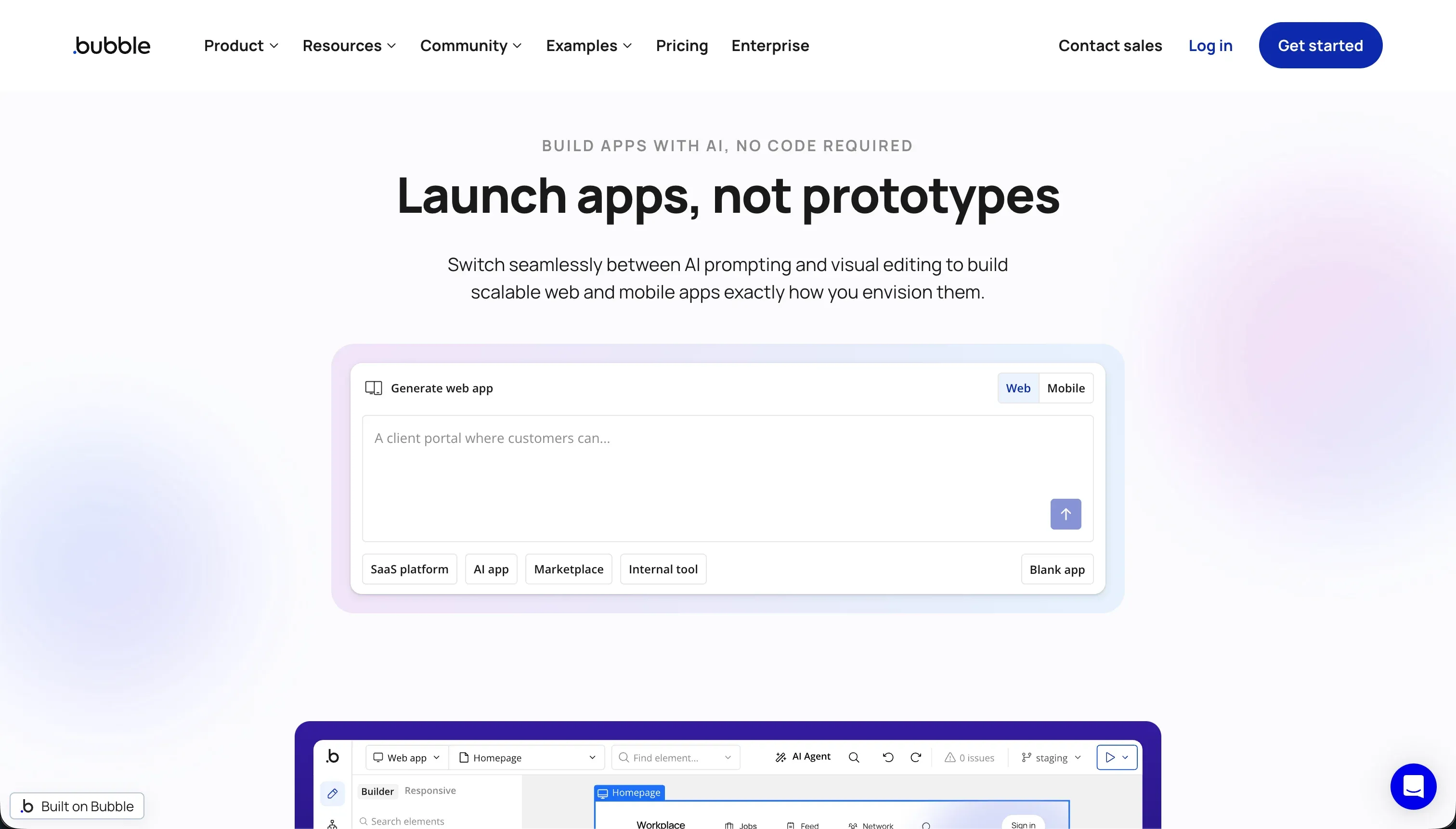 Bubble homepage snapshot
When a legal cockpit requires intricate, multi-tiered routing routines, Bubble provides a visual workflow canvas. It scores 8.5 for design flexibility and 8.0 for data & integrations, handling relational tables with relative ease. But ease of build scores 5.0 due to the complex visual model.
Security & access control scores 6.5, meaning builders must configure every individual database rule manually; a missed toggle can fail silently and expose contract documents. Do not select Bubble if you operate on a strict, predictable budget, as its workload-unit usage charges are hard to forecast.
4. Replit - best code-first route with AI development assistance
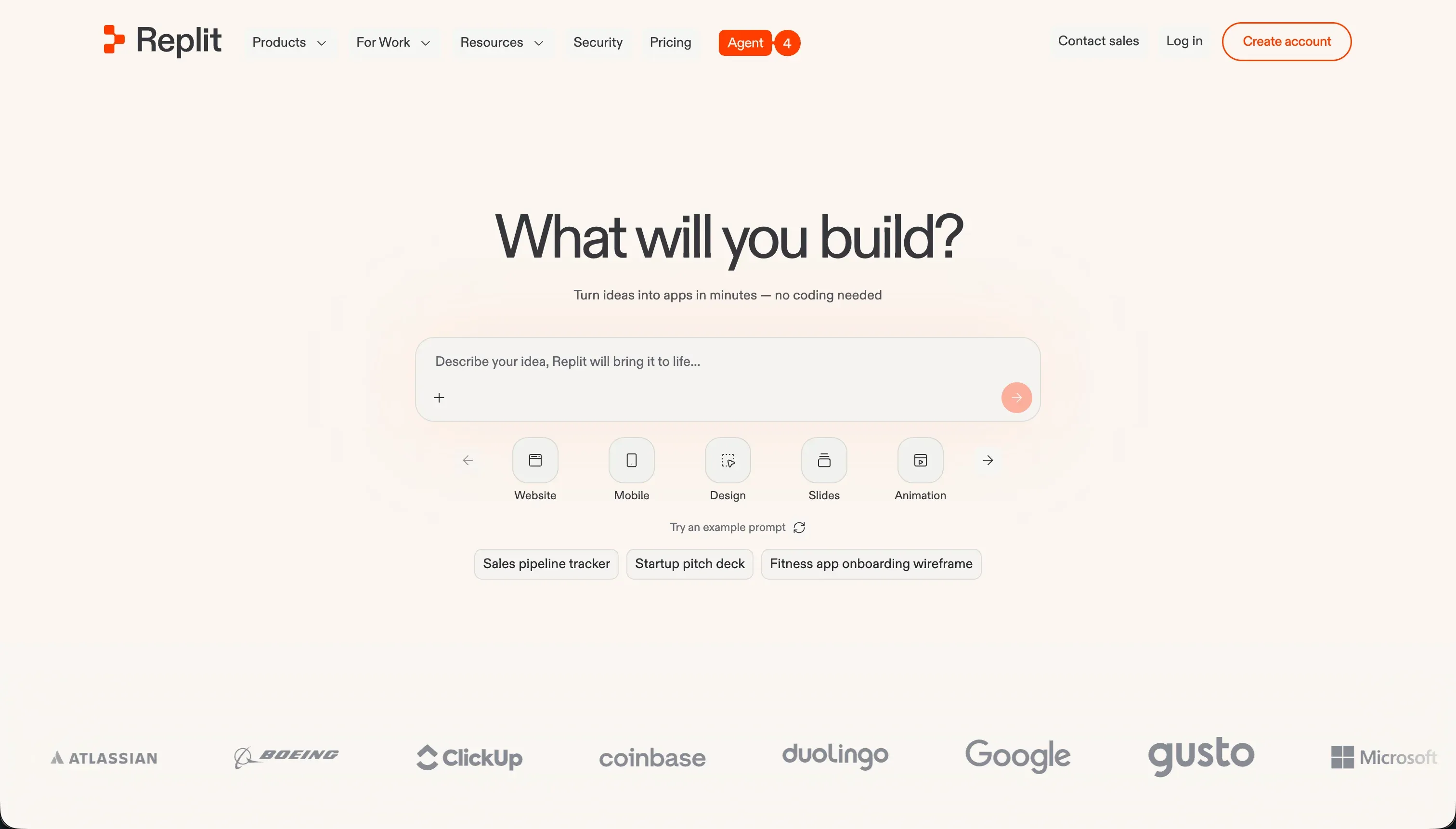 Replit homepage snapshot
For software engineering departments prioritizing complete codebase ownership, Replit is an exceptionally capable platform. Its autonomous agent handles scaffolding and dependencies, outputting a real React and Node repository. It scores 8.5 for design flexibility and 8.0 for production readiness. But security & access control scores 6.0, as all row-level policies reside in generated scripts.
Your technical team must manually audit the files to ensure external users are fully isolated. Do not select Replit if your administrative staff lacks a developer to debug agent-introduced errors.
5. Glide - best for fast spreadsheet-based contract tracking
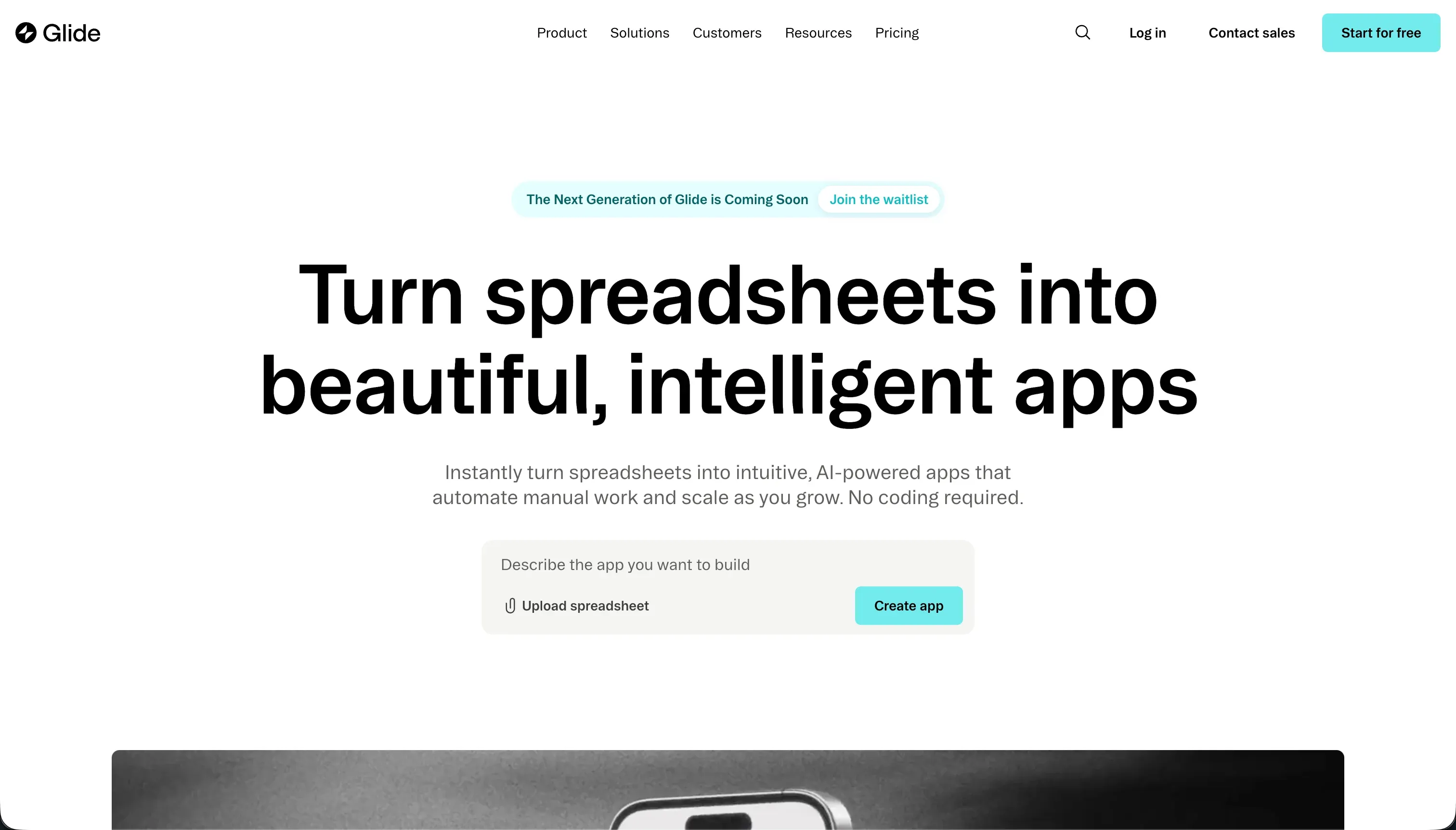 Glide homepage snapshot
When contract data exists in legacy spreadsheets, Glide turns sheets into mobile-friendly apps quickly. It scores 8.5 for ease of build and connects directly to Google Sheets, Airtable, or its own internal Glide Tables. The interface is clean, responsive, and easy to edit.
However, security & access control scores 5.5; defining granular user boundaries across multiple client companies is difficult.
This template design system limits developer-level customization, scoring 4.0 for design flexibility. Avoid if you require a branded desktop interface with deep operational logic.
6. Airtable - best relational schema builder for internal teams
If you are focusing entirely on mapping relational data, Airtable is the most intuitive database in the category. It scores 8.5 for ease of build and 8.0 for data & integrations, managing complex fields and linked records easily. The friction is on the frontend: its Interface Designer scores 4.0 on design flexibility with rigid administrative layouts.
Security & access control is limited at 5.0, as base-level roles prevent hiding specific fields or records from individual portal users. Do not use Airtable to build external vendor portals if you want to avoid expensive guest seat pricing.
How to select and pilot your contracting platform
Do not attempt to pilot all six platforms simultaneously. Instead, divide your procurement checklist into two distinct structures: external client portals and technical internal workflows. For general contract tracking, vendor portals, and document upload gateways, you should evaluate Softr alongside Glide, mapping of data can stay on database backends or external sources.
If your contract routing requires custom administrative databases managed by engineering teams, focus on Retool or evaluate code-first options.
When setting up your initial trial, design a test using five variables: contract metadata upload, automated approval workflows, multi-role dashboard visibility, mobile document readability, and PDF sync. Build a rule where vendors see only their assigned records while legal admins monitor the entire pipeline.
If you are integrating digital signatures or PDF rendering, explore our guides on document management apps and approval workflow apps to evaluate how these tools bridge relational schemas. Learn more about how we test and weight platforms by visiting our methodology documentation.